This independent guide concerns another university’s programme. It does not describe an INTIAU programme, branch or established partnership.
Official sources checked: 17 October 2026. The admissions-test information below is specifically for 2027 entry, through the 2026 admissions round. Later applicants must check their own entry year. The course discussion summarises the structure publicly available at the check date.
Oxford’s undergraduate Computer Science course links mathematical reasoning with the design and understanding of computer systems. For an applicant, that means looking beyond a list of programming languages: proof, algorithms, models of computation and practical work all matter. The department describes the degree as a connection between theory and practice, with mathematics supporting both applications and rigorous reasoning about programs. See the official Computer Science teaching overview.
Choose the course before completing the application
Oxford offers Computer Science, Mathematics and Computer Science, and Computer Science and Philosophy. They are distinct undergraduate courses, so this article’s single-subject curriculum should not be used as a plan for either joint course. Applicants choose a course and a college preference, or make an open application. The department organises lectures centrally; college choice does not create a separate departmental syllabus. The department’s application guide explains these choices and the UCAS route.
Oxford lists a three-year BA exit and a four-year MCompSci route. Fourth-year progression requires at least a 2:1 at the end of year three. Check the current award and progression rules.
Academic preparation and international qualifications
For single-subject Computer Science, the department publishes an A-level offer of A*AA, including A*A in Mathematics and Further Mathematics, in either order, when both are taken. Further Mathematics is strongly encouraged and generally expected when available. Its guidance also gives alternatives where it is unavailable and explains the position for other qualifications. Applicants should match their actual qualification to the official entry-requirement guidance, rather than making their own percentage-to-A-level conversion.
Selection focuses on academic ability, potential and commitment. Oxford says it does not require particular computing knowledge; it does want interest in computing and strong mathematical ability. A useful preparation record therefore explains what you investigated and how your reasoning developed, rather than merely counting certificates. The department’s selection guidance gives the basis for this distinction.
The test route for 2027 entry: TMUA
Oxford lists the Test of Mathematics for University Admission, or TMUA, for Computer Science in the 2026 admissions round for 2027 entry. Its admissions-tests page also lists TMUA for the two joint Computer Science courses. This is an entry-year-specific statement, not a claim that an older MAT preparation timetable still applies. Use Oxford’s official admissions-tests guidance and its linked test-provider information.
The department states that MAT will not run in the 2026 admissions round and that TMUA results inform shortlisting alongside the UCAS application and school background. It does not publish a simple TMUA pass mark in that guidance. UCAS submission, test registration and test booking are separate steps. Its application guide states the 15 October, 6pm UK-time UCAS deadline; that date has passed as of this article’s 17 October 2026 check. Readers planning a later cycle should wait for and follow that cycle’s published arrangements.
How the published course develops
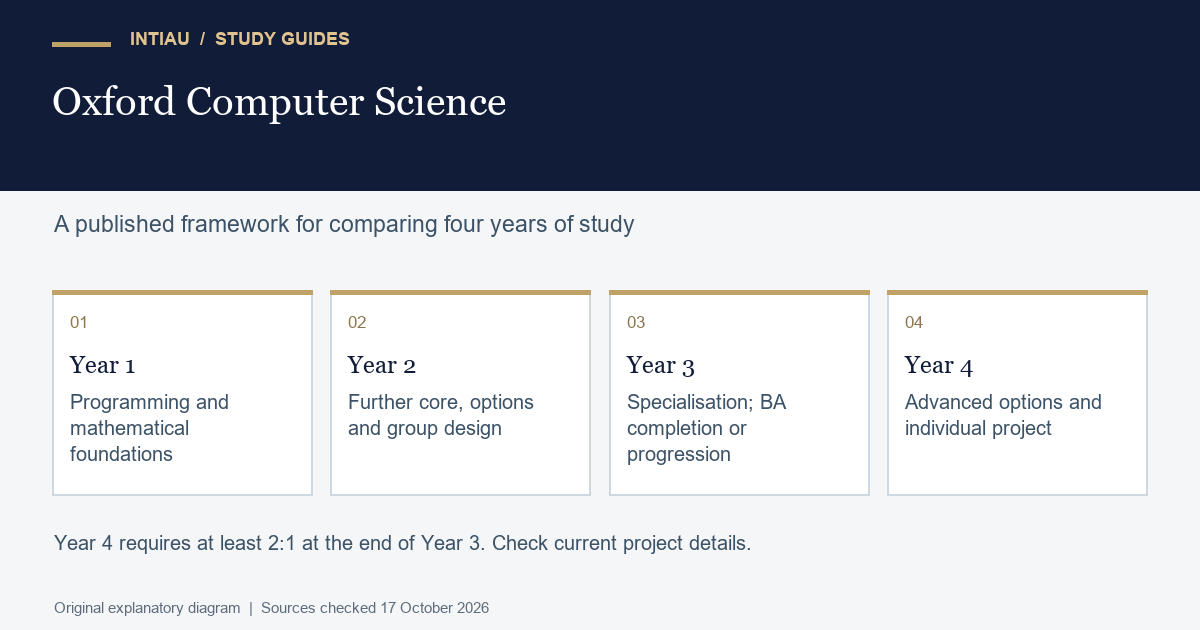
This table summarises the current course framework. Third-year project arrangements remain subject to confirmation.
| Year | Main learning focus | Practical or progression point |
|---|---|---|
| 1 | Programming and mathematical foundations. | First-year examinations. |
| 2 | Core and options. | Group design practical. |
| 3 | Specialisation. | BA completion or fourth-year progression. |
| 4 | Advanced options. | Individual MCompSci project. |
First-year study introduces different ways of expressing and analysing programs. The department’s core-one descriptions connect functional programming to mathematical reasoning and imperative programming to systematic construction. Discrete mathematics and probability provide tools for understanding correctness and performance. When comparing curricula, ask whether you enjoy explaining why a solution works as well as getting it to run.
In the next core stage, models of computation examine the capabilities and limits of computing. Concurrency addresses interacting activities, while compiler study examines how a higher-level language becomes executable instructions. These topics are described in the second-year core guide. They help explain why the degree is broader than preparation for one development framework.
Later choices offer increasing depth. The department’s advanced-options guide includes areas such as security, computational biology and formal reasoning, while warning that options vary from year to year. Use it to identify interests to explore, then check the actual teaching-year syllabus. A topic appearing in an illustrative options guide does not guarantee its availability in your final year.
Frequently asked questions
Is prior programming experience compulsory?
The department encourages applicants with little or no programming experience; its sample interview guidance illustrates mathematical discussion.
Is MAT the test for 2027 entry?
No. Oxford publishes TMUA for the 2026 admissions round leading to 2027 entry. Check the official test page.
Can I assume a listed advanced option will run every year?
No. The department’s options guide expressly says the list varies.
Related INTIAU information
Explore INTIAU’s Courses for its own educational information. Use Relations or Contact for an institutional enquiry. This independent guide does not establish an Oxford partnership, guaranteed admission or credit recognition; Oxford’s official requirements govern applications.
View the explanatory diagram