
Stellenbosch University offers the BEng (Chemical Engineering), an independent university programme separate from INTIAU.
Checked 17 October 2026. Current departmental curriculum overview; 2025 yearbook context; 2027 selection policy checked 17 October 2026.
Read the degree through its progression
The department describes a four-year programme beginning with a common engineering first year. Later study develops chemical-engineering theory and design, culminating in plant design and an independent research project. Department curriculum.
For comparison, distinguish foundation subjects, increasingly specialized modelling and work that brings several decisions together. A shared first year should not be treated as proof that every later engineering route is interchangeable. Look for how a programme moves from a calculation on a defined problem to a justified response to an open problem.
| Stage | Published learning emphasis | Comparison question |
|---|---|---|
| Year one | Mathematics, physical sciences and common engineering foundations. | Which prerequisite gaps need attention? |
| Years two and three | Phase behaviour, heat transfer, reactions and equipment design. | How does a model support a design decision? |
| Year four | Integrated plant design and an independent engineering investigation. | How are conflicting objectives and evidence handled? |
The first-year list includes Engineering Chemistry 123 and Computer Programming 143. The later overview connects reactors, heat exchangers, transport equipment and separation units. These are selected curriculum examples, not reproduced syllabuses. Module context.
The linked 2025 Engineering Yearbook is historical context, not a 2027 module contract. 2025 yearbook.
Keep the 2027 selection policy separate
The explicit 2027 BEng policy sets minimum school-result conditions and then applies selection. Its NSC/IEB example includes a 70% average, Mathematics 70% and Physical Sciences 60%, alongside language and bachelor-entry requirements. International-school rules are separate. 2027 selection policy.
That policy gives 31 July in the preceding year as the application closing date. For intended 2027 entry, 31 July 2026 is already past on this guide’s check date, 17 October 2026. This article does not imply that late entry is available.
Use the policy for your actual school system and cycle. Do not turn a minimum mark into a personal selection prediction. If a document or equivalency question remains unresolved, record the precise issue for official admissions rather than calculating an apparent entitlement from a single percentage.
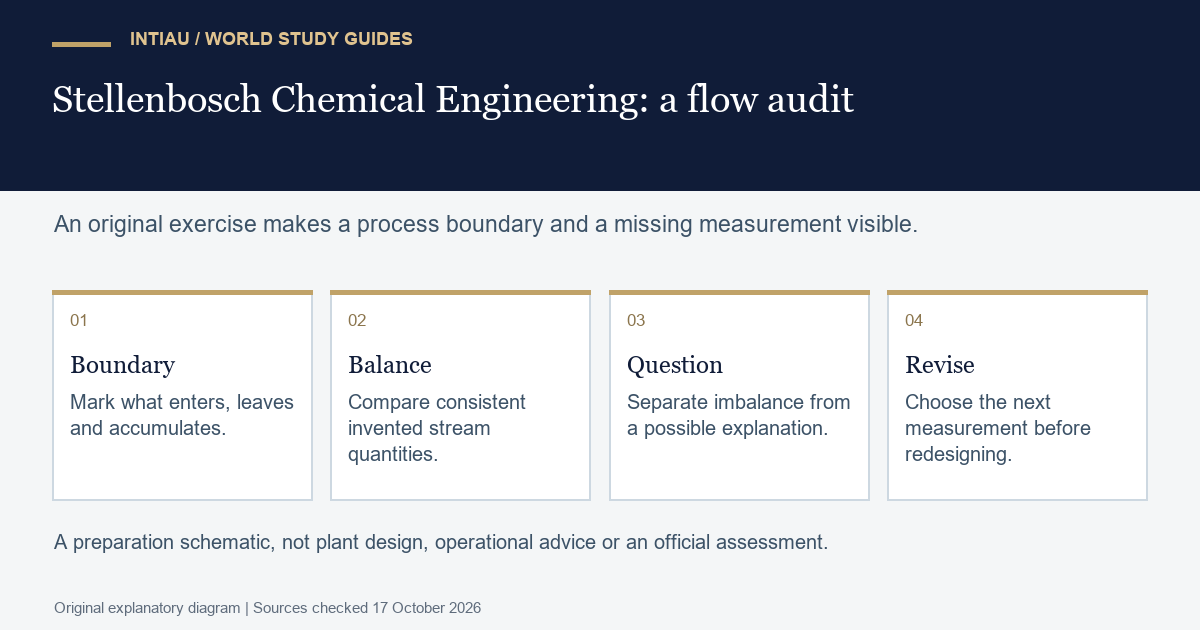
Original exercise: reconcile a fictional process balance
Draw a box around an invented mixing process. In a demonstration period, label two incoming streams as 40 and 60 mass units. Label the outgoing stream as 95 mass units. Start by writing the unresolved difference. Do not immediately describe it as waste, a leak or an error; the drawing has not established any of those explanations.
List alternative explanations: accumulation inside the boundary, a missed stream or inconsistent measurement periods. For each explanation, specify one observation that could support or weaken it. Keep the units and time interval identical across all streams before doing any further calculation. If you change the boundary, redraw it and show why the accounting changed.
Now imagine that the process must use less energy. Write two possible questions rather than two equipment recommendations: where is energy used, and what operating condition drives that use? Identify the measurements required to compare alternatives. The exercise is deliberately incomplete because deciding what to measure is part of defensible problem formulation.
Finish with a short technical note containing the diagram, a balance, an assumptions list and the next evidence request. Use invented quantities only and do not apply the sketch to a real process. The goal is to make the relationship between a model and a decision visible, including the point where the available evidence no longer supports a conclusion.
Prepare for a useful curriculum discussion
Bring one question about mathematical preparation and one about integrated design to academic advising. Ask which official edition governs your intended cohort and which course outline answers your question. Compare the relationship among foundations, analysis and project work instead of assuming that similar module names imply identical degrees or professional outcomes.
Frequently asked questions
Is the table a complete 2027 curriculum?
No. It summarizes the current departmental progression and selected examples, not every requirement or offering.
Does that yearbook govern every new applicant?
No. Obtain the official rules for your intended cohort.
Are the published minimum marks an admission guarantee?
No. The 2027 policy distinguishes eligibility conditions from selection within available capacity.
View the curriculum comparison map
Official sources and further comparison
Continue your independent comparison through the INTIAU Courses directory, or use INTIAU Contact for a general enquiry. The university controls its programme and admissions decisions.