Nanyang Technological University in Singapore is a separate institution; its Bachelor of Engineering (Materials Engineering) with Honours is not an INTIAU programme or partnership. The full-time programme normally spans four years and includes professional internship and a final-year project.
The School of Materials Science and Engineering is located at 50 Nanyang Avenue. This guide concerns NTU Singapore, not another university sharing the NTU abbreviation.
Start a materials comparison with a decision rather than a favourite substance. What must a component do, under what conditions and for how long? Write a short specification before browsing course names. This helps you ask whether the curriculum develops a chain of reasoning from scientific description to a defensible engineering choice.
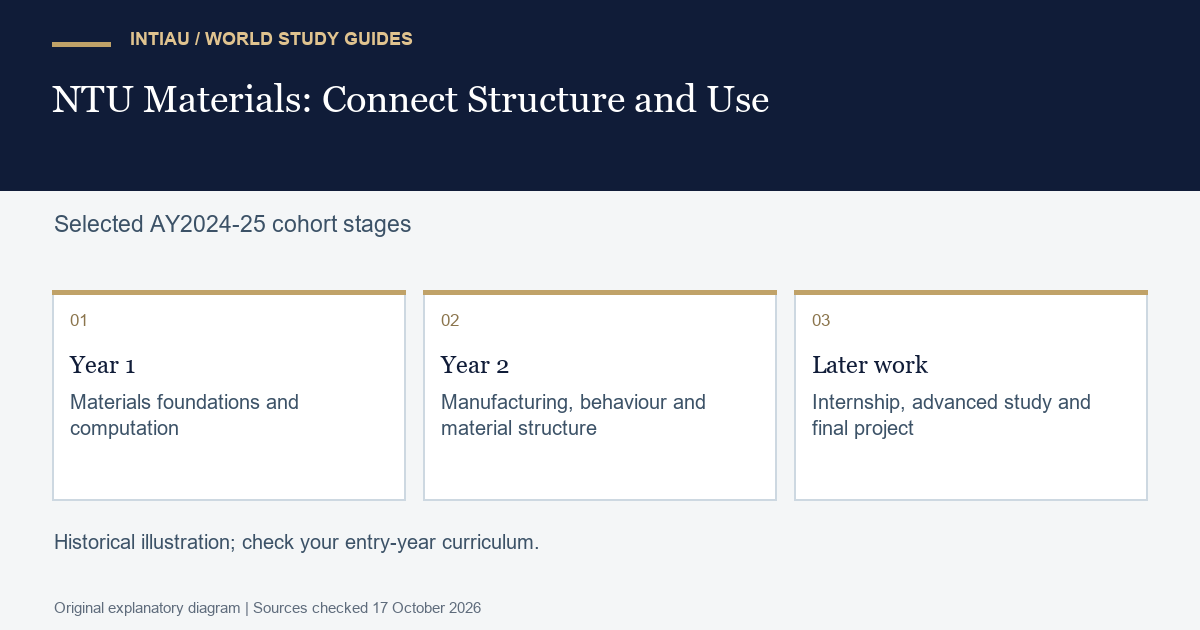
Use a dated map as an illustration
The AY2024-25 first-year-entry map illustrates that cohort; it is not a confirmed 2027 entrant plan.
| Stage | Selected official components |
|---|---|
| Year 1 | MS1018 Properties of Materials; MS1008 Introduction to Computational Thinking. |
| Year 2 | MS2015 Mechanical Behaviour of Materials; MS2014 Materials Structure and Defects. |
| Later years | Professional internship and final-year project. |
Read horizontally as well as vertically. A course about a property and a course about manufacturing address related but different questions. In your comparison sheet, reserve columns for scientific explanation, quantitative analysis, practical work and design decisions. Mark your own interpretation so it cannot be confused with the official list of compulsory requirements.
Inspect the mechanical-behaviour syllabus
The MS2015 course summary covers loading, stress and strain, deformation, fatigue and fracture. Its learning outcomes connect mechanical calculations with materials selection under loading and geometric constraints. The page lists three academic units; confirm the applicable offering and rules for your cohort.
When reading such a syllabus, ask what is given, what is calculated and what must still be measured. A numerical result is only as useful as the assumptions behind its model. Compare whether another course expects you to derive relationships, interpret test data or justify a design decision; matching a topic word alone does not establish equivalent learning.
Practical exercise: a fictional bracket selection
Imagine a small indoor bracket with three candidate materials, labelled A, B and C. Create a simulated property table showing stiffness, density, a processing constraint and a relative cost. Label every value as invented. Define the required function and two constraints before looking at which candidate appears strongest on any single measure.
First reject any candidate that violates a stated constraint. Then explain the trade-off among the remaining options. Change one assumption: perhaps the bracket must now be easy to repair, or the expected temperature changes. Record whether your preferred option changes and why. Do not manufacture a precise safety factor from an exercise dataset that contains no reliable test evidence.
Finish with a decision memo containing the specification, the simulated table, the rejected option and the most important missing information. Ask a peer to identify a property you overlooked. Add a proposed test that would reduce the uncertainty. This is an independent comparison activity, not a component certification, a laboratory procedure or an NTU assignment.
Check the qualification-specific application window
Checked on 17 October 2026, NTU lists 15 October 2026 as the opening of AY2027 applications for international qualifications, including IB. Closing windows depend on the qualification. The admissions page directs applicants to the relevant portal and supporting-document instructions.
Use your exact school qualification to choose that route. Keep programme subject requirements beside, rather than inside, a general timeline note. A university-wide opening date is not evidence that every qualification has the same closing date or document deadline. Revisit the current curriculum once an entry cohort is known, and do not reuse an older map as an enrolment authority.
Three engineering-planning questions
Is this a three-year standard degree?
No. NTU describes the normal honours programme as four years.
Is the example map for a new 2027 intake?
No. It is explicitly the AY2024-25 first-year-entry map.
What is a useful materials comparison output?
A specification, transparent trade-offs and a statement of the evidence still needed before a real design decision.
Official source trail
- Materials Engineering undergraduate programme
- Materials first-year-entry map, AY2024-25
- MS2015 Mechanical Behaviour of Materials
- Undergraduate application routes
- Materials school location
For INTIAU information, visit INTIAU Courses or INTIAU Contact. These links do not submit an application to the separate institution discussed above.
Related guides
View the curriculum diagram