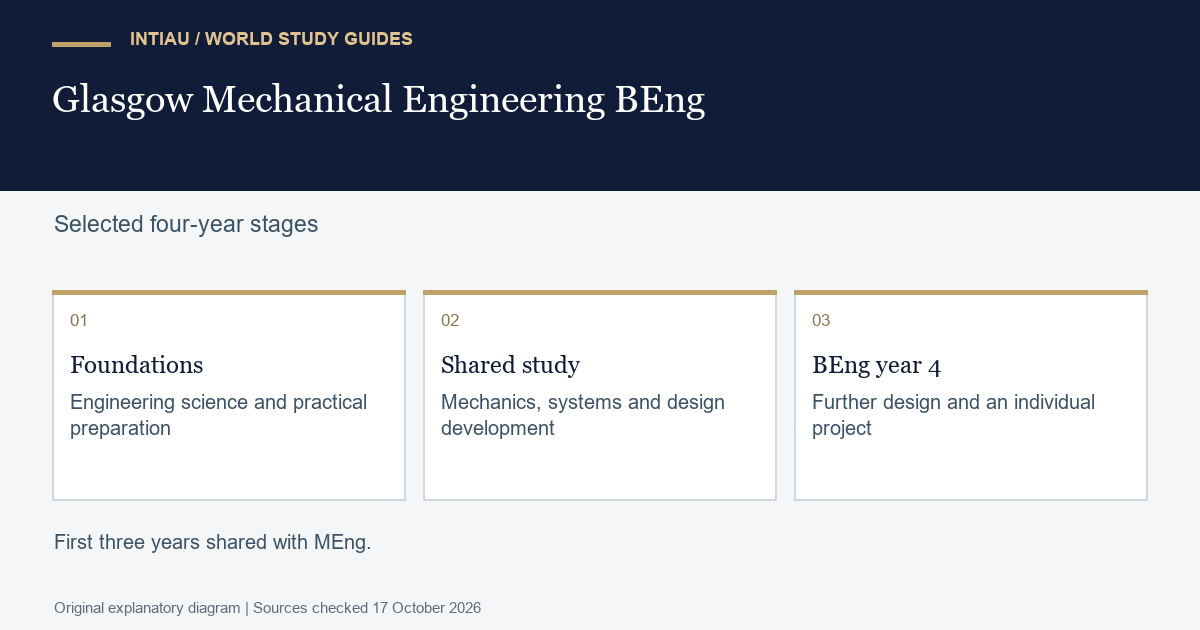
The University of Glasgow is separate from INTIAU; Mechanical Engineering BEng is a Glasgow degree. The 2027 programme page identifies H300 as a four-year route at Gilmorehill campus, distinct from the five-year MEng.
Mechanical engineering is easier to compare through a design problem than a list of machines. Choose a familiar object and ask how loads, movement, materials and manufacture interact. Then ask what evidence would let another person judge whether your design is usable. Those questions connect scientific knowledge with the decisions a design must survive.
Distinguish the BEng route from the MEng
| Stage | Examples |
|---|---|
| Year 1 | Mathematics, mechanics, electronics, materials and thermodynamics. |
| Years 2–3 | Shared BEng/MEng study; later mechanics, fluids, systems and design courses. |
| BEng year 4 | Finite Element Analysis, Mechanical Design and Individual Project. |
Keep the award boundary visible on a comparison sheet. A longer programme may continue beyond a shared foundation, but that does not make an extra year part of every student’s degree. Record required work separately from possible options, and leave transfer conditions as questions until the university’s own instructions answer them.
One real design-course example
The 2026/27 Mechanical Design 3 catalogue entry, ENG3017, describes a group design task moving from an initial brief towards an embodied proposal. Students then develop a selected component individually into detailed design and a manufacturing drawing. The outline also addresses uncertain data and potential failure modes. This is a selected course example, not the full BEng syllabus.
Read the example as a sequence of decisions. A brief defines a need; a proposal makes choices; a drawing communicates enough detail for someone else to inspect those choices. When comparing courses, ask where students receive feedback on the connections between these stages. A polished final picture does not reveal whether the underlying problem was defined well.
Original exercise: compare two ways to hold an object
This exercise is created for this guide, not assigned by Glasgow. Imagine a desk stand for a small electronic device. Write a short brief covering the intended user, the size of the object and two situations in which the stand should remain usable. Keep the task on paper; it is not a tested construction design.
Sketch two different concepts. For each, identify how it supports the object, where movement might occur and which dimension most affects its usefulness. Mark dimensions you have estimated. Add a materials question and a manufacturing question without assuming that the cheapest-looking shape is necessarily easiest to make.
Introduce a change: the user now wants the stand to fold for travel. Record which earlier decision must be revisited and what new information is needed. Do not simply add a hinge to the drawing and declare the problem solved. Think about what the folding action changes elsewhere in the design, including how the device is placed and removed.
Make a comparison table with four rows: user need, supporting evidence, unresolved issue and next check. Finish with a short choice between the concepts that explains one trade-off and one uncertainty. Ask a reader to challenge the assumption most likely to change the decision. This task can help you distinguish an interest in mechanism, quantitative behaviour, product development or communicating technical detail.
Use the correct application information
Glasgow’s undergraduate application hub separates choosing a degree, entry requirements, application routes, dates and later offer steps. It links UCAS guidance and information for international applicants. Use the route and entry-year instructions that apply to your circumstances rather than treating an academic curriculum as an application form.
Before applying, save the exact qualification route and date of the information you used. Keep any uncertainty about your school subjects or English-language evidence separate from a question about programme content. You can compare your academic interests now while asking the university to resolve an entry requirement that the public examples do not explain.
Frequently asked questions
Does the BEng include an MEng fifth year?
No. H300 is the four-year BEng route.
Is ENG3017 a real design course?
Yes. Its 2026/27 catalogue entry describes group and individual design development.
Should I use one generic application instruction for every applicant?
No. Check Glasgow’s official route and entry guidance for your circumstances.
For INTIAU’s own information, see Courses or Contact. Glasgow makes its own academic and admission decisions.
Related guides
View the curriculum diagram