The University of Southampton is separate from INTIAU; Aeronautics and Astronautics BEng is a Southampton degree. The official course page identifies a three-year full-time route, H422, based at Highfield and Boldrewood.
Aerospace programmes invite comparisons across very different systems. Before choosing by a vehicle image, ask what the system must do, in what environment and under which constraints. An aircraft and a spacecraft can share engineering tools while posing different questions. Use a curriculum map to see how foundational knowledge supports more specific decisions.
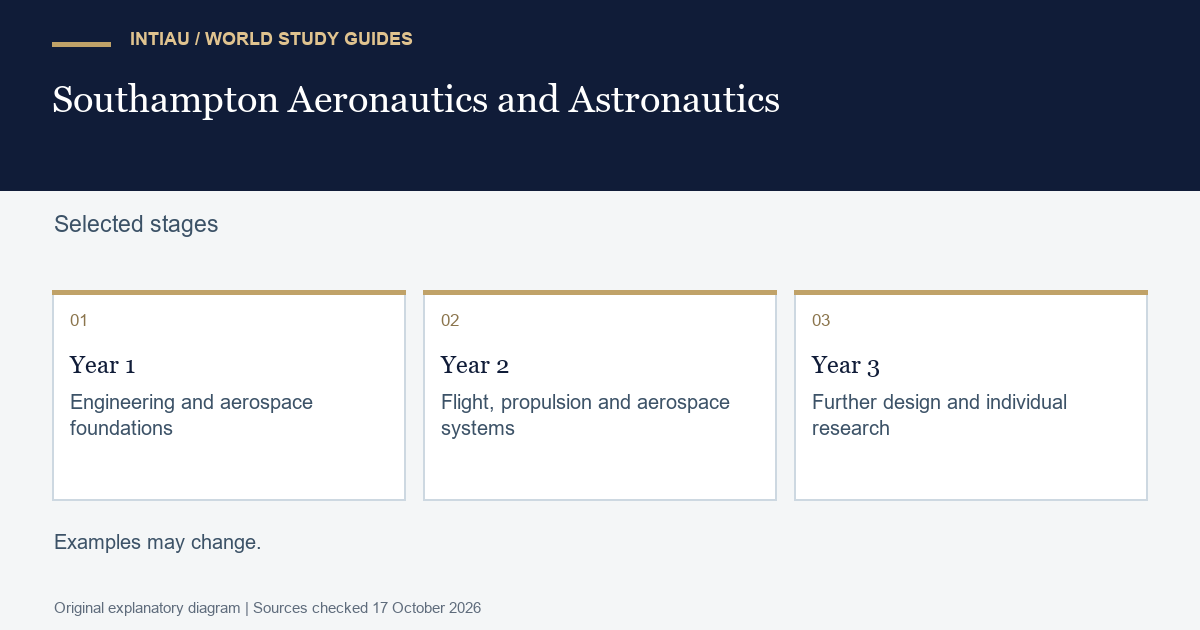
Read the stages as a development of tools
| Year | Examples |
|---|---|
| 1 | Engineering foundations, materials, electronics, computation and thermofluids. |
| 2 | Aerodynamics, astronautics, flight mechanics and propulsion. |
| 3 | Aircraft design, aerospace control and an individual research project. |
When comparing two programmes, record the task behind each subject. A model predicts behaviour, a design sets requirements and a test generates observations. Ask where the curriculum connects these tasks rather than assuming that a common subject name means identical learning. Keep a separate note for preparation you have not yet acquired.
One published module, with its academic year
The 2027/28 SESA1015 module entry, Introduction to Aeronautics and Astronautics, uses Newtonian mechanics to examine aircraft, launch vehicles and spacecraft. It introduces aerospace systems and operations alongside wider engineering considerations. This selected real outline is a starting point for reading the subject, not the full BEng syllabus.
Look at how a familiar principle becomes an unfamiliar question. Knowing a mechanics formula is different from deciding what assumptions make it useful. In a comparison sheet, write the proposed model, the quantities it needs and the circumstances in which it might be inadequate. A useful question for a department concerns how students learn to challenge a model, not only how often they use software.
Original exercise: define a mission before choosing a design
This exercise is created for this guide, not assigned by Southampton. Imagine a small system intended to observe a remote area after a storm. Begin with a fictional mission brief: what information is needed, how soon and in what form? Keep the exercise conceptual rather than planning a real flight or deployment.
Compare two imagined approaches: a reusable airborne platform and an orbit-based observation service. List what each would need to know about coverage, timing, energy and communication. Do not decide that one is better because it sounds more advanced. Define a success criterion that an observer could actually check, then record where the criterion depends on missing information.
Introduce a change: the user needs repeated observations over several weeks rather than one image. Identify which earlier assumptions are affected. A design choice that looks attractive for the first request may need to be reconsidered when the mission changes. Write the chain of reasoning rather than merely changing the preferred option.
Finish with a one-page comparison containing a simple system sketch, a table of assumptions and a short recommendation. State one uncertainty that could reverse the recommendation. Review whether your main interest lies in the physical behaviour, the system connections or the definition of a useful mission. Those distinctions can help you read optional modules with more purpose.
Separate programme examples from regulations and entry
Southampton’s published 2026/27 engineering regulations identify BEng Aeronautics and Astronautics within their programme coverage. That regulatory edition is distinct from a recruitment page’s future module examples. Use the applicable regulations and course information together, rather than treating a selected table as a complete award rule.
Apply through the course page’s UCAS route, H422. Its 2027/28 module examples may change.
Create an application record that distinguishes academic preparation, the exact award and the intended year. Keep unanswered qualification questions for Southampton, and record the official answer when it arrives. Do not import a deadline or condition from a different aerospace route simply because the programmes share some modules.
Frequently asked questions
Is H422 the three-year BEng?
Yes. The course page identifies that award and duration.
Is the introductory example a real module?
Yes. SESA1015 has a published 2027/28 entry.
Does a short stage map replace the regulations?
No. Read the applicable programme regulations for award requirements.
INTIAU’s separate information is available through Courses and Contact. Southampton controls its degree and admission decisions.
Related guides
View the curriculum diagram