
The Federal University of Paraná offers undergraduate Oceanografia through its Centro de Estudos do Mar; this independent guide describes UFPR study, not an INTIAU programme or partnership. Programme overview.
Ocean observations can differ because places differ, because conditions change over time, or because measurements were made differently. Before choosing an explanation, a reader needs to know how the evidence was collected. Use this selected curriculum map to connect scientific foundations, methods, marine management and a question that can be investigated responsibly.
Identify the applicable curriculum
The programme’s curriculum index labels version 2022 current, distinguishes the previous 2016 version and lists later amendments, including an August 2026 prerequisite correction. Version and amendment index.
The programme overview describes a final Trabalho de Conclusão de Curso for the Oceanógrafo title. The original title is retained rather than replaced by an assumed foreign award.
Sources were checked on 17 October 2026. The table selects from the 2022 matrix and identified amendments; it is not a complete updated personal timetable. Admission is a separate process: identify the relevant UFPR undergraduate notice and applicant route before treating any date or document list as applicable to you. No future window is asserted here.
Selected study layers
| Layer | Original published example | English reading aid |
|---|---|---|
| Scientific foundations | Biologia e Evolução; Física I | Biology and evolution; introductory physics |
| Analytical tools | Computação I; Probabilidade e Estatística | Computing, probability and statistics |
| Marine planning | Planejamento para o Espaço Marinho; Gerenciamento Costeiro | Marine spatial planning and coastal management |
| Final investigation | Trabalho de Conclusão de Curso | Final undergraduate work |
The 2022 matrix identifies computing and statistics as actual subjects. Original names assist record matching; translations do not establish equivalence.
The marine-planning examples show why a comparison should include more than laboratory techniques. Keep the scientific question, the measurement method and the decision context separate. A selected course name does not establish the professional authority to carry out a survey or approve a coastal intervention.
Worked exercise: separate location from measurement time
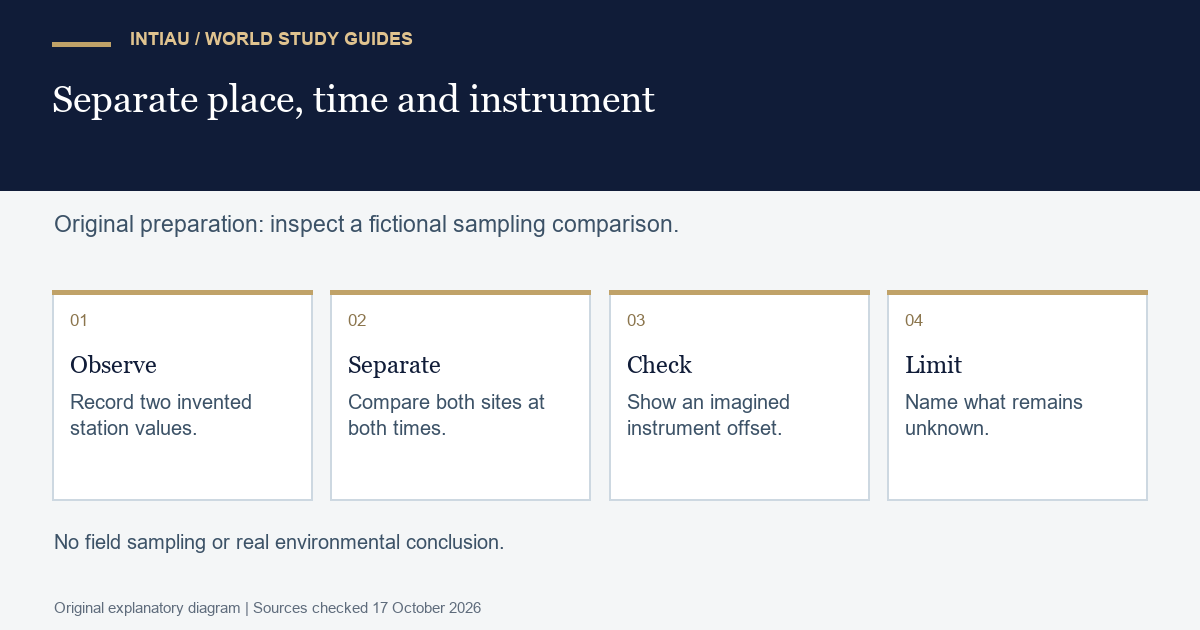
Invent two sampling stations, A and B. At the first fictional observation, A has a value of ten and B a value of fourteen arbitrary units. A report claims that location B is always higher. Write down what the evidence actually supports: a difference of four units between these two observations. It does not establish an enduring spatial pattern.
Now reveal that A was observed in the morning and B in the evening. Time and location changed together. Make a two-by-two paper plan with both locations observed at both times. Fill it with invented values: morning A ten and B twelve; evening A twelve and B fourteen. Each location difference is now two, while each time difference is two.
Explain how the expanded fictional comparison changes the original interpretation. It suggests that the first four-unit difference mixed more than one change. Do not attribute the pattern to an actual tide, chemical process or biological event; the exercise contains no physical evidence for any of those explanations.
Add a measurement issue. Suppose the instrument used at B reports one unit higher than a reference instrument in a fictional check. Calculate how subtracting that offset would alter B’s values and the location differences. Keep both the original and adjusted values visible. An adjustment without a documented reason would make the notebook harder to audit.
Create columns for station, time, original value, proposed adjustment and uncertainty. Finish with one question that remains unresolved even after the adjustment. You might need repeated observations, a better measurement check or a different sampling design. Describe the missing evidence without inventing a successful field campaign.
Use the comparison to plan study
Identify the reasoning step you most want to improve: designing a comparison, handling units, checking an instrument or explaining confounding variables. Keep a clear one-page example and a revised conclusion. This is stronger preparation than presenting a graph whose sampling conditions cannot be reconstructed.
For a programme notebook, retain original subject names, the curriculum year and the amendment relevant to a question. An old matrix and a later amendment can be related without pretending that the old file already incorporates every change. Ask the university to confirm a complete current route rather than filling missing prerequisites from guesswork.
For admissions, separate application, selection, registration and recognition of previous study. A general programme description cannot settle all four. Keep your intended entry period and background attached to any official enquiry.
Frequently asked questions
Is the 2016 matrix silently used as current?
No. The programme index labels 2022 current and distinguishes the previous 2016 version and subsequent amendments.
Are the English course descriptions official award translations?
No. They are selected reading aids. Preserve the original Portuguese names when comparing academic records.
Does the sampling example describe an actual ocean site?
No. All stations, observations and instrument effects are invented. The exercise demonstrates comparison design and supports no real environmental conclusion.
View the study diagram
Official sources
For other independent study comparisons, see INTIAU Courses; general enquiries can use Contact. The named university decides its own admissions and academic requirements.