
The Federal University of Rio de Janeiro offers Engenharia Civil through Escola Politécnica; this independent guide describes that UFRJ undergraduate programme, not an INTIAU award or partnership. Official programme page.
A civil-engineering comparison should keep a physical question connected to the assumptions behind the calculation. A number can be arithmetically correct yet answer the wrong question. This guide retains Portuguese course wording where useful and translates selected themes for English readers; those translations do not create a different official award.
Read the programme and curriculum version together
The programme overview describes scientific foundations during the first two years, professional subjects from the fifth period, and specialist formation from the ninth. It links an ementário explicitly labelled curriculum version 2017-2.
UFRJ’s Acesso à Graduação site separates selection and registration notices by process and academic period. Use the notice for your own entry route. Official undergraduate access site.
These sources were checked on 17 October 2026. An older curriculum label is retained as an edition boundary, not silently promoted to a 2027 timetable. This article concerns the Escola Politécnica route; it does not combine it with a programme at another UFRJ campus. Confirm the current applicable matrix with the school before planning registration or a transfer comparison.
Selected study layers and actual subjects
| Layer | Published example | Independent question |
|---|---|---|
| Scientific foundation | Mathematics, physics, chemistry and computing | Are the quantities and units explicit? |
| Professional foundation | Mecânica dos Fluidos — fluid mechanics | Which flow assumptions are being made? |
| Water and environment | Hidrologia; Saneamento Ambiental — hydrology; environmental sanitation | What measurements would support the model? |
| Later emphasis | Construction, transport, structures, geotechnics or water resources | Which area needs deeper preparation? |
The water-resources department identifies Mecânica dos Fluidos and Hidrologia among the Civil programme’s common required subjects. Department teaching scope.
This is a selected conceptual map. It gives no full syllabus, module substitution decision or professional registration conclusion. Keep the complete official record beside the table when examining a specific cohort or seeking academic advice.
Worked exercise: a fictional runoff ledger
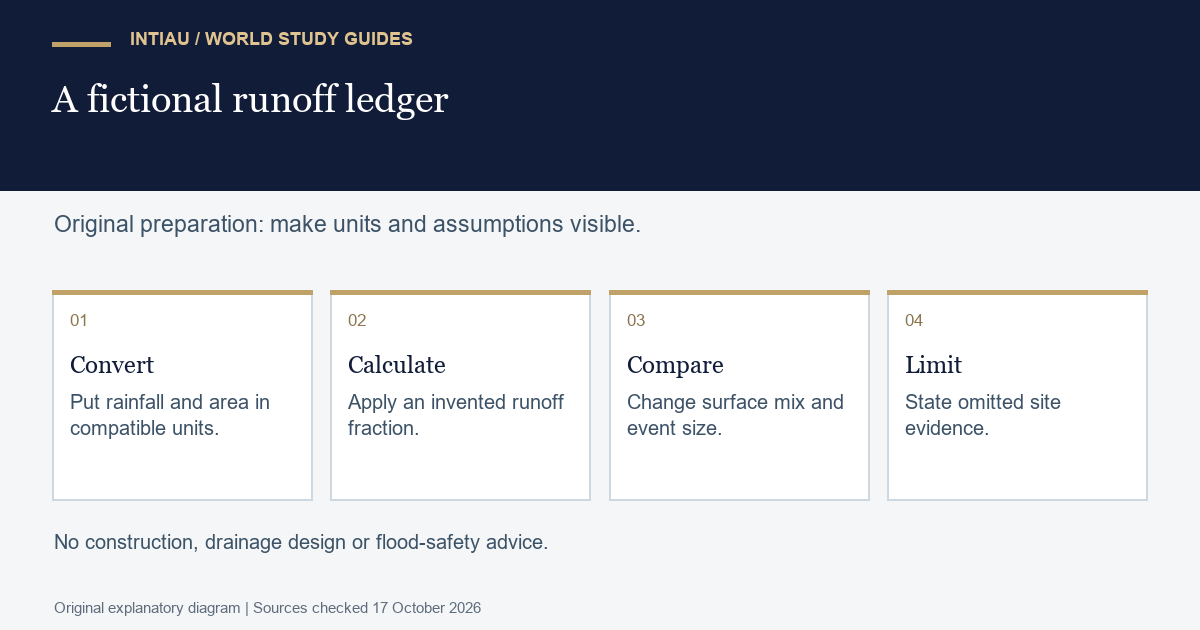
Imagine two paper surfaces, each covering one hundred square metres. A fictional rainfall event supplies ten millimetres of water. Convert ten millimetres to 0.01 metres, then multiply by area: each surface receives one cubic metre. Show the conversion before drawing any conclusion. A missing unit can create a much larger error than an untidy decimal.
Assign an invented runoff fraction of 0.8 to surface A and 0.3 to surface B. Their runoff volumes become 0.8 and 0.3 cubic metres. The difference is half a cubic metre for this imagined event. State that the fractions are assumptions, not measured properties of a real material or design values suitable for construction.
Now combine half of each surface into one hundred square metres. Under the same simplified assumptions, the runoff is 0.55 cubic metres. Check this by calculating each half separately. Explain why an average fraction is acceptable in this deliberately simple case, while leaving room for processes the exercise omits.
Add a change: the fictional event doubles to twenty millimetres. The simple proportional model doubles each runoff volume. List the reasons you would hesitate before extending that rule to a real site: changing ground conditions, storage, timing, drainage interactions and the quality of the rainfall record. You are listing questions, not asserting how a particular site behaves.
Finish with a comparison sheet containing input, assumption, calculation, result and limitation. Write a conclusion that a non-specialist can follow. It may state what differs between the fictional alternatives, but it should not prescribe a drainage system, claim flood safety or approve construction. The original exercise is preparation in quantitative explanation only.
Turn a calculation into a useful enquiry
Identify which step required the most care: reading units, setting the boundary, distinguishing a fraction from a volume, or explaining the missing processes. Select one learning goal and keep a corrected solution. This gives you something concrete to discuss when exploring whether a mathematically demanding programme matches your interests.
For a course comparison, preserve the Portuguese title, code when available, curriculum version and assessment evidence. For entry planning, create a different checklist headed with your selection process and period. Neither a degree overview nor an old teaching schedule should be used as a universal admissions instruction.
Frequently asked questions
Does the table reproduce a full current syllabus?
No. It selects published study layers and subjects. The programme links a versioned curriculum record that must be checked for the relevant cohort.
Is Mecânica dos Fluidos an actual subject?
Yes. The department identifies fluid mechanics within its required teaching for the Civil programme.
Does the runoff exercise support construction decisions?
No. Its rainfall and runoff fractions are invented. It omits the evidence required for a real design or safety conclusion.
View the study diagram
Official sources
For other independent study comparisons, see INTIAU Courses; general enquiries can use Contact. The named university decides its own admissions and academic requirements.