
The University of Campinas, Universidade Estadual de Campinas, offers undergraduate Engenharia de Alimentos at FEA; this independent guide describes Unicamp study, not an INTIAU programme or partnership. Faculty programme project.
Food engineering asks how a process can transform a material while retaining a clear account of what enters, what leaves and what remains uncertain. The original Portuguese programme title is retained here. English explanations of selected subjects are reading aids, not substitute official award names or a claim that the programme is taught in English.
Distinguish the route and catalogue year
FEA distinguishes the integral course, code 13, from the noturno course, code 43. It describes the same disciplines arranged across different semester structures.
The faculty’s undergraduate entry page directs readers to Comvest and separate selection notices for the different admission modalities. Entry-route guidance.
Checked on 17 October 2026, the course records below are labelled 2026. They are not a declaration that a 2027 application window is open or that every listed class will run in the same slot. Choose the applicant route and study schedule before building a document checklist; leave selection dates to the relevant official notice.
Selected course progression
| Learning layer | Actual Portuguese example | Selected English explanation |
|---|---|---|
| Introduction | FT100 Introdução à Engenharia de Alimentos | Introduction to the course and its engineering principles |
| Material understanding | FT311 Química de Alimentos | Food constituents and changes during processing and storage |
| Project integration | FT841 Projeto Industrial | Preliminary food-industry project, process and feasibility choices |
The 2026 FT841 record includes FT742 or its listed alternative as prerequisite information. A course description and its access conditions should be read together. Selected project record.
The table shows a conceptual progression, not a replacement curriculum matrix or individual registration plan. It deliberately preserves original course names so readers can find the exact records, identify the applicable catalogue and ask about a particular requirement without relying on an approximate translation.
Worked exercise: a fictional material balance
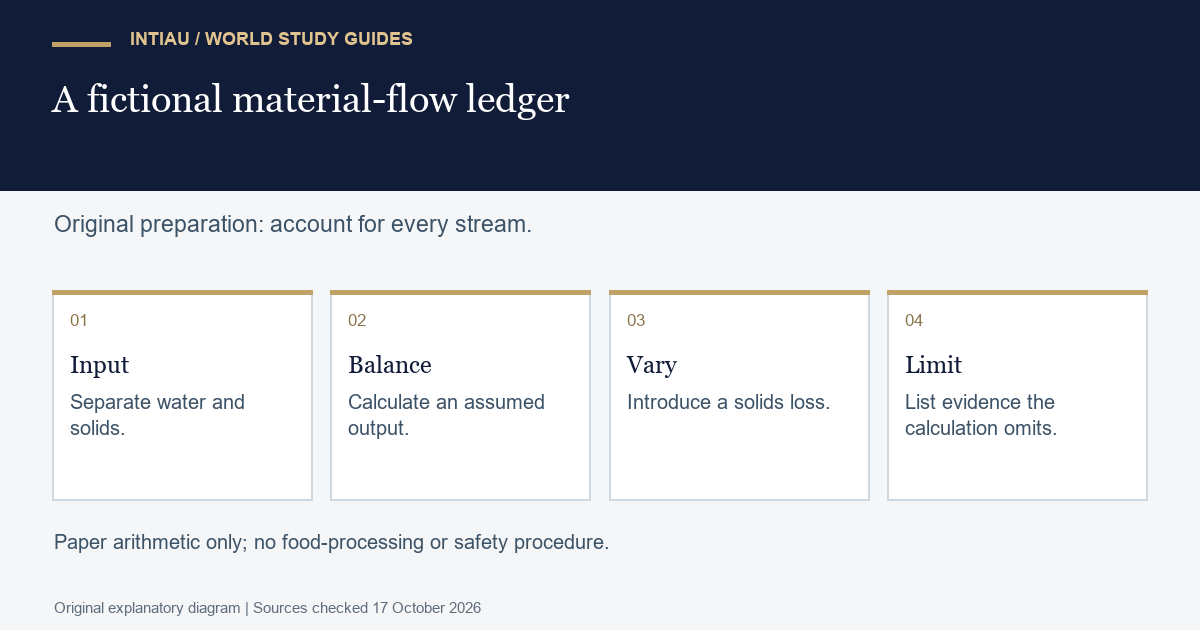
Imagine a paper process receiving one hundred kilograms of a fictional mixture. It contains twenty kilograms of solids and eighty kilograms of water. Suppose the desired output contains the same twenty kilograms of solids at a solids fraction of forty percent. Dividing twenty by 0.40 gives fifty kilograms of final mixture. Its remaining thirty kilograms are water.
The imagined process therefore removes fifty kilograms of water. Check the balance in two ways: total input minus removed water equals total output, and the solids total is unchanged. State the assumptions openly: no solids leave, no material is added, and the initial composition is known exactly. The arithmetic is only valid within those invented assumptions.
Now introduce a loss of two kilograms of solids. If the final solids fraction remains forty percent, the final mixture is forty-five kilograms, containing eighteen kilograms of solids and twenty-seven kilograms of water. Record the separate streams rather than concealing the loss in an unexplained change of yield. Describe which measurement would be needed to distinguish water removal from solids loss.
Add a decision question: would a larger numerical output necessarily be preferable? You have not measured product quality, energy consumption, safety, equipment limits or waste handling. Make a blank evidence column for those issues. Do not fill it with invented compliance claims or treat this paper calculation as instructions to process food.
Conclude with a small balance diagram and a paragraph explaining why a changed assumption altered the result. Give every arrow a unit and check that nothing disappears without a named stream. This exercise is about traceability: another reader should be able to reconstruct your reasoning from the page alone.
Prepare a focused programme comparison
Use the calculation to identify a skill you want to develop, such as proportions, units, experimental measurement or explaining a process choice. Then compare that interest with a selected course record. Keep prerequisites, teaching term and the broader degree requirement in separate columns; a course being listed does not by itself establish that you can enrol.
For admissions planning, retain the Portuguese name of the selection route and its notice identifier. Ask for clarification where your educational background does not fit a displayed category. Translate documents only according to the receiving institution’s instructions, and do not infer a foreign professional title from an informal English description.
Frequently asked questions
Are integral and noturno the same timetable?
No. FEA identifies separate course codes and different semester arrangements, despite describing the same disciplines.
Is Projeto Industrial a real course?
Yes. FT841 appears in the 2026 undergraduate record with project and prerequisite information.
May I use the calculation as a food-processing method?
No. It uses invented assumptions and omits safety and operating evidence. It is a paper learning exercise, not a production procedure.
View the study diagram
Official sources
For other independent study comparisons, see INTIAU Courses; general enquiries can use Contact. The named university decides its own admissions and academic requirements.