Singapore Management University is a separate institution; its Bachelor of Science (Information Systems) is not an INTIAU programme or partnership. This guide concerns the Information Systems undergraduate degree, rather than a postgraduate IT award or a similarly named programme at another university.
SMU states that its medium of instruction is English.
Its undergraduate FAQ describes possible three-, three-and-a-half- or four-year completion for non-Law single degrees through approved exemptions or fast-tracking, while noting the value many students find in four years. Do not assume an individual accelerated plan is automatically available.
Information systems study connects people, organisational processes, data and software. Begin with a problem someone needs to solve, not with a preferred technology. Ask where a curriculum develops the ability to define a need, represent a process and test whether a proposed solution actually meets the requirement.
Read components before inventing a year plan
| Component | Published examples |
|---|---|
| University core | 12 credit units, including Writing & Reasoning and Computational Thinking and Programming. |
| IS major core | 12 credit units; IS112 Data Management; IS210 Business Process Analysis and Solutioning; IS211 Interaction Design and Prototyping. |
| Specialisation and choice | 6 credit units of major electives and 6 free electives. |
| Project integration | Information Systems Project Experience within the major core. |
The map totals 36 credit units for AY2025 entrants onward. Courses may change. The school lists Stamford Road addresses in Singapore.
This component map does not assign every course to a particular year. For a personal plan, check prerequisites and actual offerings before drawing a sequence. Compare how a programme combines process reasoning and software development rather than assuming that every course with a business label is nontechnical, or that every programming course addresses an organisational decision.
Use a real course title as a syllabus question
IS210 Business Process Analysis and Solutioning is a published core course.
Ask its applicable syllabus what process representations students use, how they examine exceptions and how a proposed change is evaluated. The curriculum page supplies the real title and place in the core; it does not justify invented weekly topics, assessment weights or software tools.
Record the course title, cohort structure and unresolved syllabus question separately. If a track looks relevant, check whether a listed subject is compulsory or merely a sample elective.
Worked exercise: redesign a fictional booking handoff
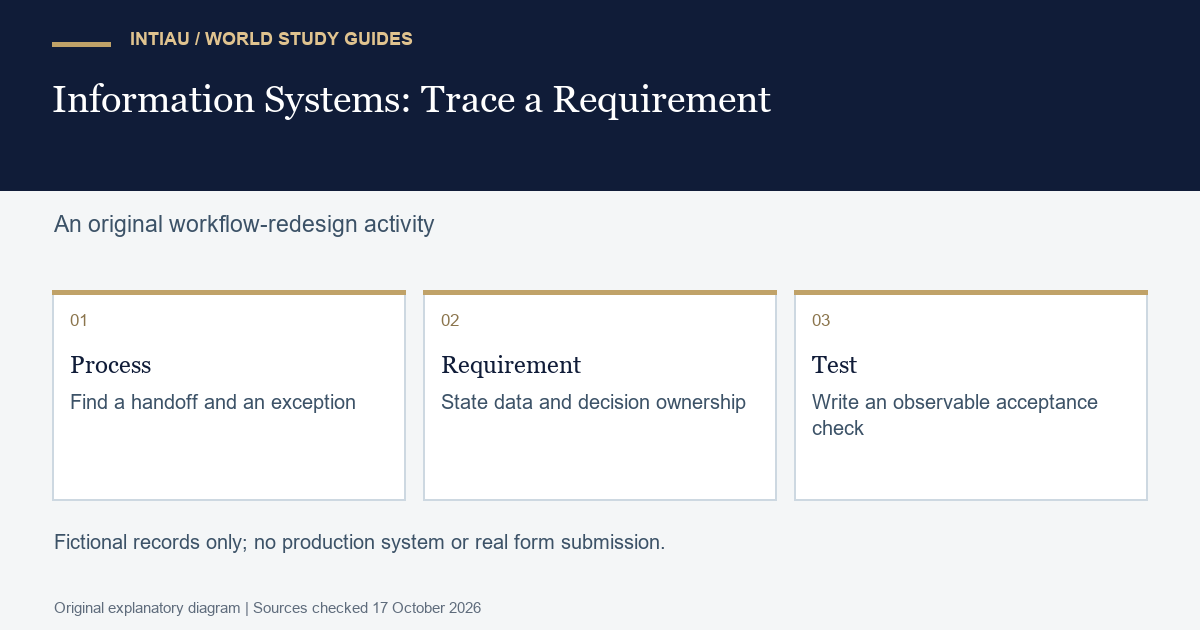
Invent a small equipment-loan service using fictional items and users. Its paper process has four steps: request, availability check, approval and collection. Draw the handoff between requester and coordinator at each step. Add an exception in which an item becomes unavailable after approval. Do not use real names, identifiers, records or a live booking form.
Write one requirement: when availability changes, the responsible person must be able to see which approved requests are affected. List the minimum fictional data needed to support that decision. Avoid adding a birth date or address merely because a database could store it. Identify who may change a status and what evidence should explain that change.
Now write an acceptance check in observable terms. Given an approved request and an unavailable item, the affected request should appear in a review list with a clear status. Add a second check for the ordinary case, where availability has not changed. Ask a peer to find an ambiguous word such as “quickly” or “correctly” and replace it with a specific observable result.
Produce the workflow, one exception path, the data list and two acceptance checks. Explain one trade-off between convenience and control. This independent preparation exercise needs no code or deployment. Its purpose is to show whether a proposed system responds to a defined problem, not whether a prototype has an attractive interface.
Keep the visible admissions year explicit
Checked on 17 October 2026, the international-qualification page still labels its application timeline AY2026-27, closing on 19 March 2026. That deadline has passed and must not be projected into 2027. The page distinguishes accepted qualifications, test evidence and shortlisted interviews; consult the subsequently published cycle before applying.
Use your qualification category rather than nationality alone to select instructions. Keep evidence of entry eligibility separate from curriculum planning. A previous grade profile or a course choice cannot replace the current admissions guide, and a past closing date is not a future application opportunity.
Three systems questions
Does the table provide a fixed year-by-year timetable?
No. It is a selected component structure for AY2025 entrants onward.
Is the visible March 2026 deadline a 2027 deadline?
No. It belongs to the explicitly labelled past cycle.
What should the workflow exercise produce?
A clear handoff, a stated exception and observable checks linked to the actual requirement.
Official source trail
- Information Systems programme
- AY2025-onward curriculum
- Teaching language
- International qualification route
- Undergraduate duration FAQ
For INTIAU information, visit INTIAU Courses or INTIAU Contact. These links do not apply to the separate institution discussed above.
Related guides
View the study diagram