LMU Munich is a German institution separate from INTIAU. Its History BA major is German-taught, normally six semesters, with 120 ECTS in History and a separately chosen 60-ECTS minor. The Historical Seminar is in Munich.
The distinction between a major and the complete degree matters. Comparing 120 History credits with another programme’s entire credit total would confuse two different quantities. Keep the main subject and minor visible as separate components, then ask how the combination supports your interests. A language, method or regional interest may influence the minor you investigate without making it an automatic extension of the History requirements.
Period breadth before later concentration
The July 2026 guide covers winter 2020/21-onward entrants.
| Stage | Published direction |
|---|---|
| Early semesters | Ancient, medieval, and modern/contemporary introductory modules |
| Developing study | Historical working methods and advanced modules |
| Final stage | Advanced study, a concluding seminar and bachelor thesis |
A real Ancient History introductory module combines an introductory lecture with a Basiskurs. These are distinct components.
Use that distinction to compare how a programme moves between orientation and evidence work. A lecture can establish a field of questions, while a focused course can let you investigate a smaller body of material. Do not infer the assessment of a particular annual class from this general structure. Record the actual offering and relevant regulations when a course becomes central to your plan.
Worked exercise: two dates, two purposes
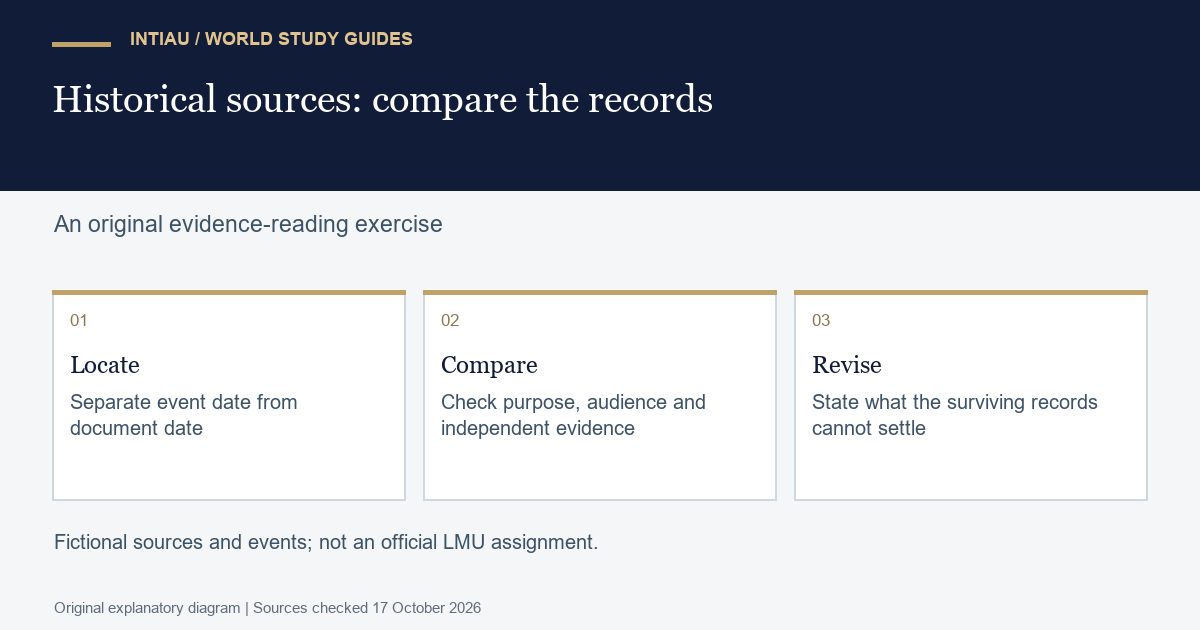
The following records are invented. Record A is a town committee’s notice dated 10 June: “The new footbridge will open on 1 July.” Record B is a shopkeeper’s notebook dated 3 July: “The bridge opened yesterday; customers used the old crossing all week.” Neither record belongs to a real place or archive. Write down each document’s date separately from the event date it describes.
A predicts a future opening on 1 July. B, if read literally, reports an opening on 2 July. The two sources therefore do not agree about the event date, but they also do different things: one announces an intention and the other records a retrospective observation. Calling one “official” does not automatically make it the better record of what eventually happened.
Construct a small evidence sheet with columns for author, intended audience, event described and possible limitation. For A, a limitation is that a planned date may change. For B, a limitation is that the writer’s observation may be incomplete or the phrase “opened” may refer to a particular use. These are questions to investigate, not defects that entitle you to discard either document.
Now add a third invented record, a newspaper paragraph repeating A’s announcement word for word. You have another surviving document, but not necessarily an independent confirmation of the opening date. Identify the likely dependence and explain why counting three documents is different from having three independent observations. Similar wording can prompt a source relationship question without proving exactly how a text circulated.
Write a qualified conclusion: the committee intended an opening on 1 July, while the notebook reports use beginning a day later. The available records do not settle whether there was a delay, a partial opening or an imprecise note. Identify one additional kind of record that could help, such as dated committee minutes, and state which question it would address.
Finally, revise the conclusion after imagining that the notebook was copied from memory months later. Distinguish the date written on a document from the date the surviving copy was made. A small change in provenance can alter the weight of evidence without changing a single quoted sentence. This exercise tests whether you enjoy careful source criticism rather than simply collecting facts in chronological order.
Entry route and language planning
The programme page lists a higher-education entrance qualification and unrestricted first-semester admission. The chosen minor can have different admission conditions. Follow LMU’s current applicant-specific enrolment instructions rather than assuming that unrestricted admission removes every requirement.
The departmental bachelor page links the current guide, regulations and thesis information. Use those sources together; a study guide does not replace binding examination rules.
Checked on 17 October 2026, this guide provides no unconfirmed future closing date. Keep language preparation, qualification assessment, minor selection and module planning as separate tasks. Completing one does not settle the others.
Three History questions
Does History alone account for the whole BA?
No. The 120-ECTS major is combined with a 60-ECTS minor.
Which entrant framework does the guide cover?
Entrants from winter 2020/21 onward.
Are three documents necessarily three independent observations?
No. A document may repeat another source rather than independently confirm it.
For INTIAU’s separate information, use Courses and Contact.
Related guides
View the study diagram