Université de Strasbourg is a French institution separate from INTIAU. Its Licence Histoire, parcours Histoire is French-taught, normally three years and 180 ECTS, with the programme catalogue marked 2026/27.
The faculty location page identifies the Palais Universitaire in Strasbourg. Check the timetable for individual teaching venues rather than treating a faculty address as a complete room allocation.
When comparing history programmes, ask what happens between reading a document and defending a historical claim. A document can establish that a statement was made without proving that the statement was accurate or that its instructions were followed. A useful study map therefore connects period knowledge with source criticism, writing and the construction of a defensible argument.
Study stages and a real course example
| Stage | Published examples |
|---|---|
| L1 | Introductions to historical periods |
| L2 | Continuing period study and historical-writing methodology |
| L3 | Period choices, historiography and semester project work |
The programme describes a tutored mini-dissertation each semester, developing historical research and writing progressively.
The 2026/27 Introduction à l’histoire moderne A–J outline covers the late fifteenth to late eighteenth centuries. It identifies historiographical approaches, historical-document commentary and scholarly reading and bibliography as learning aims. This is a selected course example; alphabetical allocation and other programme choices should be read in the actual catalogue, not reconstructed from this summary.
For a comparison sheet, place one period-based component beside one methodological component. Then ask how knowledge of the period could change your interpretation of an apparently straightforward source. A familiar word may have a specific local use, while a surviving document may have been created for a purpose quite different from the question you now want to investigate.
Worked exercise: permission is not proof of use
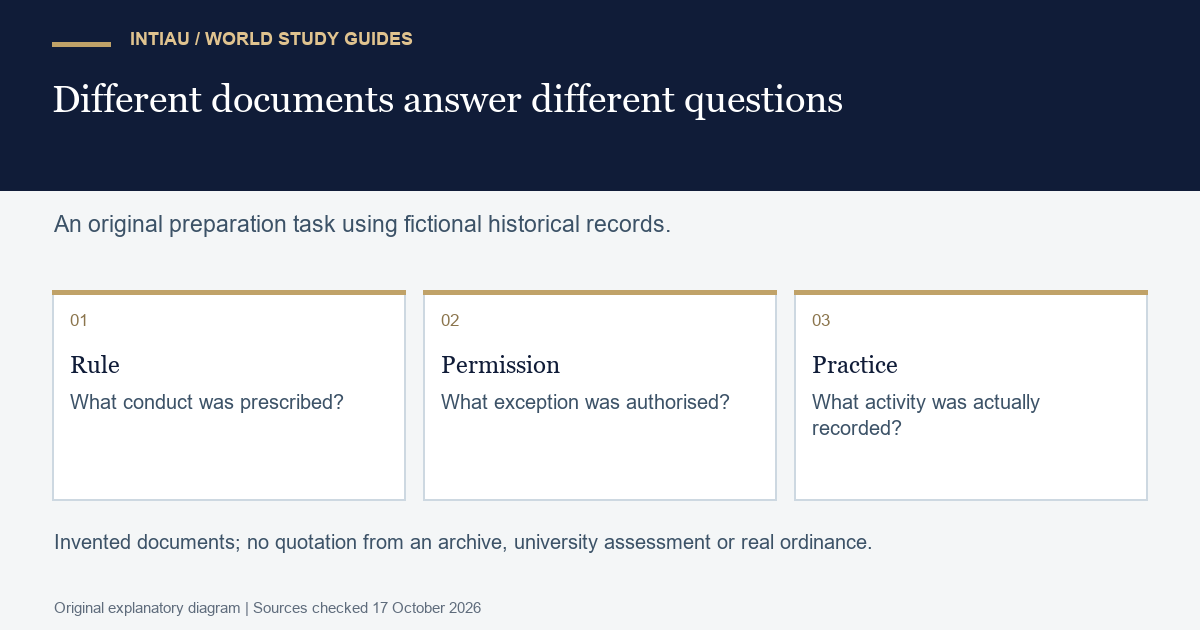
This original exercise uses three invented documents about an imaginary town. Document A is a market rule stating that stalls must close at dusk. Document B is a permit ledger authorising two stalls to remain open on one Friday evening. Document C is a fictional stallholder’s note saying that their own stall made no sales after dusk that Friday. No real archive, ordinance or person is represented.
Begin by writing what each document directly records. A states a general prescription. B records an authorised exception for two stalls. C makes a claim about one stallholder’s activity. They do not answer the same question, so the first task is to identify each source’s purpose and scope before calling the accounts contradictory.
A and B can be consistent if the rule allows exceptions or was later modified. The exercise does not provide that procedural detail, so keep both possibilities open. The existence of B alone does not prove that the permitted stalls opened late, made sales or attracted customers. An authorisation is evidence of permission, not automatically of implementation.
C likewise does not establish that the entire market was closed. Its claim concerns one stall, and that stall may or may not be one of those in B. A defensible short answer would say that at least one recorded account asserts no late sales for one stall, while the permit ledger records two authorisations. It would not combine them into a numerical estimate of town-wide trading.
Now add a fourth invented record: a clerk copied B into a later summary. Does this create another independent observation of market activity? No. It may help trace how the permission was recorded or remembered, but it remains dependent on the ledger for that information. Counting documents without checking their relationship could exaggerate the apparent support for a claim.
Prepare an evidence sheet with columns for document type, date, creator, direct statement, possible inference and unresolved question. For A, a useful unresolved question is whether exceptions were permitted. For B, ask whether the authorisations were used. For C, ask which stall it describes and how its statement could be checked. The worksheet should preserve uncertainty instead of filling gaps with a plausible story.
Finish with a two-sentence conclusion. The first should state what the three records support; the second should identify the evidence needed to claim actual late trading. This is preparation in careful argument, not a university assignment or a substitute for reading real sources within their historical setting.
Application routes and the checked cycle
The faculty admissions page links central first-year instructions and distinguishes later-year applications through eCandidat where required. Its displayed 2026 later-entry dates were already past on 17 October 2026. Follow the current profile-specific university route, including international guidance where applicable; no 2027 deadline is supplied here.
Keep curriculum interests separate from eligibility and language evidence. A selected advanced course is not permission to enter its year directly. Save the exact qualification, applicant category and relevant cycle instructions before preparing final documents.
Three history questions
Which teaching language does the degree listing specify?
French.
Is the selected modern-history outline tied to an edition?
Yes. The A–J course page is marked 2026/27.
Does the fictional permit ledger prove late sales occurred?
No. It records permission; evidence of actual trading would be a separate question.
For INTIAU information, use Courses or Contact.
Related guides
View the study diagram