Politecnico di Milano offers the Laurea in Urbanistica: Città Ambiente Paesaggio at Milano Leonardo; this independent programme is not an INTIAU award or partnership. The three-year programme belongs to class L-21 and is taught in Italian. School programme record.
When comparing urban-planning degrees, ask how an observation becomes a representation, and how that representation supports a proposal. A visually convincing boundary can conceal assumptions about who is included, how travel is measured and which places are counted twice. Keep a small notebook of those assumptions alongside your course comparison.
Selected curriculum, not a complete timetable
The 2026/27 manifesto develops analysis and representation into policy, environmental evaluation and successive planning laboratories. The selection below translates course names for orientation. Published curriculum.
| Stage | Selected component | Question for your comparison |
|---|---|---|
| Year one | City and Territory Analysis Laboratory; Planning Laboratory 1 | How will I record a spatial observation? |
| Year two | GIS and Digital Cartography; Urban Policies; Planning Laboratory 2 | How does a representation inform a choice? |
| Later study | Planning Laboratory 3; final work | How will I explain a proposal and its limits? |
A specific example is CI Economia e Società, an eight-credit integrated course listed in year two for 2026/27. Its published summary connects urban structure and change with land rent and urban sociology. Selected course summary.
Use this example to make a better comparison than simply counting software titles. Write one question about a spatial pattern, one about the people affected and one about the explanation offered for that pattern. Keep the questions distinct: a map may display a difference without explaining why it exists, while an explanation still needs evidence.
Read the application route before making a calendar
For 2026/27, an entrance examination is mandatory and places are limited. Rules distinguish Italian or equivalent applicants from the reserved international category, with specific provisions for foreign qualifications. Use the applicable call and its amendments. No 2027/28 opening is established here. Official admission route.
Prepare a checklist with separate rows for eligibility, examination registration, ranking and enrolment. Record the source and applicant category beside each action. A date without its action is incomplete: sitting an examination, appearing in a ranking and accepting a place answer different administrative questions. Keep unresolved points as questions for the university.
Original worked exercise: overlapping service areas
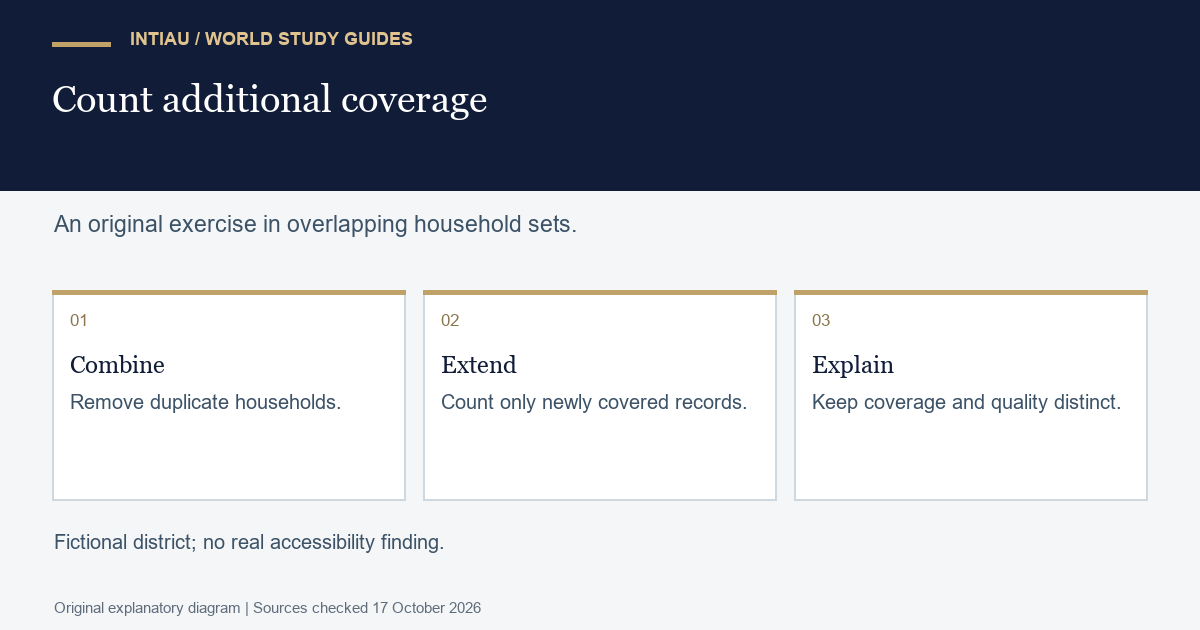
This fictional paper exercise is independent of the university’s assignments. Imagine a district containing 300 distinct households. A drawn service area A contains 120 households and area B contains 100. Forty households appear in both areas. The question is how many distinct households are covered by at least one of these two areas.
Adding the two counts gives 220, but that includes the overlapping forty twice. The distinct total is 120 + 100 − 40 = 180 households, or 60% of the district. Write the denominator explicitly. The answer describes coverage within the invented district, not the capacity or quality of the services.
Now consider area C, containing seventy households. Fifty are already in the combined A-and-B set. C therefore adds only twenty new households. The combined total becomes 200, or about 66.7%. Reporting seventy additional households would confuse membership in C with additional coverage beyond the current arrangement.
Draw three boxes representing the original data, the overlap correction and the additional coverage. Label each household only once in your final tally. Then ask what would happen if the fifty-household overlap with the union had instead been reported separately against A and B. You would need to know whether some households appeared in all three sets before adding those two overlap counts.
Finish with a short decision note. State the invented coverage measure, show the calculation and identify missing evidence such as demand or capacity. Do not rank actual neighbourhoods from these numbers. The purpose is to practise checking what a spatial count means before turning it into a claim about improvement.
Questions to keep with your comparison
Is the English programme webpage evidence of English teaching?
No. The programme record identifies Italian as the teaching language.
Should I copy the complete course list into my comparison?
Choose a few components that answer your question, retain their original names and edition, and explain why they matter. A long list alone does not demonstrate fit.
Does the exercise establish real service accessibility?
No. Its household counts and boundaries are invented. A real investigation would require a defined population, defensible spatial data and an appropriate method.
Explore INTIAU’s course information or use the contact route for questions about INTIAU’s own services.
Official source index
- School record: identity and language.
- Manifesto: selected progression.
- Course record: selected theme.
- Admission page: applicant route.
Related guides
View the study diagram