
The University of Turin’s Global Law and Transnational Legal Studies is a three-year bachelor in Turin, taught in English with mixed delivery; this guide concerns that independent programme, not an INTIAU qualification or partnership. Its current record identifies class L-14 R. Official programme record.
For a useful law-course comparison, ask how a conclusion depends on the source and scope of a rule. Similar wording can have a different effect when the applicable framework changes. A careful reader first establishes which text is relevant, then interprets it and applies it to a particular set of facts. Confidence in an answer cannot replace those steps.
Keep the entrant sequence and delivery choices visible
The entrant sequence labels first year 2026/27 and later years 2027/28 and 2028/29. Some subjects offer regular/online alternatives.
Confirm the delivery arrangement applicable to your own route. A cohort sequence should not become an assumption about unrestricted future choices.
| Published stage | Selected examples | Reading question |
|---|---|---|
| First year | International Law; Principles of Constitutional Law; Legal English | Which terms require an explicit definition? |
| Second year | Corporate Law; Administrative Law; comparative-law choices | Which framework governs the question? |
| Third year | Labour Law choices; Dissertation | How is an argument supported and qualified? |
The department’s published International Law outline concerns the public international legal order and the interactions it structures. This is a selected thematic example, not a complete new assessment outline. Department course outline.
In your comparison notes, distinguish the subject being discussed from the method used to discuss it. Reading a case, comparing a concept and analysing an institution can illuminate different aspects of the same topic. Record a question that a public outline leaves unresolved, rather than supplying an imagined reading list or weekly teaching pattern.
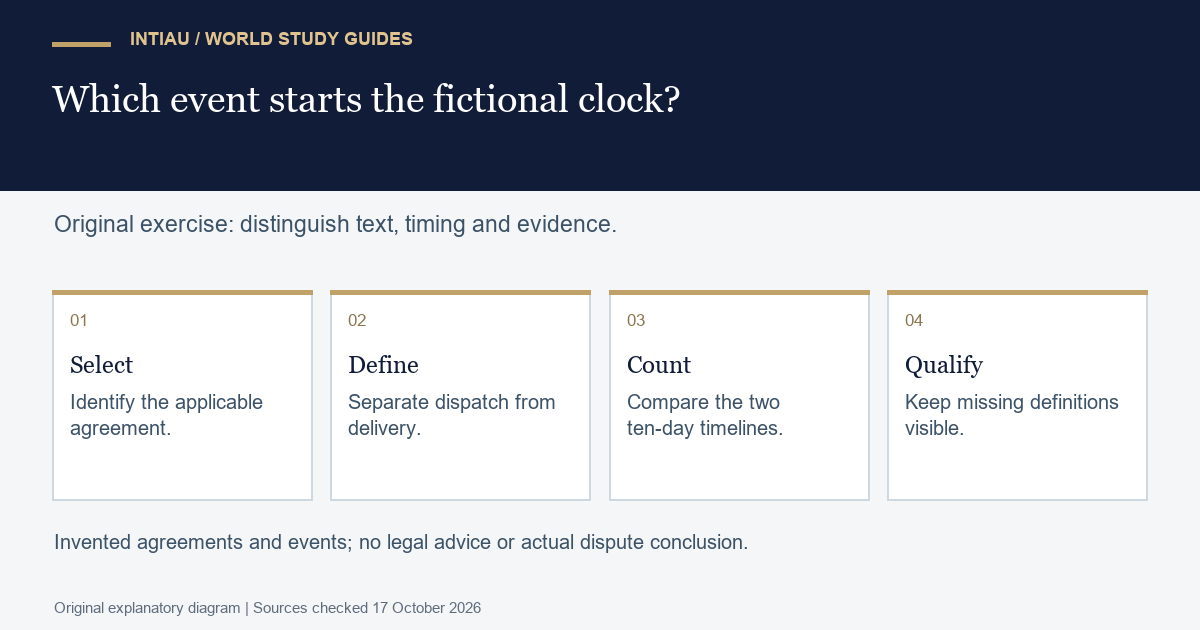
Original worked exercise: the event that starts a clock
This exercise uses two invented agreements and no real law. Agreement A permits a fictional review request within ten calendar days after delivery. Agreement B uses the same period after dispatch. Stipulate that the triggering date is day zero in both agreements. A package is dispatched on 1 November, delivered on 4 November, and a review is requested on 13 November.
Under A, day ten is 14 November, so the request falls within the stipulated period. Under B, day ten is 11 November, so the same request falls outside it. Show the dates on two timelines. The outcome changes because a different event starts the clock, not because ten days has a different mathematical meaning.
Now add a dispute about evidence: one record says delivered on 4 November, while another records a message sent on 2 November saying the package was ready for collection. Do not immediately replace the delivery date. Ask whether readiness for collection counts as delivery under the invented agreement, and what further wording or evidence would settle that question.
Prepare two short arguments. One treats the collection message as sufficient; the other requires actual receipt. For each, identify the assumption it needs. If the supplied text does not define delivery, label the resulting uncertainty. A reasoned answer can explain competing interpretations without pretending that the fictional record contains a definitive rule.
Next change the source question. Suppose a covering document says Agreement A applies, but an attached form reproduces B’s dispatch wording. Before counting again, identify the inconsistency and ask which document has priority. Do not invent a hierarchy merely because one document produces a preferred result. Write a concise request for the missing contractual instruction.
Finish with a matrix containing the possible applicable text, triggering event, deadline, supporting evidence and unresolved issue. Include the two worked dates, 11 and 14 November. Separate a factual disagreement from an interpretation question and a choice-of-text question. These categories may interact, but combining them into one vague concern makes an argument harder to examine.
The exercise is not legal advice, a prediction about a court or a substitute for professional judgement. It is an original reading task for comparing study interests. Its value lies in showing how an answer changes when a material assumption changes, while keeping the original reasoning available for another reader to challenge.
Read the actual applicant requirements
For 2026/27, the programme record identifies TOLC-SU for the initial requirements assessment. Its open-access label should not be read as an absence of an assessment procedure.
The programme site organises study plans by entrant cohort. Preserve the year attached to each record. Cohort-plan index.
Sources were checked on 17 October 2026. For an actual application, consult the intended cycle’s instructions and qualification category. This guide announces no unverified 2027 opening and establishes no professional admission or credit equivalence.
Frequently asked questions
Should a later curriculum table become my application checklist?
No. Keep the intended entry instructions and your qualification category separate from the subjects you hope to study.
Is the table the complete degree requirement list?
No. It selects published components. Delivery alternatives and a personal plan require the applicable rules.
Are the deadline agreements genuine legal documents?
No. Both texts and all events are invented. Their worked interpretation supports no conclusion about an actual legal dispute.
View the study diagram
Official sources
INTIAU’s own information is available through Courses and Contact. Turin makes its own academic and admission decisions.