Kyung Hee University is a separate institution; its Hospitality Management undergraduate programme is not an INTIAU programme or partnership. The department belongs to the College of Hotel and Tourism Management in Seoul, South Korea. Its subject extends across lodging, food service and convention or MICE management. The department’s introduction explains that three former majors were combined in 2023, with flexible tracks within the resulting department.
Identify the programme before comparing credits
The official English bulletin calls the award a Bachelor’s Degree in Hospitality Management. Although its download sits in a 2026 directory, the relevant pages are internally labelled 2024–2025. Its older single-major credit subtotal should therefore not replace the dated 2026 departmental regulations used below. The English bulletin, printed page 410, is useful for the award wording and the programme’s management emphasis, rather than for overriding newer requirements.
The college’s official history records its transition to a four-year university college and separately records the establishment of Global Hospitality and Tourism in 2024. Those histories help distinguish units; they do not turn the two programmes into the same admissions route. The 2026 study table below covers years one to four, without predicting an individual’s completion date.
Use the 2026 plan for the selected progression
The 2026 Hospitality Management regulations require at least 120 graduation credits; the single-major subtotal is 64: nine foundational, twelve required and forty-three elective. The selected rows are not a complete schedule.
| Year | Published example | Question for your study notes |
|---|---|---|
| 1 | Understanding Big Data in Hospitality | What would make a dataset useful? |
| 2 | Business Statistics | Which comparison does the evidence support? |
| 3 | Financial Management in Hospitality Industry | What assumptions drive a financial decision? |
| 4 | Graduation Thesis (Hospitality Management) | Can you answer a narrow research question? |
For an actual learning-theme example, HSPMT2003, Business Statistics, covers probability distributions, hypothesis tests, analysis of variance, regression and nonparametric methods. These are catalogue themes, not a reproduced weekly syllabus. The table’s year allocation also does not establish that every elective runs every semester.
Match applicant language and the current cycle
The Spring 2027 international admissions guide lists Seoul Hospitality Management separately from Global Hospitality & Tourism Management [English Track]. Korean-track freshmen can use TOPIK level 3 among specified language options. Applicants and both parents must meet non-Korean nationality conditions, with secondary education completed before entry. This does not establish English teaching throughout Hospitality Management.
Checked on 17 October 2026, the first intake’s August application period had ended. The guide schedules second-intake online applications for 26 October–6 November 2026, ending at 17:00, with postal documents postmarked by 5 November. Recheck the university’s current notices and complete checklist before acting; this dated calendar is separate from the 2026 curriculum edition.
Read management evidence as well as course titles
The department’s introduction connects management theory, customer experience and practical exploration. Compare how an operational decision uses customer evidence. An industry name on a webpage does not promise an internship, job or individually available project.
The internally dated English bulletin describes coordinating operations across lodging, food and events, using theoretical and practical skills. This is a management education profile, not training for every specialist occupation in those sectors. Prefer a focused study question to a list of possible careers.
Worked exercise: diagnose a fictional booking comparison
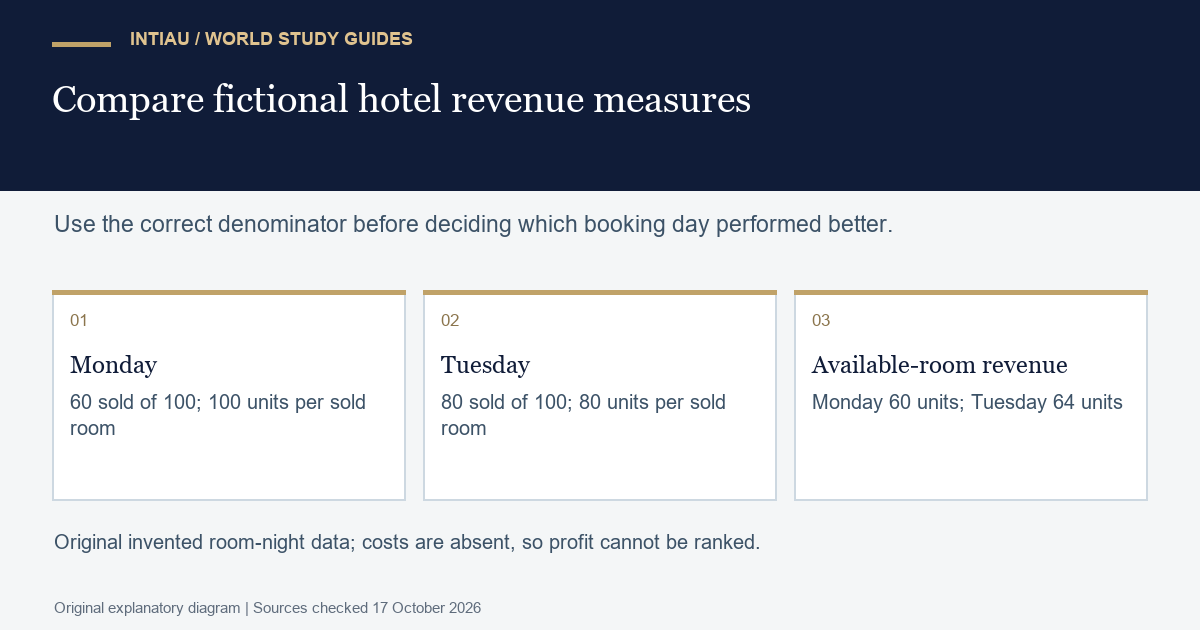
An imaginary hotel sells 60 room-nights at 100 fictional units each on Monday and 80 at 80 units each on Tuesday. It has 100 available room-nights on each day. Calculate occupancy, average daily rate and room revenue per available room. Then decide whether Tuesday was more profitable. These are invented records, not university or hotel data.
Monday’s occupancy is 60%, its sold-room average is 100, and revenue per available room is 6,000 ÷ 100 = 60 units. Tuesday’s values are 80%, 80, and 6,400 ÷ 100 = 64 units. Tuesday has higher room revenue and revenue per available room, despite a lower sold-room average. Profit cannot be ranked because operating and acquisition costs are absent. The common error divides revenue by sold rooms while labelling the result “per available room.” Submit the three labelled measures, their denominators and the missing cost question. This original exercise is a preparation activity, not a Kyung Hee assessment or a real business recommendation.
Frequently asked questions
Is Hospitality Management the named English-track unit?
No. The admissions table identifies Global Hospitality & Tourism Management separately as the English track.
Does the 64-credit major subtotal complete the whole degree?
No. The 2026 rules specify at least 120 graduation credits overall.
Does the booking exercise prove higher profit on Tuesday?
No. It compares room revenue measures; the fictional records omit costs.
For other study topics, see INTIAU Courses. Direct questions about INTIAU’s own information through INTIAU Contact.
Related guides
View the study diagram