Universidad Autónoma de San Luis Potosí publishes Ingeniería Ambiental through its Faculty of Engineering in San Luis Potosí, Mexico. This independent guide concerns that programme, not an INTIAU qualification or partnership.
Read the course index by semester and edition
The department’s outline index runs from semesters I to X, but its linked documents carry different years, including 2016, 2019, 2021 and 2023. It is therefore useful evidence of named teaching components, not a verified single complete 2027 cohort plan. Use the actual semester index.
| Selected stage | Actual entries, translated |
|---|---|
| I–II | Biodiversity and Evolution; General Ecology; Chemistry; Calculus |
| III–IV | Meteorology and Climatology; Environmental Soil Science; Material and Energy Balances |
| V–VII | Environmental Hydraulics; Hydrology; Environmental Microbiology; Air Pollution Control |
| VIII–X | Water Pollution Control; Environmental Risk; Environmental Impact; professional practice |
The programme description connects physical, mathematical, chemical and biological foundations with problems involving water, air and soils, environmental assessment and management. These are its published programme themes; translated subject names here do not establish English-medium teaching.
A useful way to compare environmental-engineering routes is to follow one quantity through several kinds of problem. How is it measured? How does it move? How might an intervention change it? What evidence would demonstrate that the intervention worked? Keeping those questions distinct prevents an attractive project title from replacing a clear account of the engineering work involved.
A real project course requires communication as well as investigation
The department describes a ninth-semester research project in which students address environmental problems, integrate earlier study and develop tools to communicate findings convincingly. Its project archive includes several academic years. This establishes an actual teaching aim, not the content or assessment of every future project. A full current weekly outline for the individual pollution-control units was not verified. Read the project-course description.
That combination gives you a concrete preparation task: turn a broad concern into a question that could be answered with evidence. “Water quality matters” is a motivation. A comparison with specified measurements, locations and conditions is closer to an investigable question. A report should then distinguish what was observed, how it was calculated and what remains uncertain. Communicating a result clearly does not mean making the conclusion stronger than the evidence.
The admission process is separately dated
The Faculty of Engineering’s 2026 applicant instructions give pre-registration from 19 January to 31 May and direct applicants through an online, personal process. That window is past on 17 October 2026. The page does not establish a new 2027 registration period or, by itself, all programme-specific examination requirements. Use the applicable university admission instructions before planning an application. Consult the faculty’s dated guidance.
The exact current degree-credit audit and a complete current admission-examination specification were not established from the reviewed public records. Keep those as explicit questions for the institution. A mixed-edition course index can still help you judge subject fit, but should not be converted into a self-certified transfer or graduation calculation.
Original exercise: a lower concentration is not the whole result
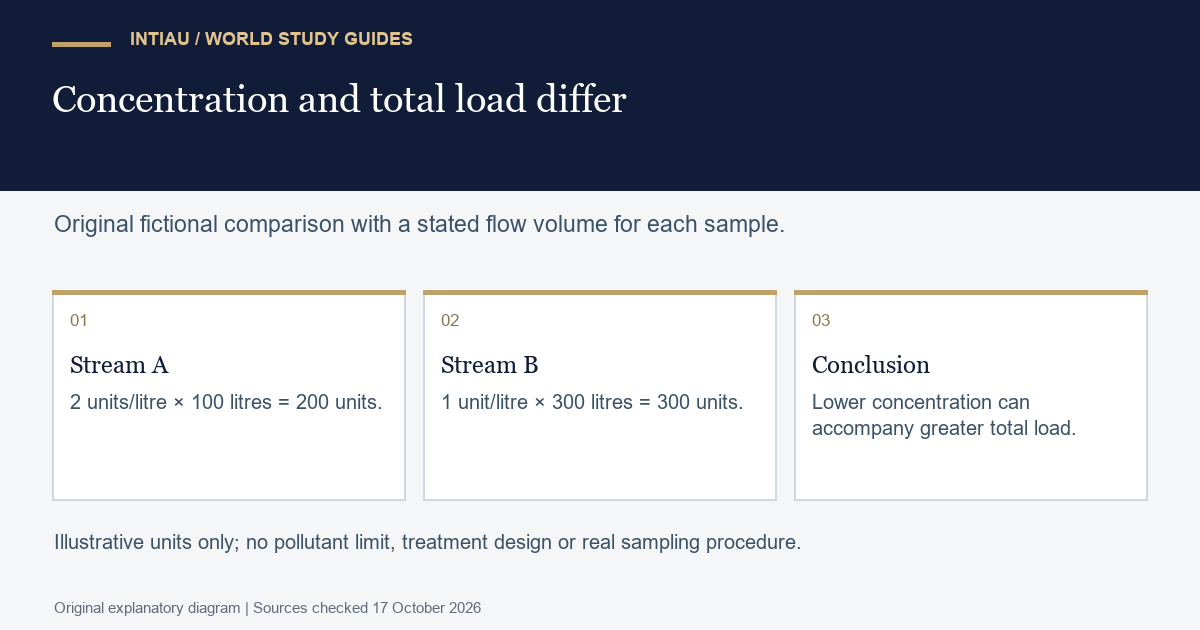
Imagine Stream A contains 2 fictional units per litre across a measured volume of 100 litres. The total is 200 units. Stream B contains 1 unit per litre across 300 litres, giving 300 units. B has half the concentration but carries a greater total quantity in the stated volumes.
Write separate conclusions about concentration and total load. Then ask whether the volumes cover equal time intervals: without that information, a rate comparison is not established. If your next proposal claims that one stream is “cleaner,” specify what that word means and which measure supports it. Do not infer a health limit or treatment requirement from the invented units. This original exercise checks dimensional reasoning; it is not a real environmental measurement or a UASLP assessment.
Questions to settle
Is the outline index one newly verified cohort plan?
No. Its documents have mixed editions; the index should be read with those dates.
Does the project involve presenting findings?
Yes. Communication of research findings is part of the department’s stated teaching aim.
Is the published 2026 registration window still future?
No. It ended on 31 May, before this guide’s October check.
Official reading
- Environmental Engineering programme (published description)
- Semester and outline index (mixed 2016–2023 editions)
- Research-project teaching (published description)
- Engineering applicant instructions (2026)
For other study topics, browse INTIAU Courses; use Contact for questions about INTIAU services. University applications belong with the institution named above.
Related guides
View the study diagram