Aalto University is separate from INTIAU. Its Design and Media programme includes an English-language Bachelor of Arts (Art and Design), normally 180 ECTS over three years, followed by a separately defined master’s stage. This guide focuses on the bachelor.
Read the studio sequence before choosing a minor
The 2026–2028 curriculum allocates 26 credits to general studies and 111 to the major. Selected major units illustrate progression:
| Year | Selected named units |
|---|---|
| 1 | Introductory Design Project; Programming for Designers; Thematic Studio I |
| 2 | Digital Service Design Project; Strategic Identity and Design; Thematic Studio II |
| 3 | Introduction to Research in Design and Media; Bachelor’s Thesis and Seminar |
The table is a selection, rather than the entire study plan. It helps distinguish the recurring studio component from a single specialist technique. When comparing a programme, ask how a proposal develops across successive projects: what problem is defined, what alternatives are examined, and how a final decision is explained. A visually convincing result can still rest on an unclear purpose.
Keep a second list for interests that could shape a minor. That list should not replace the required major sequence. A sensible comparison checks both the breadth of the degree and whether a preferred subject can fit without displacing required work. The question is how the parts connect, rather than how many attractive course names can be collected.
A specific course connects perception and practice
The same curriculum lists Colour and Perception, ARTS-A0304, as a three-credit English-language art-course option. It combines lectures on perception and colour use with exercises in colour interaction, combinations, observation and identification. Its presence in this list does not make it a compulsory major unit.
A useful reading question is whether a course explains both a way of making something and a way of judging the result. An observation about colour appearance needs conditions: the surrounding colours, medium and viewing context can matter to the comparison being made. In your own notes, distinguish “I prefer this” from a claim about what a design enables a reader to understand.
Follow the actual 2027 selection sequence
The 2027 admissions instructions give an application period of 7–22 January 2027, ending at 15:00 UTC+2. Selection proceeds through preliminary assignments, intake assignments and an interview, with screening between stages. Preliminary assignments are scheduled for publication on 17 December 2026; their submission deadline is 29 January 2027 at 15:00 UTC+2.
A qualifying foreign upper-secondary qualification must give eligibility for university-level study in its awarding country. The instructions separately specify academic documents and proof of English. Applicants must complete selection work independently under Aalto’s rules.
The distinction between the application deadline and the assignment deadline is practical: neither should be assumed to cover every document or later stage. Keep the official instructions open when making a checklist. As checked on 17 October 2026, this article cannot describe the content of assignments that have not yet been published.
Try an original design-reading exercise
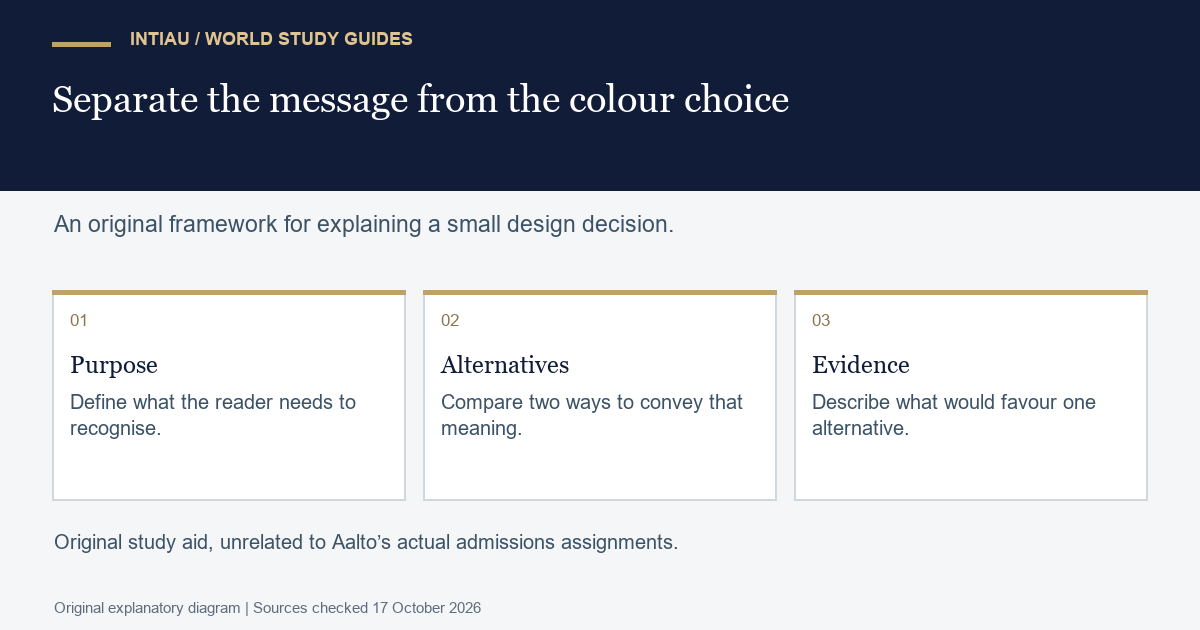
Consider a fictional library display with three room states: available, occupied and unavailable. Proposal A communicates them only through three colours. Proposal B uses the same colours with short text labels and distinct symbols. Before choosing, define the task: a visitor should identify the room state without asking another person.
B supplies additional cues, but that observation alone does not prove that its complete layout is effective. The labels might be too small, the symbols ambiguous or the display crowded. Write one question that could distinguish the proposals, such as whether readers correctly identify each state at the intended viewing distance. Record errors by state rather than reporting only an overall impression.
This is an original paper comparison of communication choices. It is not an Aalto assignment, a portfolio template or advice for completing the university’s independent selection work.
Questions about the bachelor
Is the bachelor taught in English?
Yes. The published Design and Media bachelor is English-language.
Does the table reproduce the whole curriculum?
No. It selects major units.
Are the 2027 preliminary assignments already described here?
No. Their scheduled publication is 17 December 2026.
Explore subject comparisons through INTIAU Courses, or use Contact for INTIAU information-service enquiries.
Related guides
View the study diagram