Aarhus University is separate from INTIAU. This guide examines its Cognitive Science bachelor as a programme to investigate minds and behaviour with evidence, rather than treating an interest in the brain as a substitute for an interest in research methods.
The original 2014 ministerial programme document specifies the title Bachelor of Science in Cognitive Science, an Aarhus location and 180 ECTS. That historical descriptor is not evidence for today’s admission deadlines.
Start with the language-change notice
Aarhus’s programme page, revised 7 October 2026, describes current English teaching but expects a switch to Danish for the 2027 intake. It says that, if implemented, Danish A and English B would be required, and anticipates an update around 1 December 2026. The change remains conditional in the text checked here.
This is a practical reason to separate three decisions: whether the academic subject suits you, whether you meet the applicant requirements, and whether the next cohort’s teaching language is workable for you. A familiar degree title does not settle the third decision. Keep the page’s actual conditional wording in your planning notes instead of silently converting it into either an English-language promise or a confirmed Danish intake.
A dated route through the course sequence
The university-hosted 2025 student orientation guide provides this course-map example. It is useful orientation evidence, not the binding academic regulations for a future cohort.
| Semesters | Selected 2025 map components |
|---|---|
| 1–2 | Introduction to Cognitive Science; Methods 1 and 2; Applied Cognitive Science. |
| 3–4 | Perception and Action; Methods 3 and 4; Cognitive Neuroscience. |
| 5–6 | A 15-ECTS bachelor project and supplementary-subject study. |
Methods 1 is named Introduction to Experimental Methods, Statistics, and Programming and carries 10 ECTS in that map. A full current course outline was not retrieved, so specific weekly topics or assessment rules are not asserted here.
At programme level, Aarhus describes experimental investigations, statistical analysis and programming, including laboratory work with behavioural experiments, brain-scan data and text databases. The published subject requirements include English B, Mathematics B and one of History, History of Ideas, Social Studies or Contemporary History at Danish B level.
The sequence is worth reading as a relationship between a substantive question and a way of testing it. Ask what a task measures, why a statistical comparison is appropriate and what a computational model assumes. If one of those steps feels uninteresting, investigate it before choosing a degree because a later neuroscience topic sounds appealing. The methods should help answer the question, rather than becoming a decorative technical appendix.
Use the university’s applicant route
The international-applicant hub organises admission guidance around entry qualifications, specific requirements, language, documentation and application steps. Use its official route together with the programme’s updated requirements. This guide does not project an undated annual deadline into 2027.
For an enquiry, identify your exact secondary credential and the subjects you completed, then ask which evidence is needed to establish the Danish subject level. Keep that administrative question separate from questions about course content. It gives the admissions team a concrete issue to resolve and avoids treating an informal translation of a subject name as a completed equivalence assessment.
Try an original two-measure exercise
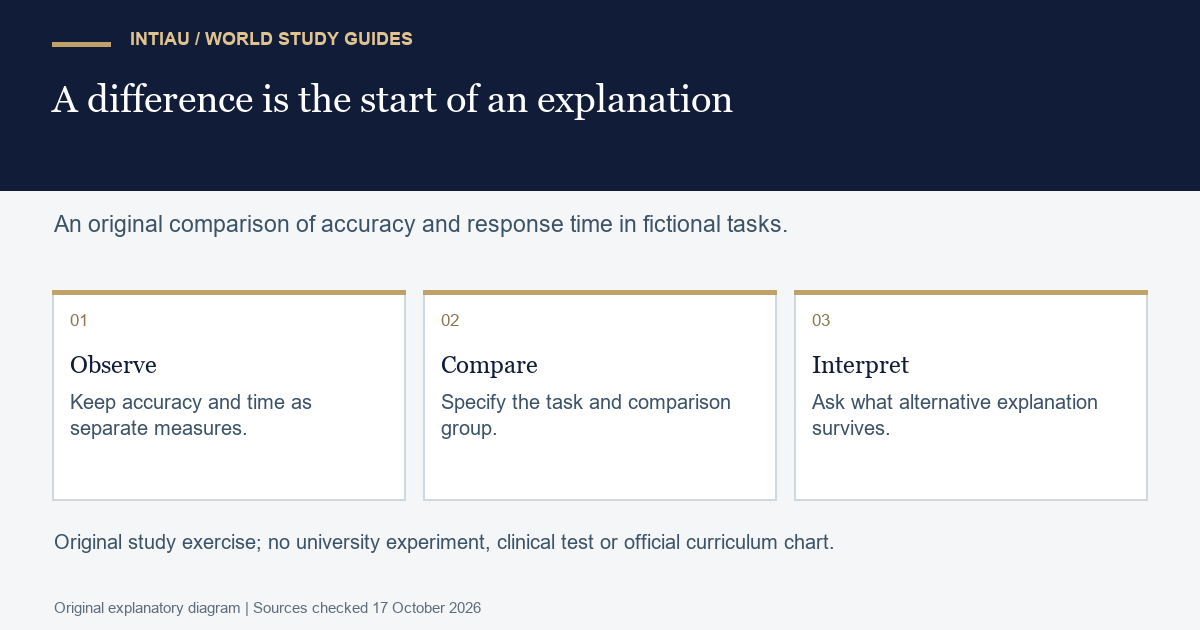
In a fictional paper exercise, task A produces eight correct answers out of ten with a median response time of 600 milliseconds. Task B produces nine correct answers out of ten with a median of 750 milliseconds. B is more accurate in these observations but slower. A claim that B is simply “better” has hidden the choice of outcome.
Write one explanation involving greater checking time, then identify another possibility: the tasks might differ in difficulty. Without a suitable design, the small comparison cannot distinguish them. The worked answer therefore reports both measures and keeps the explanation provisional. No people need to be recruited and no real behavioural data need to be collected for this exercise.
Questions about this reading
Is English teaching guaranteed for the 2027 intake?
No. The dated notice describes a conditional change to Danish.
Is the course table a verified 2027 syllabus?
No. It condenses a university-hosted 2025 student orientation map.
What degree descriptor is documented?
The ministerial document specifies a BSc in Cognitive Science and 180 ECTS.
Explore INTIAU Courses for subject comparisons, or Contact for INTIAU information-service enquiries.
Related guides
View the study diagram