The University of Oslo is separate from INTIAU. Its Philosophy bachelor is a three-year, 180-credit programme. This guide examines its subject structure and one real course description, rather than treating philosophy as a list of famous thinkers.
Read the major alongside supporting subjects
The structure page, updated in March 2026, sets out the components below. The bachelor’s thesis is recommended but optional. Credit choices must still satisfy the full degree requirements.
| Component | Published extent |
|---|---|
| Philosophy | 80 credits |
| Supporting subject group | At least 40 credits |
| Free courses | Up to 40 credits |
| Exphil and exfac | 20 credits |
Do not interpret the minimum supporting allocation and maximum free allocation as permission to ignore the total. The important comparison is how a supporting subject changes the questions you can examine. For example, an interest in scientific explanation and an interest in political justification may lead to different combinations. Write down the philosophical question first, then consider what additional knowledge would make the argument more informed.
The suggested progression names introductory units including FIL1001, FIL1005, FIL1003, FIL1006 and FIL1002. This is evidence of a published route through the subject, not a claim that every course has identical availability or assessment in every year.
A real course examines knowledge and justification
The FIL1002 description, Introduction to Epistemology and Philosophy of Science, examines scepticism, perception, knowledge and justification. Its science component considers observation and theory, induction, explanation and scientific progress. Students are expected to evaluate positions and present a short, clear written discussion. The published course is ten credits and Norwegian-language; the directly readable page linked older implementations, so no current delivery timetable is asserted here.
This description reveals the difference between recognising a position and evaluating it. A summary might say that a thinker doubts whether an experience establishes knowledge. An evaluation must identify the reason for that doubt, show what it challenges and consider whether the response addresses the same issue. Merely reporting disagreement leaves the philosophical work unfinished.
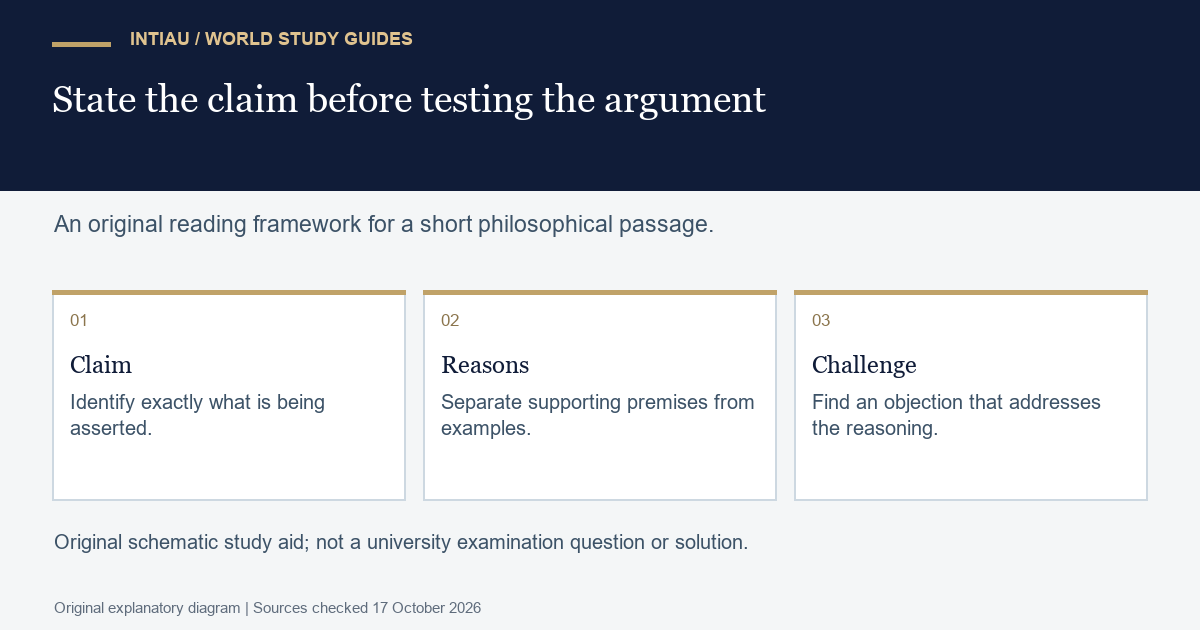
A useful reading habit is to annotate each paragraph with its role: claim, reason, example, objection or reply. The same sentence may serve more than one role, so explain your classification when it is ambiguous. This creates a compact map that can be checked against the text rather than relying on an overall impression of what the author “must mean.”
Keep admissions and course registration distinct
Oslo’s undergraduate admissions guidance directs applications through Samordna opptak. It states general university-entry eligibility and links any additional programme requirements. Its explicitly dated opening refers to 2026; the annual April deadline is already past for that cycle. This guide does not project a 2027 calendar.
The course description separately requires students to obtain a teaching place and register for the examination in Studentweb. A programme application is therefore not the same action as registration for an individual course.
Check qualification and language evidence through the university’s applicable admissions instructions. The language of this English guide does not establish the teaching language of the degree. Similarly, permission to answer an examination in a particular language would not establish that all teaching uses that language.
Try an original argument check
Consider this fictional argument: “Every reliable instrument gives repeatable results. This instrument gives repeatable results. Therefore it is reliable.” The conclusion does not follow from those premises. A systematically miscalibrated instrument could repeat the same wrong result.
The counterexample does not prove that the actual instrument is unreliable. It shows that the stated reasoning has not established reliability. Repairing the argument would require an additional premise or independent evidence. Distinguishing those conclusions is the point of the exercise: criticism should identify exactly what has failed, rather than claim more than the objection supports.
Questions about the plan
Is a bachelor’s thesis compulsory in this structure?
No. The page recommends a thesis but makes it optional.
Does FIL1002 have a published learning description?
Yes. It specifies epistemology, philosophy of science and clear written discussion.
Does the undergraduate route use Samordna opptak?
Yes. That is the route stated in the university guidance.
Explore subject comparisons through INTIAU Courses, or use Contact for INTIAU information-service enquiries.
Related guides
View the study diagram