TU Wien is separate from INTIAU. Its Technical Mathematics bachelor, programme UE 033 201, awards a Bachelor of Science after 180 ECTS over six semesters. The teaching language is German. The programme combines mathematical foundations with technical and scientific modelling.
Read the module framework rather than an invented timetable
The curriculum effective from October 2025 defines named modules. This selection maps components, not a complete semester chart:
| Selected module | ECTS |
|---|---|
| Analysis | 21 |
| Linear Algebra and Geometry | 21 |
| Programming; Numerical Mathematics | 6; 9 |
| Measure and Probability Theory; Statistics | 15.5; 6.5 |
| Scientific Work | 13 |
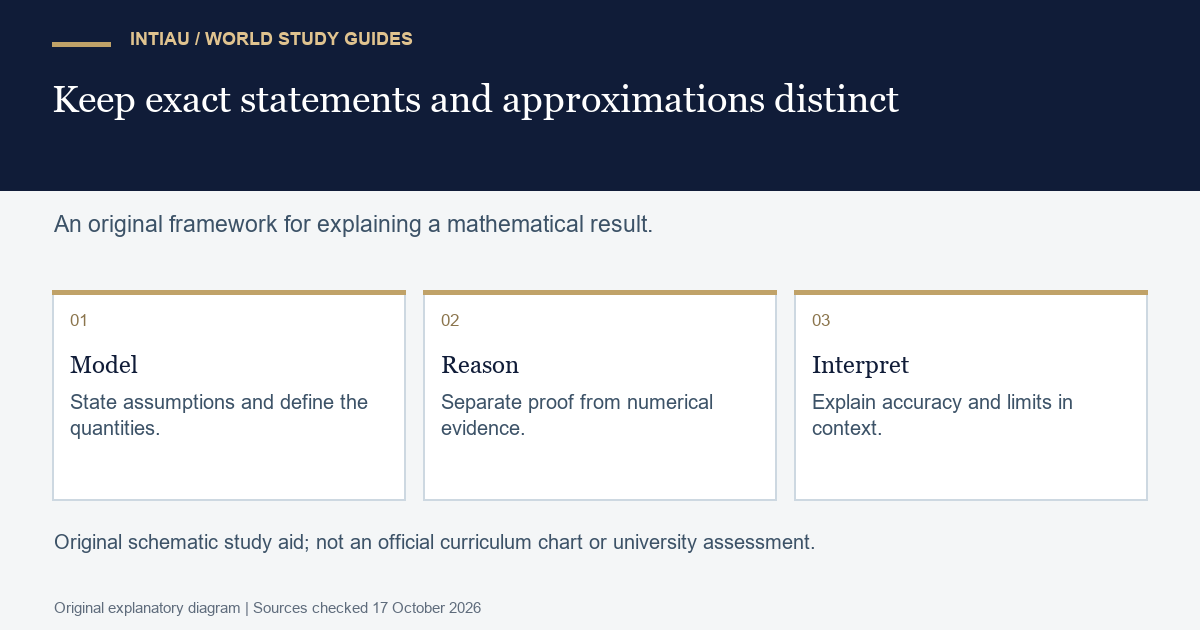
The distinction between analysis and numerical mathematics is particularly useful when comparing degree content. An exact statement may establish that a solution exists or has a particular property. A numerical method attempts to compute an approximation under stated conditions. A plausible decimal answer does not settle either question on its own.
In your comparison notes, select a problem and identify three layers: the mathematical formulation, the method used to investigate it and the interpretation of the result. A programme may develop all three through different modules. Reading only a software list would miss much of that intellectual structure.
A real module specifies more than calculation
The Analysis module’s learning outcomes include applying definitions and theorems, carrying out numerical and symbolic calculations, writing clear proofs and communicating mathematical content. Its topics include convergence, functions, differentiation and integration. Analysis 1 and Analysis 2 have separate lecture and exercise components within this module.
This is a substantive difference from a course description that merely names calculus. A proof explains why a statement follows under assumptions; an example illustrates a case. When reading a proof, record where each assumption is used. Then ask whether the conclusion would remain true if one assumption were removed. That question can reveal the purpose of a condition that initially looked like a technical detail.
For exercise-based learning, retain unsuccessful approaches in a short notebook. State why an approach failed rather than simply copying the final method. This can distinguish an algebraic error from a misunderstanding of the problem. It also makes discussion more productive because the point of uncertainty is visible.
Separate preparation from selection and admission
The programme page states that Technical Mathematics has no competitive entrance procedure. It instead requires completion of the Studien-VoR preparation and reflection phase before admission; the separately offered self-assessment is voluntary.
The winter 2026 instructions gave pre-registration from 1 April to 5 September 2026, now past. The preparation phase includes an online study-choice survey and an interactive introductory course. Completion is required, but a particular result is not. The page does not establish a 2027 schedule.
The university’s bachelor admissions navigation distinguishes Austrian or equivalent school certificates from international certificates. Follow the instructions for the qualification actually held.
These processes answer different questions. A preparation activity helps clarify the study choice; it does not replace qualification and language checks. Keep the curriculum edition separate from administrative dates, especially when planning after the published cycle’s deadlines.
Try an original approximation comparison
Suppose a fictional calculation approximates a quantity whose exact value is known to be 1. Two methods return 0.99 and 1.01. Their absolute errors are both 0.01. Averaging the results gives 1, but that cancellation does not prove that either method is generally accurate.
Change the input or the step size and examine whether the errors behave predictably. A result that happens to match one known case supplies a useful check, not a proof for all cases. This original paper example shows why an answer, an error estimate and a justification should be reported separately.
Questions about the route
Is Technical Mathematics an English-taught bachelor?
No. The programme’s stated teaching language is German.
Does the Analysis module include proof writing?
Yes. Clear mathematical proofs are an explicit learning outcome.
Does the preparation phase require a particular score?
No. Its completion, rather than a specified result, is required.
Compare subjects through INTIAU Courses, or use Contact for INTIAU information-service enquiries.
Related guides
View the study diagram