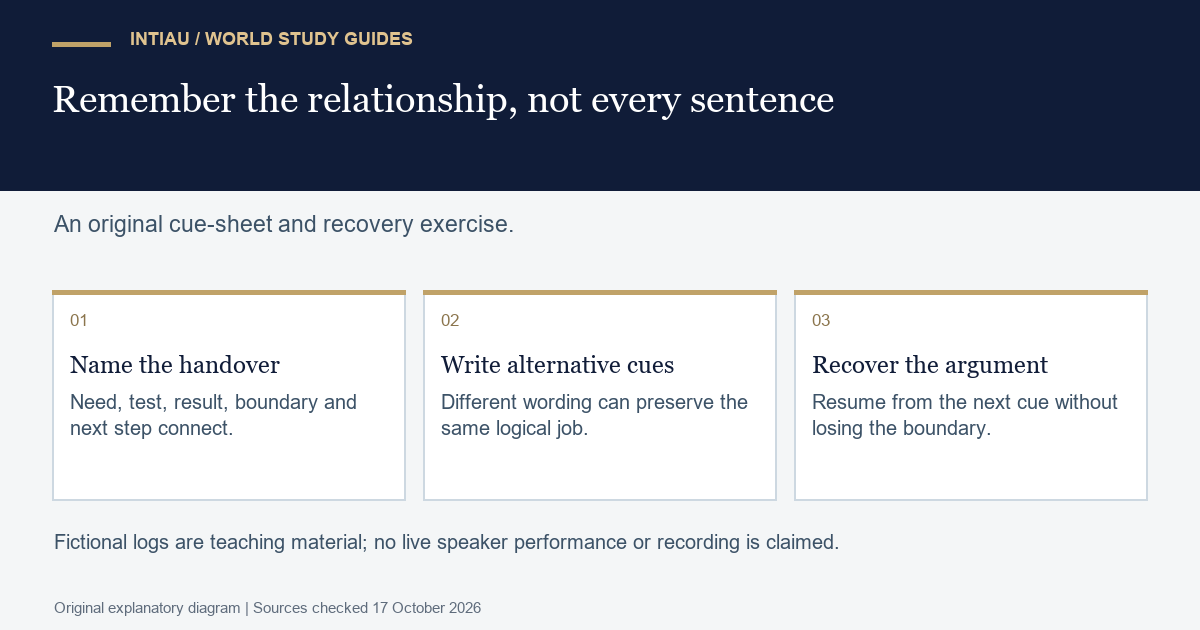
This self-study workshop builds transition cues that connect the parts of a talk without requiring a memorised script. You will identify the logical job of each handover, write alternative wording and use fictional rehearsal notes to decide what needs repair. The output is a compact cue sheet and a complete recovery plan.
Choose notes that support the speaker
The Newcastle University presentation guide discusses experimenting with different forms of notes and practising aloud. It recognises trade-offs among scripting, prompts and memorisation rather than prescribing one universal approach.
The original fictional talk concerns a model parcel sorter. Its four parts are need, test, result and next step. The supplied finding is that a revised label had fewer wrong-bin placements, but the revised-label tasks came later. The next step is a test with varied order. This workshop concerns the connections between those parts, not a new evaluation of the sorter.
Give each transition a logical job
| Handover | Relationship | Worked cue | Alternative wording |
|---|---|---|---|
| Need to test | The test addresses the stated problem. | Wrong bin → compare labels | “To examine that placement problem, we compared two labels.” |
| Test to result | The result answers the measured question. | First placement → count errors | “The measure was the first bin chosen; here is what we recorded.” |
| Result to boundary | The design limits attribution. | Later tasks → practice possibility | “The order matters when interpreting that difference.” |
| Boundary to next step | The next test addresses the unresolved explanation. | Vary order → test again | “We therefore need a comparison that changes the order as well.” |
Cover the last column and say, or silently compose, a different sentence from each cue. The words need not match the model. The relationship must: the test follows from the need, the result follows from the measure and the next step follows from the design boundary.
Use the complete worked sequence
A connected version is: “Wrong-bin placements interrupted the model task. To examine that problem, we compared the two label versions using the first bin chosen as the outcome. The revised-label tasks had fewer wrong first choices. That difference needs a boundary: every revised-label task occurred later, so practice remains an alternative explanation. Our next comparison will vary label order while retaining the same first-placement measure.”
This is a complete short sequence for the supplied talk skeleton. It does not include invented counts. It also does not require remembering the exact phrase “that difference needs a boundary.” You could say “the task order limits what we can infer” and retain the same function.
Read fictional rehearsal notes diagnostically
Three invented paper logs describe attempts at a longer version. Log A lasts 101 seconds and repeats the background before the result. Log B lasts 96 seconds and omits the order boundary. Log C lasts 89 seconds and includes all four handovers. These are illustrative records, not actual recordings or a claim that this article has been tested on speakers.
The answer is not simply “use the fastest attempt.” Log B is shorter than A but drops a necessary qualification. Repair A by replacing the repeated background with the test-to-result cue. Repair B by inserting the result-to-boundary cue before the next step. C supplies a promising structure, but its duration alone does not prove clarity for an audience.
For a recovery plan, imagine losing your place after describing the result. Look at the next cue, “later tasks,” and say: “Before drawing a conclusion, note that these tasks came later.” You have resumed the argument without restarting the talk or inventing a new result. Write a second recovery phrase for a missed opening: “The decision this test addresses is whether to investigate the revised label further.”
Score continuity, not identical wording
Use five checks: all four relationships are present; each cue identifies the next job; at least two alternative wordings are available; the order boundary survives; and the recovery sentence reconnects to the evidence. The model earns five. A word-perfect recital that omits the design boundary cannot earn the fourth point.
You may complete the check entirely on paper. If you choose private rehearsal, note the one thing to improve before repeating a whole talk. A focused transition revision is more observable than a vague instruction to sound more confident. No audience recruitment, recording upload or external coaching account is required.
Must I avoid a written script altogether?
No. The activity compares cues with complete wording and lets you choose a useful form of notes. Its outcome is preserved logic, not compliance with a rule against scripts.
Is the fastest fictional log automatically best?
No. The content checks come first. A shorter attempt that loses the order boundary gives the listener a less accurate argument.
Should I restart if one sentence is forgotten?
The worked recovery uses the next cue to resume the argument. It offers an alternative to restarting, without claiming that one strategy suits every speaker or setting.
This is original INTIAU editorial self-study practice; no qualification is awarded. Browse Courses or use Contact for editorial enquiries.
Related guides
View the study diagram