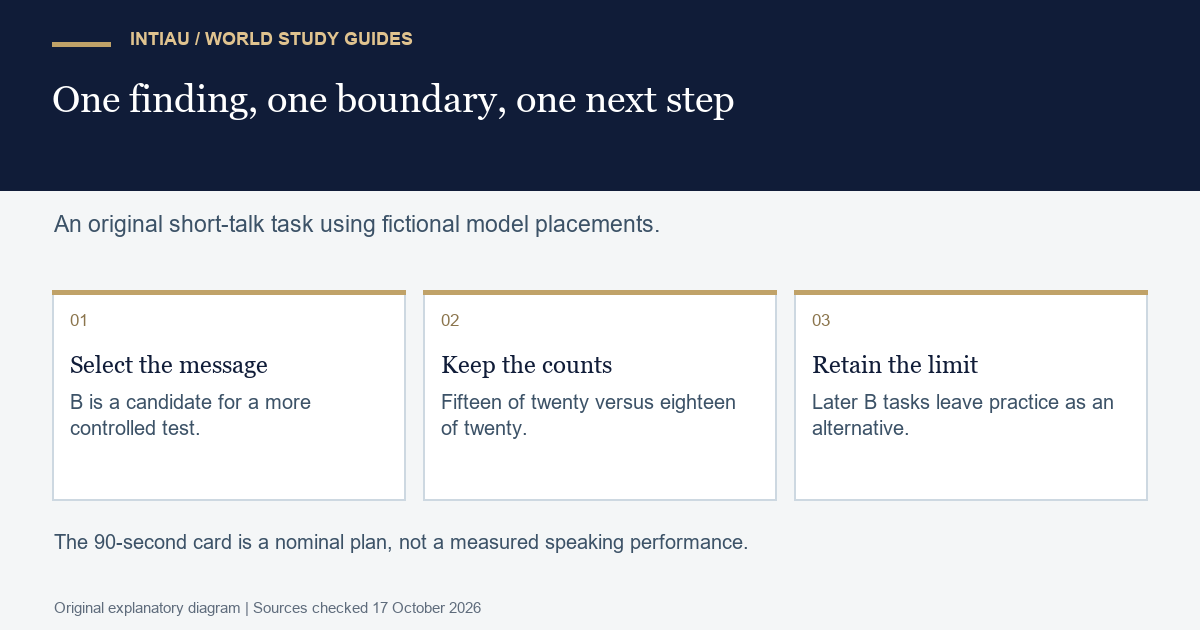
This self-study workshop compresses a fictional technical finding into a short, coherent talk. You will choose one message, keep the evidence needed to understand it and remove details that compete with it. The output is a complete model script and a 90-second planning card, ready for private rehearsal if you choose.
Choose the message before the slides
The MIT Nuclear Science and Engineering guide to presentation structure recommends identifying the audience, purpose and central message before building slides. It connects selected results to the message and the broader reason for presenting them.
Our original fictional experiment tests two labels on model component trays. Both sets contain twenty placement tasks. Label A produces fifteen correct first placements; label B produces eighteen. The B tasks all occur after the A tasks, so practice is not separated from label design. No cost or long-term performance was recorded. Your audience understands component trays but has not seen this test.
Build a 90-second planning card
| Part | Planned time | Job in the talk |
|---|---|---|
| Need | 15 seconds | Explain why first placement matters in the model task. |
| Comparison | 20 seconds | Name the two label sets and equal task counts. |
| Finding | 25 seconds | Report 15 of 20 versus 18 of 20. |
| Boundary | 20 seconds | Explain the fixed-order practice issue. |
| Next decision | 10 seconds | Recommend a counterbalanced follow-up, not immediate adoption. |
The times sum to 90 seconds. They are a planning allocation, not a measured delivery claim. Draft a one-sentence takeaway: “Label B had fewer first-placement errors in this model record, but the test order prevents a label-only explanation.” Everything you include should help a listener understand that statement.
Read the complete worked script
“A misplaced component interrupts the next step in our model assembly task. We tested whether a different tray label was worth investigating. Twenty placement tasks used label A, followed by twenty using label B. Fifteen A tasks and eighteen B tasks were correct on the first attempt. That is three more correct placements with B across equally sized task sets. The record makes B a candidate for further testing, but it does not establish that the label caused the difference. Every B task came later, so additional practice could also explain the improvement. We therefore propose another model test that varies the order of the labels and records the same first-placement outcome. The decision today is to test B more carefully, not to claim a proven improvement in real assembly work.”
The script contains the whole argument, including its limit. Its language stays close to the supplied measure. “Correct on the first attempt” is more precise than “better performance,” which could mean faster completion, fewer later corrections or lower cost. A listener should not have to guess which outcome was counted.
Cut material without losing the argument
A longer draft includes the colour of the cardboard trays, the order in which labels were printed and a description of the storage cupboard. None helps explain the supplied comparison. Cut those details first. Keep the task count and the order boundary, even if they seem less exciting than the improvement, because they determine what the result means.
For a one-card cue version, write five prompts: placement problem; A then B; 15 versus 18; practice alternative; vary order next. These are memory cues rather than replacement evidence. If the exact numbers disappear from your spoken version, the cue card needs a stronger numerical prompt.
If you rehearse privately, note the actual duration once and revise the allocation rather than claiming that the printed script automatically lasts 90 seconds. A slower explanation may need fewer words. Do not remove the design boundary solely to hit a target time; shorten the background first.
Score the short talk
Use five points: one clear takeaway, the two denominators, the three-placement difference, the practice boundary and a next decision consistent with the evidence. The model earns five. A talk that ends “adopt B everywhere” loses the decision point because the supplied record supports a further test, not universal deployment.
Is the 90-second budget a tested speaking duration?
No. It is a nominal plan for this activity. Actual delivery depends on pace and pauses; the article does not report a live rehearsal or a measured speaker performance.
Can I call the difference three percent?
No. Three additional correct placements out of twenty is a difference of fifteen percentage points. The model keeps the counts to make the comparison easy to follow.
Must I create a slide deck?
No. The complete script and cue card are enough to practise the skill. A deck would be an optional aid, not the required outcome.
This is original INTIAU editorial self-study practice; no qualification is awarded. Use Courses for general study navigation and Contact for editorial enquiries.
Related guides
View the study diagram