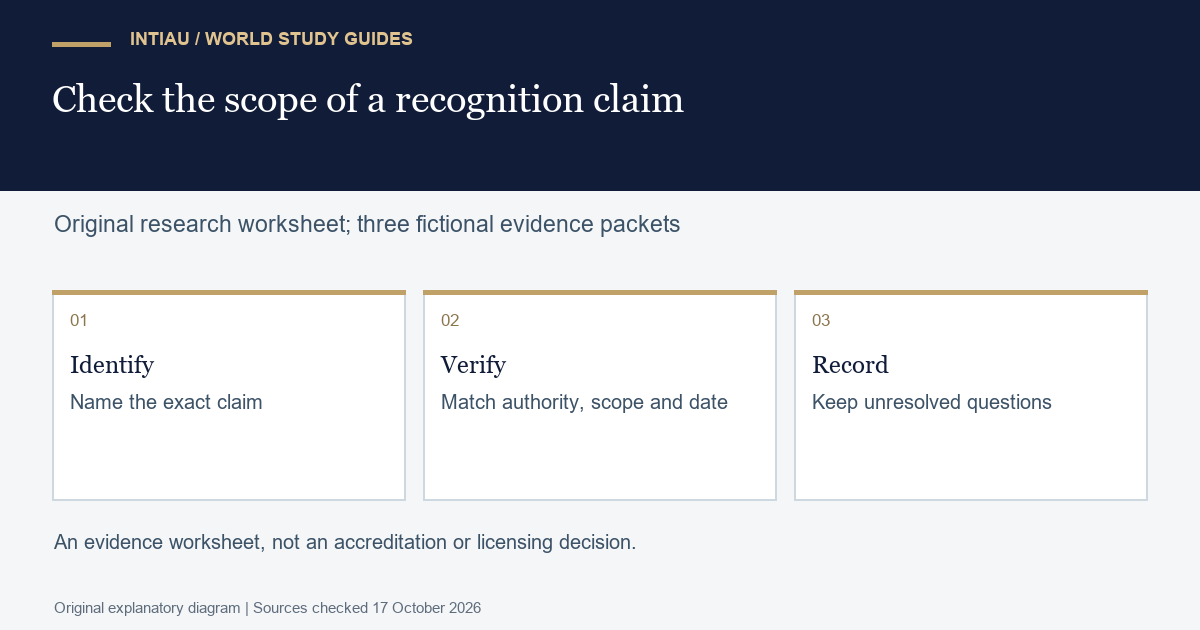
This self-guided recognition-research workshop is an original educational activity, not an INTIAU accreditation service, institutional-status determination or professional licensing decision.
Your output is a worksheet that states exactly which claim a source supports. The task is narrower than ranking universities or assembling a general shortlist. You will separate the identity of a provider, authority to award a qualification, programme accreditation and the requirements of a particular profession, while preserving gaps that need an authorised answer.
Start with the jurisdiction and claim
The U.S. Department of Education’s accreditation resources distinguish institutional and programmatic accrediting agencies and provide access to reported institution/programme records. These are U.S. resources, not a universal worldwide approval system.
For the UK, GOV.UK guidance explains that the institution awarding a degree may differ from the college teaching it; the verification route depends on where the degree is studied.
ABET describes its accreditation as programme-specific, rather than accreditation of an entire institution, and explains that accreditation is renewed periodically.
These examples demonstrate why a single “recognised” box is too crude. Write the country or territory, the exact assertion and the authority responsible for that assertion before searching. Do not transfer a term from one jurisdiction to another merely because the English wording looks familiar.
Create a claim-by-claim worksheet
| Claim being checked | Evidence to locate | Boundary to preserve |
|---|---|---|
| Provider identity | Exact legal name, location and authoritative record identifier | A similar brand name is not an exact match |
| Awarding authority | Relevant jurisdiction’s current awarding-body evidence | Teaching a course and awarding its qualification are separate questions |
| Programme accreditation | Accreditor’s record for the named programme, scope and dates | Do not extend a programme finding to every course or campus |
| Professional purpose | Requirements of the profession and intended jurisdiction | An academic-status entry alone does not settle this separate question |
Add a source address, access date and a short note identifying the exact part of the record you used. Keep the source’s status wording separate from your interpretation. An empty result should be recorded as a search gap until you establish whether the right authority, spelling, dates and scope were used.
Audit three fictional evidence packets
Packet A contains a brochure for “Fictional Provider F” claiming international accreditation but naming no agency or programme. Record the claim as unverified. Your next question asks for the accreditor’s identity and an independently accessible record. Do not label the provider fraudulent simply because the packet is incomplete; that conclusion goes beyond the evidence supplied.
Packet B contains an authority’s fictional institution record matching the legal name, but no information about the particular programme accreditation being advertised. Mark the identity finding and programme gap separately. A verified answer to the first question cannot silently become an answer to the second. Write what additional record would resolve the programme claim.
Packet C contains an invented programme listing covering Campus X from 2019 to 2024, while the learner is investigating a 2027 start. Record a historical match and a current-date gap. Search for a renewal or ask the responsible authority about the relevant intake. Do not rewrite an expired date range as a current guarantee.
Resolve contradictions without inventing certainty
If a brochure and an authority record appear inconsistent, record both dates and both claims. Check whether they refer to the same awarding body, programme version, campus, delivery mode and time period. A renamed institution or a newly introduced route might require a more specific question. Preserve that uncertainty until the responsible body explains it.
Use three working outcomes: supported within the stated scope, unresolved, and contradicted by a specified current record. These are labels for your research notes, not official findings issued by this workshop. Attach the reason for each label so another reader can reproduce your reasoning and see where it stops.
Write the final research note
Produce a one-page summary with the precise question, the authoritative sources checked, the scope each one covers and the remaining enquiry. Finish with a bounded sentence: “This record supports this named claim for this stated scope and period.” If you cannot complete that sentence without adding assumptions, keep the item unresolved.
Keep admissions, credit transfer, employment acceptance and professional licensing as separate decisions. When investigating a real case, direct the unresolved question to the institution, authority or professional regulator responsible for it. This exercise does not determine the status of INTIAU or any named university.
Frequently asked questions
Does one programme record cover the entire institution?
Not for ABET: it accredits programmes rather than institutions. Keep the exact scope of the record.
Does a missing search result prove lack of recognition?
No. Record the gap, verify the search scope and ask the responsible authority before drawing a broader conclusion.
Can this worksheet certify a university’s status?
No. It organises evidence and unanswered questions; the relevant authorities make their own determinations.
Browse INTIAU’s own Courses, or use Contact for questions about INTIAU provision.
Related guides
View the workshop diagram