Aix-Marseille Université is a French institution separate from INTIAU. Its Licence Chimie begins through the Marie Curie or Louis Pasteur scientific portal before later-year chemistry study and named pathways.
The faculty distinguishes teaching sites: Aix-en-Provence is listed for L2, while Marseille Luminy and Saint-Jérôme cover L2 and L3 arrangements. Confirm the exact pathway and venue. The pages checked here did not establish a programme-wide teaching-language statement; obtain that confirmation and applicable language-evidence requirements from the faculty before applying.
A chemistry comparison should connect a numerical result with the reasoning that makes it meaningful. A calculated value, a measurement and a conclusion about a substance are different things. Start with a question you can state clearly, then ask which theoretical and experimental components would help you answer it. Do not mistake an impressive list of techniques for evidence that you understand their assumptions.
Read the pathway and its component boundaries
The Chimie pathway page organises the later study into communication, fundamental knowledge and experimental-method blocks.
| Stage | Published emphasis |
|---|---|
| L1 | Scientific portal |
| L2 | General chemistry foundations and scientific-discovery project |
| L3 Chimie | Further theoretical and experimental chemistry, with thematic choices |
Découverte du monde scientifique, DEMOS, is a real tutored project component identified in L2. The page names it without supplying a complete assessment outline. That limited project description should not be expanded into invented laboratory exercises, hours or grading rules.
In a personal comparison sheet, distinguish communication about a result from the process used to obtain it. A well-written report can contain a flawed inference, while a correct calculation can be too poorly documented for someone else to check. Read the official requirements with both questions in mind, and record where further module-level information is still needed.
Worked exercise: recover a value from a fictional signal
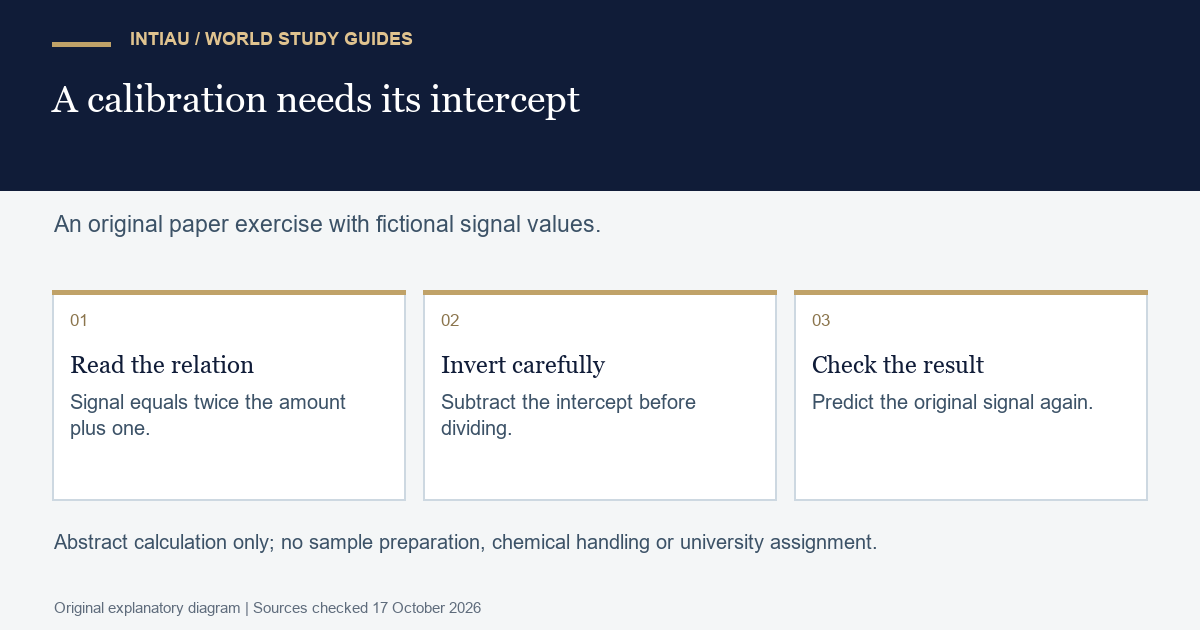
This original exercise uses abstract numbers only. Three fictional reference points pair an amount with a signal: zero gives one, two gives five, and four gives nine. Assume that the relation is linear across this range. Find the relation and calculate the amount corresponding to a signal of seven. No chemical, sample or equipment is involved.
The signal rises by four when the amount rises by two, so the slope is two signal units per amount unit. The zero-amount signal is one, making the relation signal equals two times amount plus one. To invert it, subtract one from the signal and divide the remainder by two.
For a signal of seven, the inferred amount is seven minus one, divided by two, or three. Check the result by predicting the signal: two times three plus one equals seven. A reverse check is useful because it can reveal an omitted intercept or a mistaken division before the number is used in a longer argument.
If someone simply divides seven by two, the answer becomes 3.5. That ignores the baseline signal of one. Compared with the model answer of three, the difference is 0.5, about 16.7% of three. Extra decimal places would not correct the underlying mistake; the relation itself must be read correctly.
Now consider a signal of thirteen. The same algebra gives six, but six lies beyond the reference amounts zero to four. That is an extrapolation. The calculation remains algebraically valid under the assumed line, while the supplied reference points do not establish that the line continues there. Label the distinction instead of silently presenting six as equally supported by the fictional calibration range.
Next suppose the observed signal were written as seven plus or minus 0.2, with the same exact model relation. The corresponding amount interval would run from 2.9 to 3.1. This interval propagates only the stipulated signal range; it does not include uncertainty in the slope, intercept or reference values. State that scope before treating it as a complete uncertainty account.
Prepare a small worksheet with the reference pairs, relation, inversion, reverse check and extrapolation flag. End with one sentence about what the numbers establish and another about what they do not. This offers a concrete way to test your interest in quantitative interpretation while keeping real experimental work within the university’s supervised teaching.
Choose the correct applicant route
The faculty application page separates L1 portals from L2/L3 routes and says the correct procedure depends on the applicant’s situation. Use its relevant branch and current instructions. This guide was checked on 17 October 2026 and supplies no confirmed 2027 deadline.
Keep qualification recognition, entry level, teaching language and course interests on separate checklist lines. The existence of later chemistry options does not establish eligibility to enter that year directly. Save the applicable cycle instructions before preparing final documents, rather than carrying forward another student’s timetable or an undated summary.
Three chemistry questions
Does every listed site offer the same years?
No. The faculty distinguishes Aix L2 from later-year arrangements at the Marseille sites.
Is DEMOS presented here as a complete reproduced syllabus?
No. The source identifies a tutored scientific-discovery project, with no full assessment outline verified here.
Can the fictional signal be divided by the slope alone?
No. Subtract the stated intercept first: seven minus one, divided by two, equals three.
For INTIAU information, use Courses or Contact.
Related guides
View the study diagram