
Cornell University offers the Bachelor of Science in Food Science through its College of Agriculture and Life Sciences; this independent guide describes Cornell study, not an INTIAU award or partnership. Department overview.
A food-science comparison should distinguish a product preference from an explanation for that preference. Someone may like a sample without knowing whether flavour, texture, appearance or expectation shaped the response. The useful preparation is learning to define the question, identify competing explanations and avoid claiming that a small observation proves more than it does.
Separate applicant route from course planning
CALS first-year applicants apply directly to a major. Its current page addresses students completing school in 2026-2027 and identifies calculus as required preparation for Food Science. First-year guidance.
The major page separately labels transfer requirements for Fall 2027, with different sophomore and junior lists. Do not substitute those lists for first-year entry preparation. Major and transfer guidance.
Checked on 17 October 2026, those admission labels do not establish a complete application checklist here. Match the instructions to your intended entry term and academic history. Preserve distinctions between a current programme overview, a course example and an individual schedule; they answer different questions and should not be collapsed into one promise of admission or completion.
A selected progression and course map
| Study layer | Published examples | Question to carry forward |
|---|---|---|
| Earlier foundations | Mathematics, chemistry, biology, physics and introductory food science | What measurement supports the explanation? |
| Later application | Processing, storage, distribution, sensory evaluation and safety | Which variables interact? |
| Selected laboratory | FDSC 3950 Food Microbiology Laboratory: testing and control methods | What makes evidence trustworthy? |
| Selected analytical course | FDSC 4100 Sensory Evaluation of Food: sensory methods and statistical analysis | Could presentation influence a response? |
The department describes Science, Business and Safety choices within the major. The early foundation and later application distinction is a broad programme outline, not a semester-by-semester audit.
Worked exercise: plan a fictional comparison
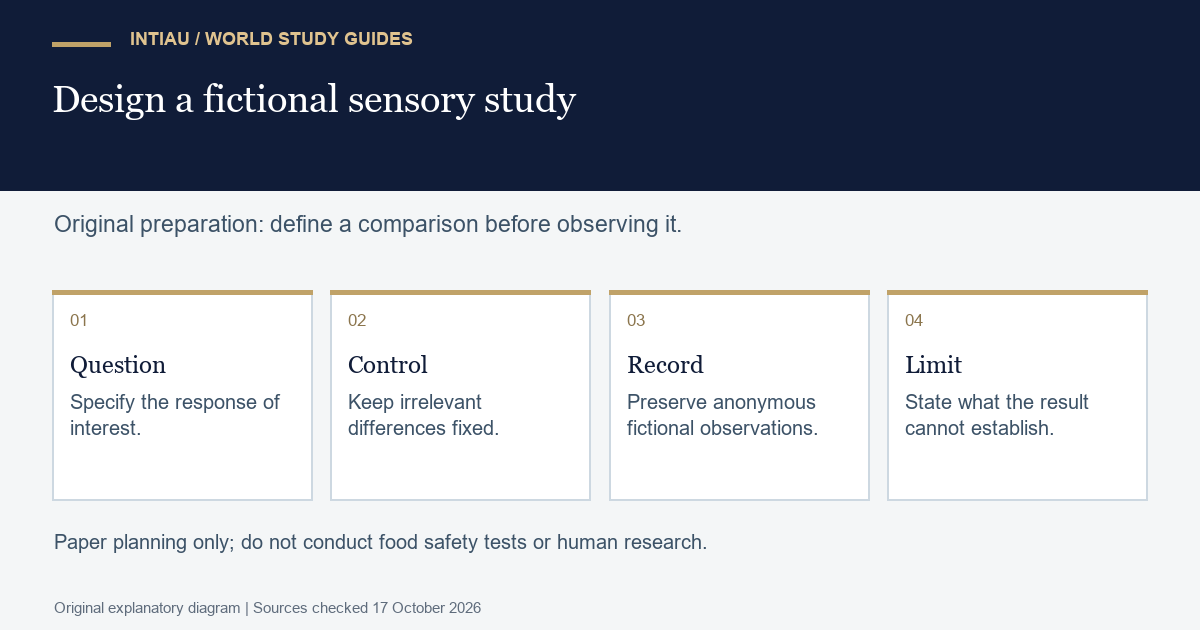
Do this entirely on paper, using invented data rather than tasting products or recruiting people. Imagine comparing the texture of two fictional crackers, A and B. Write a single question: which sample receives the higher crunchiness score under a specified imagined procedure? Avoid combining crunchiness, healthfulness and overall preference into one response, since they are different questions.
Assign fictional scores from one to five for four invented observations. Let A receive three, four, three and two; let B receive four, three, four and five. Their means are three and four respectively. Show the sums before dividing. These invented means illustrate bookkeeping only; they provide no evidence about an actual product or population.
Now identify a possible presentation effect. Suppose all imagined observers see A first and B second. You cannot tell whether the sequence influenced the comparison. Sketch an alternative plan that reverses order for half of the fictional observations. Add neutral sample codes and a consistent serving description to your paper design, but do not call the revised plan a validated research protocol.
Write an interpretation in two parts. First, report exactly what the invented numbers show. Second, explain what remains unknown: sampling, variation between observations, order effects and whether the chosen scale answers the original question. A difference in these four fictional scores cannot establish nutritional value, safety or a general preference.
Finish with a revision: if your actual interest is crispness after storage, replace the original question with that narrower comparison and list the additional variables you would need to control. This final step matters because a better question can be more useful than a more elaborate calculation performed on the wrong question.
Build an evidence folder for advice
Keep the exercise, a short explanation of your mathematical preparation and the source edition together. When examining previous coursework, record the laboratory component separately from the lecture title. A familiar subject label alone does not show the depth of practical work, the assessment method or whether a receiving programme would accept it.
For admissions, write down whether you are a first-year or transfer applicant before collecting requirements. Record unresolved questions as questions, with links and dates, rather than interpreting a sample course as an entry condition. This makes an eventual conversation with university staff much more precise.
Frequently asked questions
Are first-year and transfer requirements interchangeable?
No. The major page has separately labelled Fall 2027 transfer lists, including different requirements for sophomore and junior entry.
Is sensory evaluation an actual course example?
Yes. The major page lists FDSC 4100 and describes sensory methods and statistical analysis.
Should I carry out the fictional study?
No. Keep it as a paper exercise with invented observations. It is not human-subject research, a food-safety test or university assessment.
View the study diagram
Official sources
For other independent study comparisons, see INTIAU Courses; general enquiries can use Contact. The named university decides its own admissions and academic requirements.