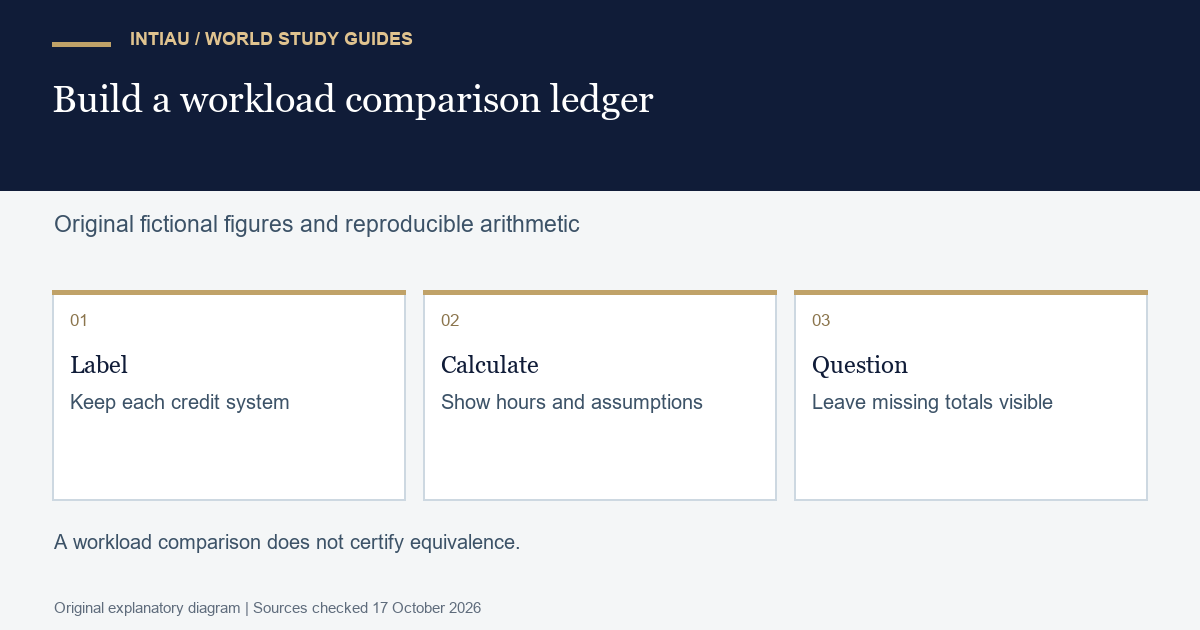
This self-guided credit-and-workload workshop is an original evidence exercise, not a scheduled INTIAU class, credit award or decision that two modules are equivalent.
Its narrow purpose is to build a ledger that keeps credit labels, estimated total work and contact time separate. You will calculate two fictional examples, expose a missing denominator and write a focused recognition question. This differs from drawing a general curriculum map: the task here is to prevent an apparently simple numerical comparison from hiding missing information.
Label the system before doing arithmetic
The European Commission’s ECTS overview connects credits with learning outcomes and workload; a full academic year corresponds to 60 ECTS.
QAA’s 2021 credit framework for England describes one credit as typically ten notional learning hours. Those hours can include classes, independent study and assessment. The framework leaves acceptance of credit to the receiving awarding body.
These statements describe their respective frameworks. They are not permission to treat every institutional point, teaching hour or credit label as interchangeable. Start a ledger with the source’s own unit name. Add the document year, module level, total workload statement and the distinction between required and estimated time. Leave an empty field visible when the source supplies no answer.
Use the fictional documents
| Case | Credit label | Information supplied | Permitted calculation |
|---|---|---|---|
| A | 6 ECTS | 168 estimated total learning hours | 168 ÷ 6 = 28 hours per stated credit |
| B | 15 local units | 150 estimated total learning hours | 150 ÷ 15 = 10 hours per stated unit |
| C | 3 local credits | 30 contact hours; total work unstated | Total hours per credit remains unknown |
The numbers are deliberately supplied as part of the exercise. Case A does not establish a universal ECTS hourly rate, and case B does not identify its local units with English credits merely because the arithmetic produces ten. Record the provenance of the supplied totals before recording the division. A tidy calculation cannot authenticate the input.
Calculate a weekly planning scenario
For another fictional assumption, spread A’s 168 hours over fourteen study weeks. The average is twelve hours per week. Spread B’s 150 hours over ten weeks and the average becomes fifteen hours. B has the lower total but the higher weekly average in this scenario. Write both the result and the assumed number of weeks; otherwise a reader cannot reproduce the comparison.
Now vary A’s schedule to twelve weeks without changing its total. Its average becomes fourteen hours. Notice what changed: the planning scenario, not the credit value or the module’s academic level. Add a warning beside the average that actual work may cluster around assessments. This is your own planning observation, not a prediction of an individual’s study speed.
Do not fill the missing denominator
Case C is the main trap. Thirty contact hours do not tell you how much reading, preparation or assessment work the fictional module requires. Do not divide thirty by three and relabel the result “total workload”. Your ledger should preserve the difference between a known contact-time ratio and an unknown total-work ratio. Write the exact missing question instead.
Before comparing recognition, add separate columns for outcomes, level, assessed work and receiving-programme fit. Put “not supplied” in these columns for all three cases. None of our arithmetic establishes that A can replace B, that either meets C’s outcomes or that an institution will accept a transfer. The result is a better question, not a conversion certificate.
Produce an auditable enquiry
Your final sheet should contain the original figures, the source label, the calculation, the assumptions and the unresolved fields. Draft an enquiry such as: “For this module and entry year, where is total estimated learning time published, and what evidence is required for an individual credit-recognition assessment?” Keep actual transcripts and personal identifiers out of a public comparison sheet.
Ask another reader to reproduce both weekly calculations and explain why C remains incomplete. If they cannot distinguish a supplied figure from an assumption, revise the ledger headings. Keep the record of that correction as part of the workshop output.
Frequently asked questions
Does the ratio prove that A and B are equivalent?
No. Our figures support arithmetic about the fictional workload statements, not an academic or institutional recognition decision.
Can I turn C’s contact hours into total study time?
Not from the supplied information. Record contact time and the missing total separately; request the relevant official description.
Should an unknown field be entered as zero?
No. Zero is a value. “Unknown” records a gap and keeps a later calculation from implying that no work is required.
For INTIAU subject information, visit Courses. Questions about INTIAU’s own provision can go through Contact.
Related guides
View the workshop diagram