Universidad de Guadalajara lists Licenciatura en Ciencia de los Alimentos at CUCBA, Mexico. This independent guide concerns that food-science route, not an INTIAU award or partnership. It should not be confused with a different campus’s food-engineering or nutrition programme.
A plan organised by formation areas
The CUCBA PDF identifies decision I/2019/2098 and a minimum 387 credits. Its areas comprise common foundations, compulsory subject foundations, compulsory specialisation, selected specialisation and open options. These categories establish a structure; they are not a newly verified semester-by-semester 2027 timetable. Read the complete published plan.
| Plan area | Selected actual entries, translated |
|---|---|
| Common foundations | Chemistry; Biochemistry; Cell Biology; Mathematics I; Statistics I |
| Subject foundations | Food Microbiology I; Food Biochemistry; Food Toxicology I; Food Regulation |
| Compulsory specialisation | Food Biotechnology; Animal and Plant Food Technologies; Quality and Safety Management |
| Integration | Integration Projects I–II; Sensory Evaluation |
The prerequisite listing makes several connections explicit: Chemistry precedes Biochemistry, which precedes Cell Biology; Mathematics I precedes Statistics I; Experimental Designs in Food Science requires Statistics I. These links are more informative than an unordered list of subjects.
Use that progression to judge your preparation. If a practical result varies, can you ask whether the variation comes from the material, the measurement or the study design? If a product description sounds appealing, can you identify which claim needs chemical, microbiological, statistical or social evidence? Writing those distinctions in your own words can help you compare this programme with a course focused primarily on cooking or nutrition.
Real named units, with an honest outline boundary
The plan lists Evaluación Sensorial as six credits, with 40 theory and 20 practical hours. It separately lists professional practice and an integration sequence. However, a detailed current CUCBA sensory-evaluation syllabus was not publicly verified here. A similarly named outline from CUCSUR, CUCEA or another degree would not establish this programme’s learning tasks.
The official programme purpose connects food science and technology with processes, product development, investigation and quality-system assurance. It is broader than a single laboratory technique. The reviewed sources support these programme-level themes, while leaving the selected sensory unit’s precise assessment and weekly content unverified.
When requesting the missing module guide, ask for the edition, learning outcomes and assessed work for this exact degree. Meanwhile, keep your own interpretation clearly separate. For example, comparing a preference result with a safety result is a useful study question, but it is not evidence that this particular unit uses the exercise below.
Admission evidence must match the campus
An official UdeG 2027-A calendar reproduced by CUCosta gives initial registration from 1 to 30 September 2026 and an admission examination on 7 November. Registration is already past on 17 October. That university calendar is useful context, but a CUCosta notice does not establish CUCBA Food Science’s available intake, places or any additional requirements. Confirm those with CUCBA and Control Escolar before relying on a campus choice.
This guide therefore does not announce an open CUCBA application window. Keep the degree name, centre and intended entry period together when checking the official record. A future test date and a programme’s continuing curriculum page answer different questions; neither alone proves that a new application can be lodged today.
Original exercise: identify what was actually measured
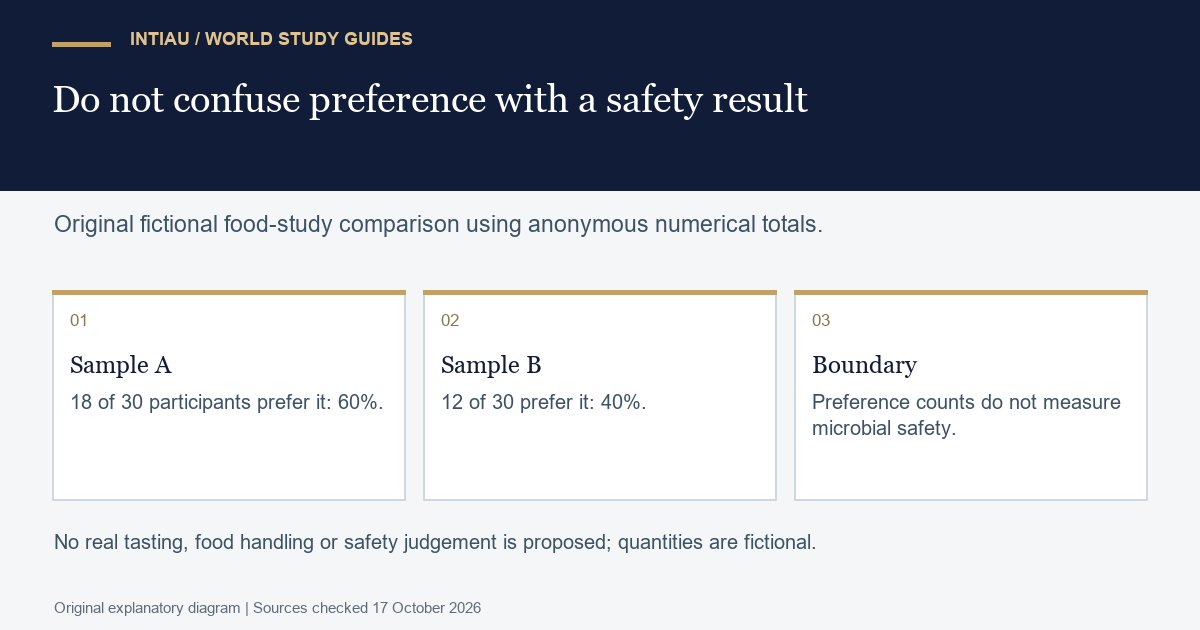
Use a fictional preference comparison with 30 anonymous responses. Eighteen prefer Sample A and twelve prefer Sample B. A has 60 percent of the preferences and B has 40 percent. Describe that result using the stated sample size; do not replace “participants in this example” with “all consumers.”
Now examine the statement “A is safer because more people prefer it.” No safety measurement appears in the record, so that conclusion is unsupported. List the separate evidence a real safety question would require without inventing its results. Then note that changing the participants or the presentation order could change the preference result. This is an original reasoning exercise using invented counts, not a tasting activity, food-handling instruction or Guadalajara assessment.
Questions to settle
Which university centre is covered?
CUCBA, the centre named in the university’s programme guide.
Was a complete current sensory syllabus inspected?
No. The verified evidence establishes the named unit and its plan allocation, not a complete current outline.
Does another campus’s calendar prove a CUCBA place?
No. Programme availability and any additional conditions need CUCBA-specific confirmation.
Official reading
- Programme identity and purpose (published guide)
- Full study plan (2019 decision)
- Course and prerequisite listing (published plan listing)
- University entry calendar example (2027-A; CUCosta publication)
For other study topics, browse INTIAU Courses; use Contact for questions about INTIAU services. University applications belong with the institution named above.
Related guides
View the study diagram