Hanyang University is a separate institution; its Seoul Civil and Environmental Engineering undergraduate programme is not an INTIAU programme or partnership. The department combines infrastructure, digital construction, and environmental questions. Its address is on the Seoul campus, which matters when matching an admissions guide to a curriculum: an ERICA programme with a similar name is not evidence for this route.
Keep the award boundary and curriculum edition visible
The exact current Seoul degree-certificate title was not established from the sources checked here. This guide therefore uses the department’s undergraduate programme name, without assigning it a guessed BSc or BEng label. Ask the department for the current award designation if a receiving institution needs that exact wording.
The department’s graduation requirements specify 130 credits for the class of 2024 under the 2024–2027 curriculum. They also require completion of prescribed courses, a graduation thesis evaluation and at least five English-taught courses. Those English-course requirements do not make the whole degree English-taught. Transfer students can have different requirements. The department directs enrolled students to check their personal graduation status before registration.
Follow the four-year study map
The published 2024–2027 undergraduate curriculum runs from year one to year four. These selected entries show increasing specialisation, rather than every course that must fit into a semester.
| Year | Examples actually listed | Comparison question |
|---|---|---|
| 1 | Calculus 1; Introduction to Engineering Design | Can you explain a model as well as calculate it? |
| 2 | Mechanics of Materials; Water Environment Engineering | Which quantities would you measure? |
| 3 | Soil Mechanics & Lab.; Hydrology | How might uncertainty affect an interpretation? |
| 4 | Digital Construction; Capstone Design1 and 2 | What evidence would justify a design choice? |
For a precise course reference, CIE3020, Water Environment Engineering, is listed in year two, semester two, for three credits and three lecture hours. A current weekly syllabus and its assessment themes were not accessible in this review. The table supports the course’s place and format, not an invented list of laboratory exercises. The department warns that the curriculum can be adjusted.
Distinguish language readiness from admission
The Spring 2027 international admission guide, pages 7–16, lists this Seoul unit without an English-track marker. Its Korean standards include TOPIK/TOPIK iBT level 4 or Hanyang IIE academic level 4. Selection and language readiness are separate: accepted Korean-track students lacking the language requirement take leave to study Korean before starting the degree.
As checked on 17 October 2026, the guide’s online window, 1–18 September 2026, and document deadline, 30 September, were already past. The freshman route requires foreign nationality for the applicant and both parents, subject to detailed nationality conditions, and high-school graduation or expected graduation. Read the complete eligibility section for your circumstances; the dates above do not advertise a still-open application.
Connect courses with research without confusing them
The department’s Environment and Energy research overview describes biological treatment, membrane separation, trace contaminants, resource recovery and resilience of water infrastructure. These are research themes, not a substitute syllabus for CIE3020. They help formulate a focused question: would you rather investigate contaminant removal, infrastructure performance, or the recovery of resources from waste? Selecting a research interest does not establish access to a particular laboratory.
The undergraduate educational objectives emphasise practical education, communication and sharing knowledge in civil engineering. A useful comparison should therefore consider how you explain decisions, not just how many technical course titles appear. When discussing a project, distinguish the measured observation, the calculation made from it and the judgment that follows. This reading approach relates to the stated educational aims; it is not a claim about an unverified assessment rubric.
Worked exercise: compare two fictional water readings
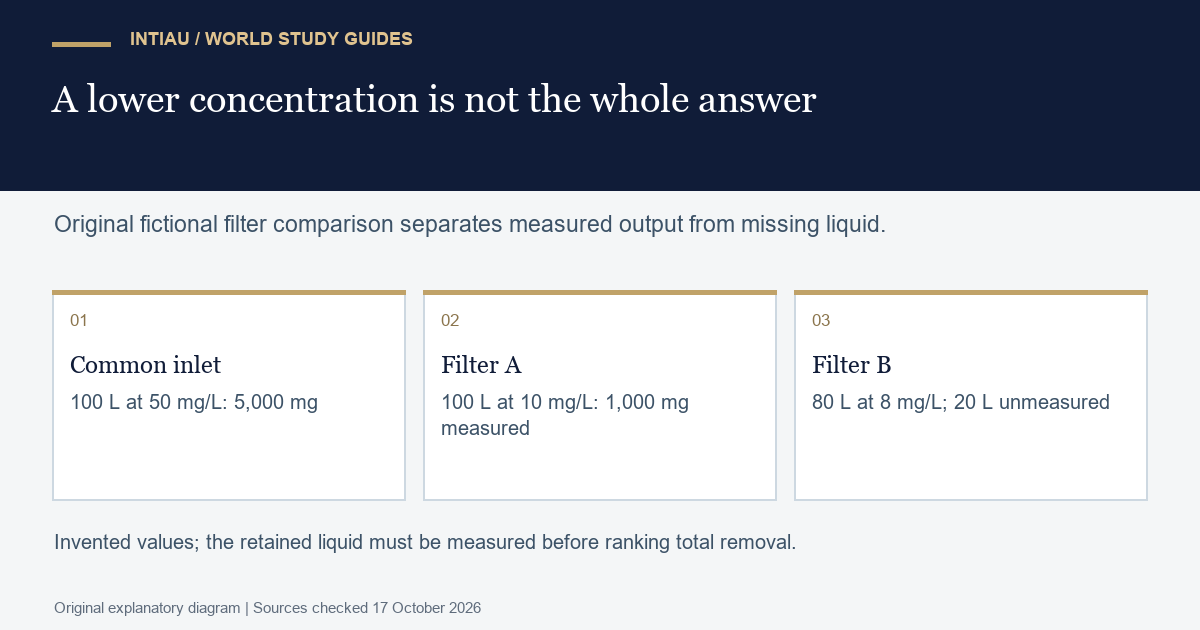
Two imaginary filters receive identical 100-litre batches containing 50 milligrams per litre of a marker. Filter A discharges 100 litres at 10 milligrams per litre; B discharges 80 litres at 8 milligrams per litre and retains 20 litres of unmeasured liquid. Which filter has the better demonstrated removal? Use only these fictional values.
The inlet contains 5,000 milligrams. A’s measured outlet contains 1,000, so 4,000 milligrams, or 80%, is absent from that outlet. B’s measured outlet contains 640 milligrams, but the retained liquid is unknown. A claim of 87.2% removal for B silently treats the unmeasured 20 litres as marker-free and ignores other destinations. The defensible answer is that the evidence does not rank total removal. Request the retained liquid’s concentration and identify any solid residue. Hand in a labelled inventory and the missing measurement, not a confident winner. This is an original reasoning task, not a Hanyang laboratory procedure.
Frequently asked questions
Is this an advertised English-track entry?
No. This unit is not marked as an English track in the reviewed Spring 2027 guide.
Is an internship the only listed practical option?
No. The requirements allow substitution by Civil and Environmental Engineering Capstone Design I or II.
Can the lower measured concentration alone rank the filters?
No. Compare total quantities and account for the unmeasured liquid before judging the fictional systems.
Explore other study topics through INTIAU Courses, or use INTIAU Contact for INTIAU’s own information.
Related guides
View the study diagram