The University of Hyderabad offers integrated master’s study after school-level education through its College for Integrated Studies. This independent guide concerns its Biology route, not an INTIAU degree or partnership.
Enter Biology before choosing a later specialisation
The 2026-27 prospectus identifies the five-year Integrated MSc in Biology as a ten-semester NEP programme. Students branch into named life-science specialisations in the third year, including Systems and Computational Biology. It is therefore misleading to treat an older “Integrated Systems Biology” heading as a separate current first-year admission promise. The reviewed prospectus gives 220 minimum credits for this integrated programme. Read the current prospectus.
The department’s undated programmes page still uses the older Integrated MSc Systems Biology wording and describes an interdisciplinary approach to complex molecular systems and high-throughput data. It also lists a separate two-year MSc with a postgraduate admission route. Keep those descriptions distinct from the current integrated undergraduate-entry route; they are not interchangeable applications.
A selected path from foundations to research
| Stage or source | Actual documented component | How to read it |
|---|---|---|
| Posted CIS outline | Introductory Biology; Structure and Function of Macromolecules | Named foundation examples, not a new timetable |
| Third year | Branching into the named Biology specialisations | Later academic pathway |
| Years 3–5 | Two-credit internships by the ends of years 3 and 4; project in semesters 8–10 | Current prospectus requirements |
The College’s source page distinguishes newer NEP course-structure and outline links from older structures and timetables. The mix of editions matters: a surviving subject code does not establish that every detail of an older table applies to a 2026 entrant.
Build a pathway sheet with three separate columns: common preparation, specialisation decision, and supervised research. Then write the questions each stage should help you answer. For example, a foundation course may help you describe a process, while a later project asks you to formulate a question and justify evidence. Keeping those purposes separate makes the curriculum easier to compare.
A real biology outline: molecules and mechanisms
The posted CIS outline describes SB151 Introductory Biology through enzymes and energy, cell-cycle regulation, inheritance, plant responses and animal homeostasis. Structure and Function of Macromolecules develops carbohydrate, protein, nucleic-acid and lipid structure, including protein folding and membrane-related functions. The same file identifies Foundation Biology as a bridge for mathematics-background students. These are real teaching themes, with the file’s own older codes and semester labels; this guide does not claim a complete current specialisation syllabus. Read the selected course outlines.
When preparing, practise explaining a mechanism with a labelled sketch and a short causal chain. Keep the observation separate from the explanation you propose for it. Learning the name of a molecule is useful, but a stronger note explains how its structure relates to a process and what evidence might challenge that explanation.
Read the correct admission notice
The university’s 2026 integrated-programme notice invites applications from candidates who took CUET UG 2026 and includes the five-year Biology route. That is the undergraduate-entry notice to read alongside the prospectus, rather than the department’s postgraduate CUET instructions. This check is dated 17 October 2026; no future application window, cut-off or guaranteed specialisation allocation is announced here.
Original practice: counts and proportions
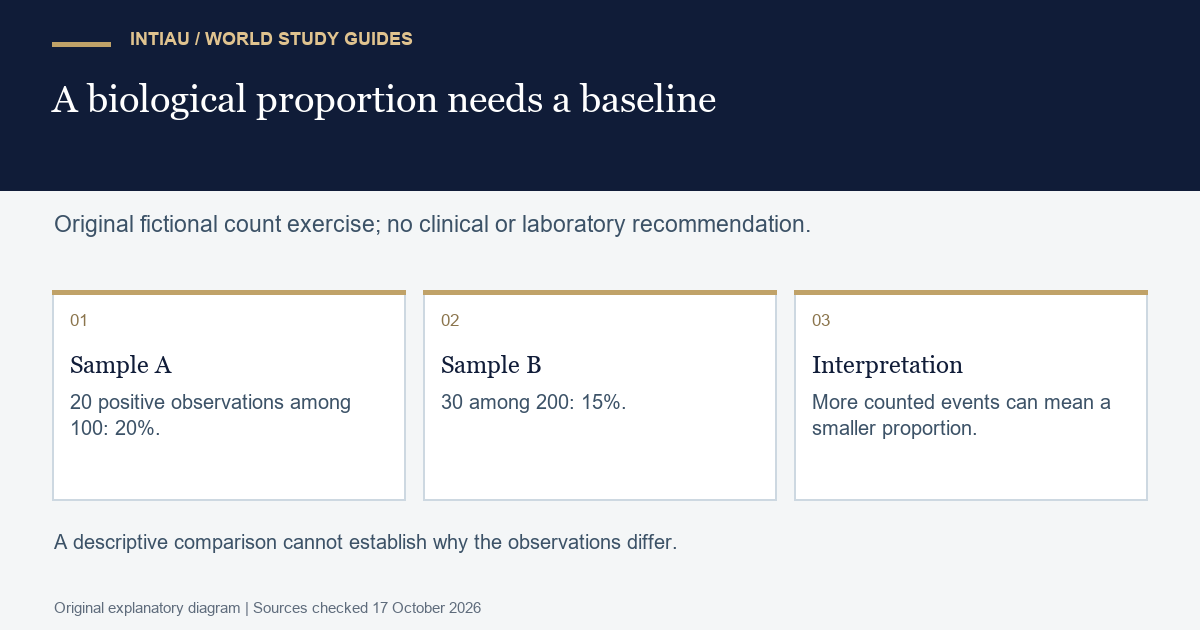
Use two fictional samples. A contains 20 positive observations among 100; B contains 30 among 200. A’s proportion is 20%, while B’s is 15%. B has more positive observations but the smaller proportion. State both denominators before interpreting the result.
If another note says that B is “higher,” ask whether it means the count or the proportion. Neither comparison establishes why the samples differ: their collection and conditions are unspecified. A complete worked answer therefore reports 20/100 and 30/200, chooses the relevant measure, and records that missing context. This is an original numerical exercise, not a clinical conclusion or a university assessment.
Questions to settle
Do school-leavers apply directly to the two-year MSc?
No. That is a separate postgraduate programme; the integrated route has its own entry process.
When does the prospectus place specialisation?
It states that Biology students branch into the listed specialisations in the third year.
Are the course examples a verified 2027 syllabus?
No. They are selected themes from the posted CIS outline.
Official reading
- Integrated Studies overview (mixed dated listings)
- University prospectus (2026-27)
- CIS biology outlines (posted2023; undated text)
- Integrated admission notice (2026)
- Department programmes (undated; legacy wording)
For other study topics, browse INTIAU Courses; use Contact for questions about INTIAU services. University applications belong with the institution named above.
Related guides
View the study diagram