Imperial College London is separate from INTIAU; this guide describes an Imperial programme, not an INTIAU programme or a partnership.
Checked 17 October 2026. Admissions details below concern 2027 entry. The detailed module example is explicitly the published 2026–27 curriculum, rather than a guarantee of every module available to a future cohort.
The programme’s official name is Mechanical Engineering MEng. This guide concerns the standard route, course code H301, rather than assuming that a year abroad or in industry is included. Use the official course page when comparing its separately named variants and entry requirements.
Connect engineering science with making and testing
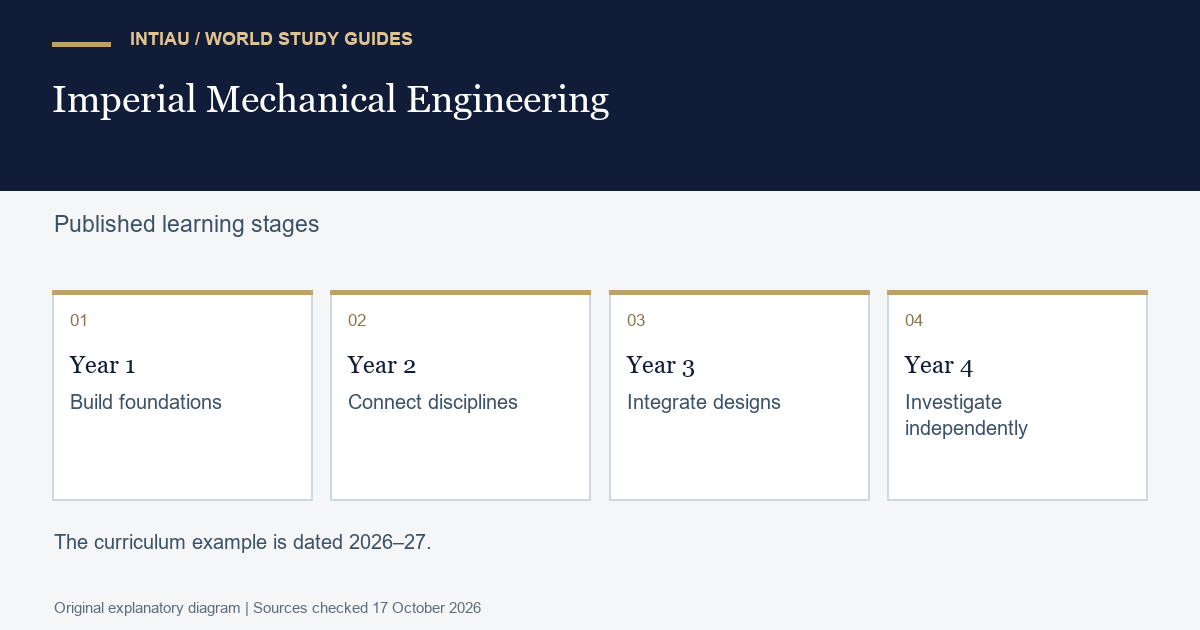
Imperial’s detailed module catalogue groups current study by year. Its early core spans mechanics, materials, fluids, thermodynamics, mathematics, computing and design. Later study combines project work with options. Availability and selection rules matter: an option appearing in the catalogue is not a guarantee that every student can combine it with every other option.
| Year | Emphasis | How the work develops |
|---|---|---|
| 1 | Engineering science and mathematical foundations. | Begin design, manufacturing and professional skills. |
| 2 | Develop the core disciplines further. | Connect analysis with practical engineering work. |
| 3 | Project integration and elective study. | Design, manufacture and test a solution. |
| 4 | Advanced study and individual work. | Complete a substantial engineering project. |
The table intentionally avoids a prescribed semester plan. A useful comparison is whether you want to move repeatedly between a mathematical model, a physical constraint and an observed result. Mechanical engineering problems often have competing objectives: making a part lighter may affect stiffness, cost or manufacturing choices. Treat those trade-offs as questions to investigate, rather than expecting one module title to answer all of them.
Understand what the projects ask you to demonstrate
The department’s third-year project guide describes supervised teams developing a design brief and showing their work in an exhibition. This connects the finished object with the decisions made while producing it. When reading a project example, ask which requirements were fixed and which the team could change. A successful demonstration should be understandable as engineering evidence, not just an attractive photograph.
The fourth-year project guide describes individually supervised work that can be experimental, theoretical, computational or design based. Students may select suggested topics or propose an idea for development. Those categories help you distinguish an interest in research questions from an interest only in operating a particular machine or software package. The published examples illustrate possibilities; they do not reserve a particular project for a future applicant.
2027 admission: keep application and test bookings separate
Mechanical Engineering applicants must take ESAT. Imperial specifies Mathematics 1, Mathematics 2 and Physics. Its ESAT guidance lists an October 2026 sitting and a January 2027 sitting; the October window has passed at this guide’s check date. January booking is listed as opening on 26 October 2026. Check the provider’s country-specific dates, booking deadline and access-arrangement rules before choosing an appointment.
Imperial’s 2027 application deadlines give 13 January 2027 at 18:00 UK time for equal consideration for courses other than its specified medicine routes. The application and admissions-test processes have separate deadlines. Build your plan backwards from both, allowing time for your school reference and the evidence required for your actual qualification.
The course requirements are the place to check the accepted qualification, subject combination and English-language evidence. An ESAT booking does not establish that you meet the academic conditions. Read the requirements for your entry year rather than substituting a previous applicant’s offer.
A practical way to compare your interests
Before deciding, describe a modest design problem in one page. State what the object must do, the constraints you would measure, and how you would judge a proposed solution. Separate assumptions from observations. You do not need an elaborate prototype to notice whether you prefer analysing loads, predicting thermal behaviour, choosing materials or planning an experiment. Use the result to formulate specific questions for the department.
Frequently asked questions
Does the standard title include a year in industry?
No. Imperial lists separately named variants; this guide concerns Mechanical Engineering MEng, H301.
Which ESAT modules are listed for this course?
For 2027 entry, Imperial lists Mathematics 1, Mathematics 2 and Physics.
Are the module examples a fixed 2027 cohort syllabus?
No. The detailed catalogue used here is labelled 2026–27, and options have selection rules and availability limits.
Explore INTIAU Courses for INTIAU’s own information, or use Contact for its services. Imperial determines its own admissions and curriculum.
View the curriculum diagram