
The University of Johannesburg offers the BA in Visual Art at Auckland Park Bunting Road; this independent guide concerns that undergraduate programme, not an INTIAU award or partnership. Official programme record.
A visual-art comparison should distinguish making an object, interpreting its context and explaining the choices behind it. A portfolio becomes more informative when a reader can follow a question through experiments and revisions. Use the selected study examples here to investigate that relationship without assuming that every appealing image demonstrates sustained enquiry.
Keep degree level and source date visible
The undergraduate page lists application dates from 1 April to 31 October 2026. That closing date was still ahead on 17 October 2026; it does not by itself identify every entry-year or departmental selection condition.
The course examples below come from the faculty’s 2023 regulations. They are historical curriculum evidence, not a claim that a 2027 timetable has been confirmed. Dated faculty regulations.
The departmental applicant page describes a university application followed by departmental steps for qualifying applicants. Applicant guidance.
Official indexed primary text was available while direct retrieval was restricted. Keep the original record and its date attached to an enquiry. The BA and a later honours qualification should not be merged into a single undergraduate checklist, and a general closing date should not be treated as approval of a portfolio.
Selected published course layers
| Layer in the dated evidence | Actual example | Question to practise |
|---|---|---|
| First-year making | Studio Practice 1 and Drawing 1 | What changes when I repeat an experiment? |
| First-year contextual study | Art History and Theory 1A and 1B | Which context changes the interpretation? |
| Selected media choice | New Media Studies 1A and 1B among the listed alternatives | Why is this medium appropriate? |
| Programme development | Art practices, theories and research methodologies | Can I explain a sustained line of enquiry? |
The regulations distinguish module choices and selection requirements. The table supplies selected examples rather than reconstructing every year of a current degree plan.
A module title cannot reveal the quality of your response to a brief. Keep the task, experiment, revision and reflection together. When seeking current advice, ask for the applicable curriculum and exact prescribed portfolio instructions rather than borrowing tasks from an old handbook.
Worked exercise: one object, three interpretations
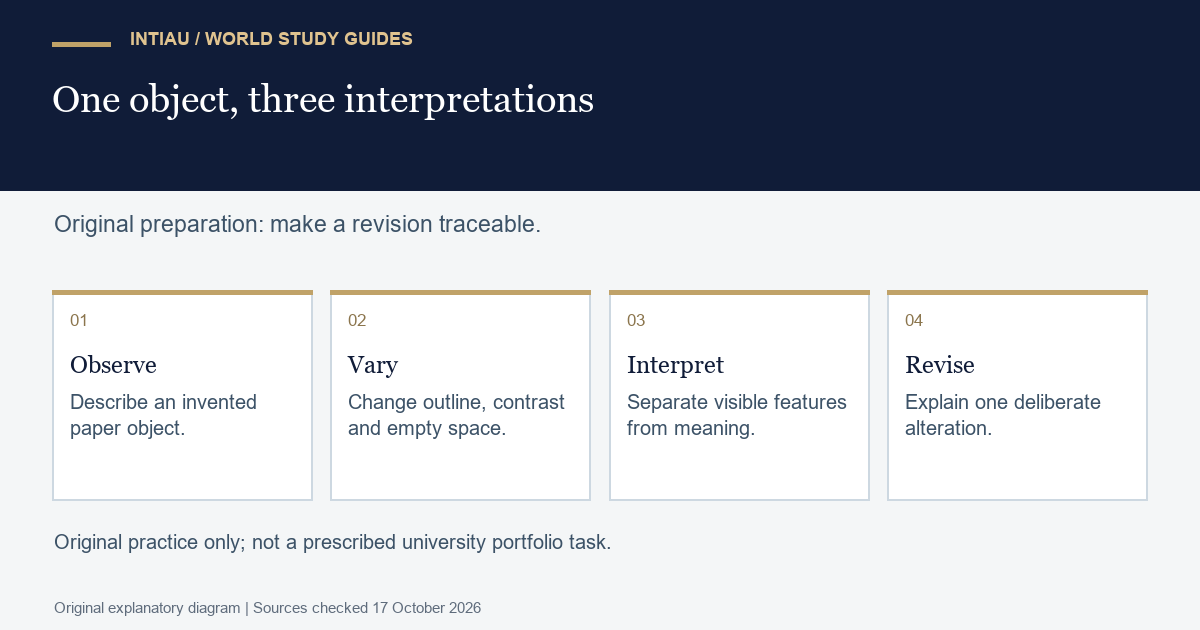
Choose an ordinary invented object, such as an unmarked paper box. Work on paper without borrowing a photograph or copying an artist’s composition. Make three small studies: an observational outline, a version emphasising shadow, and a version in which the surrounding empty space dominates. Keep the object concept constant so the comparison concerns your decisions.
Give each study a short intention before judging it. One might ask how a boundary is perceived, another how contrast directs attention, and the third how placement suggests isolation. These are proposed interpretations, not claims that every viewer will respond in the same way. Record the visual decisions that could support or weaken each intention.
Now write two captions for the same study. The first describes only visible features; the second proposes a contextual interpretation. Underline every word in the second caption that goes beyond observation. This helps reveal where evidence ends and interpretation begins. A meaningful interpretation can remain tentative without becoming vague.
Revise one study after identifying a conflict between intention and result. Perhaps the strongest contrast draws attention away from the feature you wanted to emphasise. Change one element and explain the reason. Preserve the earlier version instead of replacing it with an unexplained polished image.
Arrange the three studies and the revision as a small process sequence. Add a reflection identifying what remained constant, what changed and what you still cannot conclude. Do not fabricate viewer comments, imply that this is a university portfolio task or present another person’s work as your own.
Use process evidence in programme research
Review whether you most enjoyed drawing, contextual interpretation, experimenting with media or explaining a revision. Those interests give you specific questions to take to course descriptions. A process record also helps distinguish a deliberate choice from an effect that happened accidentally.
For application planning, keep the general university process separate from any departmental selection invitation and prescribed work. Check the current instructions for your applicant category before submitting material. This guide makes no judgement that a particular portfolio will be accepted and no promise of admission or professional success.
Frequently asked questions
Is this the undergraduate or honours qualification?
The cited programme record is the undergraduate BA in Visual Art. A separate honours route should be researched independently.
Are the module examples a confirmed 2027 list?
No. They are explicitly drawn from the 2023 faculty regulations and require a current applicability check.
Is the box exercise a prescribed portfolio task?
No. It is an original preparation exercise. Follow the university’s actual current task instructions when completing an application.
View the study diagram
Official sources
For other independent study comparisons, see INTIAU Courses; general enquiries can use Contact. The named university decides its own admissions and academic requirements.