KTH Royal Institute of Technology in Sweden is independent of INTIAU. Its Information and Communication Technology programme awards a Bachelor of Science after three years and 180 ECTS, with teaching in English at the main campus. The current offering advertises autumn 2027 entry, with the first-round application deadline 15 January 2027 and applications through University Admissions. programme details
What kind of technical foundation?
ICT can be compared as a chain: a physical signal becomes data, software transforms that data, and a network carries it to another system. Decide which part of that chain you most want to understand, then look for evidence that the degree also teaches the interfaces between parts. A course list containing both programming and electronics is useful only when you examine what connects them.
The official autumn 2026 appendix supplies the selected course progression below. Its search-indexed primary text was readable, while direct extraction returned an empty content area; the access boundary is retained. The appendix distinguishes mandatory, conditionally elective and recommended courses. A recommended course is not automatically a compulsory requirement. This 2026 cohort map must not silently become a 2027 timetable. cohort course list
| Stage | Selected appendix entries | What to inspect |
|---|---|---|
| Year 1 | The Art of Programming; Algorithms and Data Structures; Digital Design; mathematics | Representation in both code and hardware |
| Year 2 | Concurrent Programming; Networks and Communication; Computer Hardware Engineering; ICT project | How components work together |
| Year 3 | Operating Systems; Computer Security; industrial management; 15-credit first-cycle degree project | System constraints and an independently explained result |
A real 2026 syllabus rather than an obsolete title
ID1022, The Art of Programming, is a 7.5-credit course with an autumn 2026 syllabus. Its published content includes development tools, data structures, contrasting programming paradigms, debugging and testing, and an individual non-trivial programming project. Students are expected to analyse programming concepts and improve other people’s programs, as well as develop their own. The syllabus explicitly includes programming with and without AI-based code generation. Its assessment separates a six-credit computer-based assessment from a 1.5-credit individual project. These themes establish more than the fact that a programming course has a convenient title: they identify work and reasoning to compare. course syllabus
A useful preparation note therefore has two parts. First, explain a small algorithm without depending on a particular language’s syntax. Second, describe how you would check that a program implements that algorithm. Being able to produce output once is weaker evidence than being able to explain why it meets a stated requirement, including an awkward input.
Applicant evidence and qualification-specific checks
KTH requires completed upper-secondary education, English equivalent to English 6/English Level 2, and documented mathematics and physics corresponding to Mathematics 4 and Physics 2. Country-specific instructions determine which credentials demonstrate those levels. The page says applications are individually evaluated; predicted grades are not accepted and conditional admission in the final upper-secondary year is unavailable. It also states that KTH does not provide an entrance test or bridging course to make up these requirements. Check your own qualification’s instructions rather than converting course names yourself. entry requirements
Original paper task: preserve an event sequence
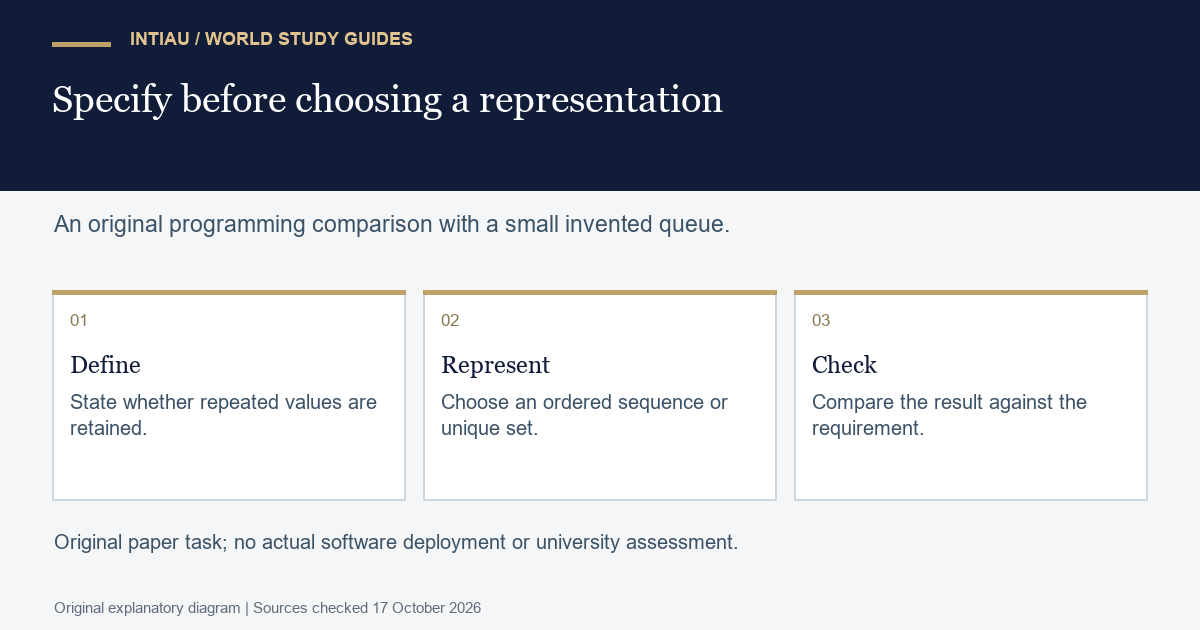
Suppose a fictional sensor queue contains A,B,A,C. A requirement says every event must be processed in arrival order. An ordered sequence preserves all four events; a set containing A,B,C loses both the repeated A and the original sequence. Now change the requirement: report only which labels occurred, ignoring frequency and order. The set is now sufficient for that narrower output. Write two checks: the original output must have length four and retain A twice, while the revised output has three distinct labels. Finally, change the task to counting each label. Neither an unordered list of unique labels nor its length gives the counts without additional information. Explain why choosing a representation before defining the required information can make a later correct-looking calculation answer the wrong question.
Three practical questions
Are all listed recommendations compulsory?
No. The appendix separates mandatory, conditionally elective and recommended courses. cohort course list
Does the selected 2026 map settle the 2027 timetable?
No. Keep the cohort label and check the final programme syllabus applicable to your intake.
Does a successful output establish a correct representation?
No. Check the information the requirement says must be preserved, including order and repetition.
INTIAU’s own information is available through Courses and Contact.
Related guides
View the study diagram