Kyoto University is a separate institution; its Undergraduate International Course Program of Civil Engineering is not an INTIAU programme or partnership. The four-year English-taught course leads to a Bachelor of Engineering. Teaching is at Yoshida Campus for the first three years, with final-year research depending on the assigned laboratory.
An infrastructure curriculum is easier to compare when you can connect a scientific model with the decision it supports. Choose a question about movement, storage, loads or competing uses. Ask what the model includes, what it leaves out and how uncertainty affects the conclusion. This gives you a practical way to read a course map without treating every specialised topic as interchangeable.
Read the progression before the subject list
| Stage | Published emphasis |
|---|---|
| Years 1 and 2 | Liberal arts, mathematics, physics and information-processing foundations. |
| Later year 2 and year 3 | Increasing specialised civil engineering study. |
| Year 4 | Laboratory research and a bachelor’s thesis. |
That is a stage map, not a complete credit schedule. Make a second sheet for actual subject requirements and mark the entry year of the handbook you consult. When one course seems especially important to your interests, trace both its background preparation and its later application. Do not infer a compulsory status or an enrolment permission merely because a subject appears on an educational diagram.
Use the annual handbook and syllabus gateway
The current curriculum page names Hydrology, Soil Mechanics and Structural Dynamics within advanced civil engineering, alongside Exercises in Infrastructure Design. These are real published subject examples; the map does not provide a weekly syllabus.
The department publishes an entrant-year subject handbook for 2026. Keep that edition explicit; it does not establish a later entrant’s complete requirements.
The official syllabus gateway links specialised engineering syllabuses, liberal-arts syllabuses and the annual subject list. It identifies the international course’s subject table within the handbook. Use an actual course entry there before claiming detailed assessment or weekly content.
For a selected syllabus, record the course title, academic year, stated objective and the kind of work expected. Leave any unpublished field blank. This modest record can support a useful comparison without reproducing a whole copyrighted syllabus. A gateway and a subject table are evidence of where to check, not permission to supply details from a similarly named course elsewhere.
Worked exercise: make a system boundary explicit
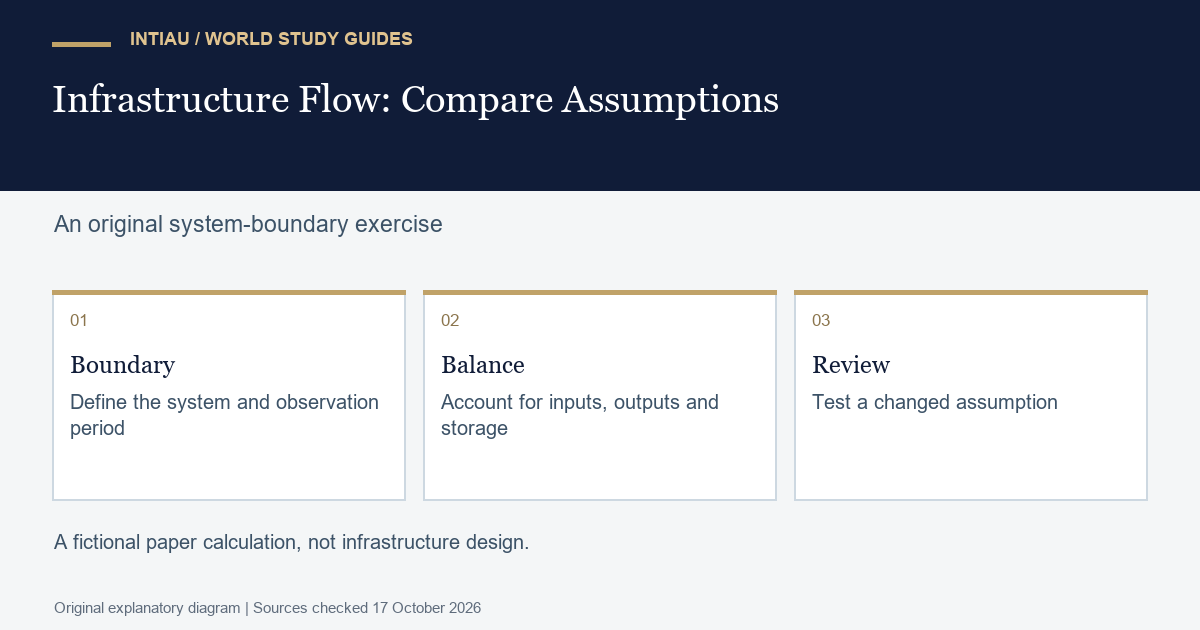
Draw a fictional storage tank as a box, with an inlet, an outlet and a level marker. Label the exercise as invented and use abstract volume units. During one interval, suppose 12 units enter and 9 leave. If the starting stored amount is 20, calculate an ending amount of 23 under the stated assumption that there are no other flows.
Now add a possible unmeasured loss of 2 units. Recalculate the ending amount as 21 and explain why the first answer was conditional rather than simply wrong. On the diagram, draw the added flow across the system boundary. State what would need to be measured to distinguish the two cases. Do not attach this fictional model to a real water supply, flood event or engineering design.
Compare a second observation interval with different inflow timing but the same total volume. Ask whether your simple balance can describe the maximum level during the interval. It cannot do so from totals alone. Write that limitation beside the calculation instead of making the model appear more detailed by adding unsupported decimals.
Produce the boundary diagram, two calculations and a short model-limit statement. Ask a peer to identify an omitted flow or an ambiguous time interval. Revise the representation so another reader can reproduce the arithmetic. This original preparation activity is about transparent assumptions; it is not a Kyoto laboratory task, a design standard or a prediction about a real system.
Recognise a closed application window
Checked on 17 October 2026, the April 2027 schedule lists mandatory preliminary eligibility screening on 3–17 August 2026 and formal application on 4–11 September. Both windows have passed. Applicants who missed preliminary screening cannot proceed in that cycle; later selection stages are not a new application opportunity.
Keep a past deadline visibly past when comparing routes. Save the source edition and wait for the institution’s next published cycle rather than moving last year’s dates forward yourself. An admission schedule and a curriculum edition answer different questions, so neither should silently supply the missing information in the other.
Three course-planning questions
Is the April 2027 application window still open here?
No. The published preliminary and formal windows described above have passed.
Does a 2026 handbook confirm a future syllabus?
No. Confirm the handbook and offering for the relevant entrant year.
What should the balance exercise show?
A reproducible calculation, an explicit boundary and the effect of a changed assumption.
Official source trail
- Civil course description
- 2026 entrant subject handbook
- Official syllabus gateway
- Current curriculum pillars
- April 2027 admission schedule
For INTIAU information, visit INTIAU Courses or INTIAU Contact. These links do not apply to the separate institution discussed above.
Related guides
View the study diagram