Kyushu University is a separate institution; its Bioresource and Bioenvironment International Undergraduate Program is not an INTIAU programme or partnership. The English-taught agriculture route leads to a Bachelor of Science in Agriculture. An optional dual-degree pathway has separate conditions and is not assumed in this guide.
The faculty is based at 744 Motooka, Fukuoka, on Ito Campus.
Bioresource questions connect living systems with decisions about how resources are used. Start with a question that includes both an intended output and a constraint. What might improve one outcome while making another harder to achieve? A useful curriculum comparison asks how biological understanding, environmental evidence and a reasoned decision can be brought together without pretending that all consequences share one simple unit.
Read the current study progression
| Year | Published emphasis |
|---|---|
| 1 | Common foundational education. |
| 2 | Specialised study. |
| 3 | Laboratory rotation and developing research interests. |
| 4 | Laboratory research and graduation thesis. |
Use this as a progression map, not a complete point-by-point requirement list. Keep the degree’s common preparation, specialist choices and research allocation separate in your notes. A laboratory interest can guide questions without guaranteeing placement. If an older brochure uses a different teaching-period description, retain its date and give the current official structure priority.
Inspect a named current subject and a dated scope
The AY2026-27 Autumn and Winter timetable names Technical Communication 2-I/II and Bioresource and Bioenvironment Experiments and Practice examples in Molecular Biology and Computational Biology. It is an actual dated offering list, not the syllabus for a new 2027 entrant.
The separately dated 2025 teaching descriptions connect Technical Communication with academic writing, oral or poster presentation, figures and scientific ethics. Use that earlier scope as an illustration; confirm the descriptor applying to the eventual offering.
A timetable answers when and under what title a course is listed. A teaching description answers a different question about its educational scope. Keep the two records separate before making a comparison. In particular, do not infer assessment weights, laboratory procedures or prerequisites from a timetable cell, and do not attach an older scope silently to a future class.
Worked exercise: allocate a fictional limited resource
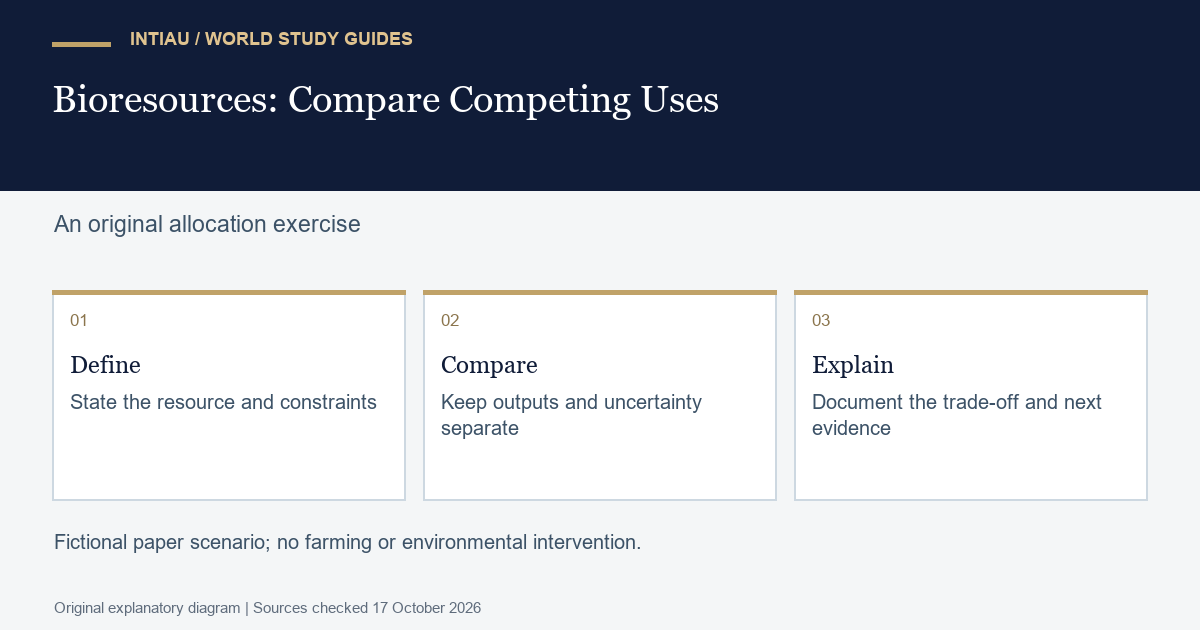
Invent a small research setting with ten abstract resource units that can be allocated to two fictional biological production activities, A and B. Give A an invented output of three units for each resource unit and B an output of two. State a second condition: at least four resource units must remain with B to preserve a hypothetical secondary function. Label every value and function simulated.
Calculate one allocation meeting that condition: six resource units to A and four to B produce 18 and 8 output units respectively. Compare it with an even allocation, which produces 15 and 10. Do not add unlike outputs into one total unless you explicitly define why they are comparable. A larger number is not automatically a better outcome when outputs serve different needs.
Now add uncertainty: A’s output could range from two to three per resource unit, while B’s could range from one to two. Show the resulting output ranges for each allocation. Explain whether the preferred option remains clear. Identify which additional observation would matter most before deciding, rather than hiding uncertainty behind a single average that the scenario did not provide.
Your output is an allocation sheet, transparent calculations and a short trade-off memo. Add one concern that the numerical scenario leaves out, such as the acceptability of the assumed secondary function. Ask a peer to distinguish a measurement question from a value judgment. This original preparation activity needs no organisms, experiments, field intervention or real resource-management decision.
Check the October intake instructions
Checked on 17 October 2026, Kyushu publishes October 2027 instructions for Bioresource and Bioenvironment, with separate Type A and Type B documents. Its English undergraduate routes in engineering and agriculture are four-year programmes taught in English, except Japanese-language classes. Read the relevant document before choosing an applicant category or deadline.
The language statement describes the programme; it does not remove every language or document requirement. Keep an applicant checklist beside your curriculum questions, and record the exact edition of each. This guide does not invent a closing date from an old brochure or treat an optional additional award as automatic.
Three bioresource questions
Does this guide assume the optional dual degree?
No. That pathway has separate conditions.
Is the timetable a new 2027 entrant syllabus?
No. It is explicitly the AY2026-27 Autumn and Winter offering list.
What should the allocation exercise produce?
A reproducible comparison, explicit constraints and a statement of the evidence still needed.
Official source trail
- International undergraduate route
- Current undergraduate progression
- AY2026-27 autumn winter timetable
- 2025 teaching descriptions
- October 2027 application instructions
For INTIAU information, visit INTIAU Courses or INTIAU Contact. These links do not apply to the separate institution discussed above.
Related guides
View the study diagram