National Taiwan University publishes a bachelor-level Forestry and Resource Conservation programme in Taiwan. This independent guide concerns NTU’s programme, not an INTIAU award or partnership. Its English bachelor page presents four curriculum divisions and a 128-credit total, but supplies no entering-cohort date.
Use the published structure with its edition limit
The page separates university requirements, general knowledge, departmental core, grouped requirements and electives. Its core names include Dendrology and Practice, Silviculture, Statistics, Forest Management and Practice, Forest Products and Practice, Forest Camp Practice, Forest Policy and Administration, and Forest Ecology and Practice. This is an undated published structure, not a verified 2027 graduation audit. Read the bachelor table.
| Selected progression | Actual examples in the linked English listing |
|---|---|
| Foundations | Calculus; Introduction to Forestry; Dendrology |
| Developing biological study | Silviculture and its practice; Forest Ecology |
| Applied forestry | Forest Management; Forest Products; field practice |
| Wider policy context | Forest Policy and Administration; seminars |
The division labels are useful for asking which part of forestry attracts you: organisms and growth, environmental processes, materials or conservation decisions. However, keep any current selection rule beside its cohort. Do not combine an old English course grid with a new admissions year and describe the result as an institution-approved current plan.
A real course shows the learning scale
The NTU course record for Introduction to Forest Ecology and Silviculture, Forest2045, concerns semester 112-2, corresponding to the second semester of 2023–24. It identifies three credits and Chinese instruction. Its actual themes include forest structure and growth, establishment, tending, regeneration, restoration and biodiversity. An English course-information interface does not make this Chinese-taught example an English-medium offering. Read the dated course record.
Those themes encourage a useful distinction between describing a forest and choosing how to manage one. A count or a growth observation can support a description. A management proposal also needs an objective, constraints and a way to judge what happens afterwards. When comparing programmes, ask how field observation is connected with interpretation and written decisions, rather than simply counting the number of outdoor activities listed.
The reviewed course is a real teaching example from a stated semester. It does not establish a current timetable, language arrangement for every required unit or the full present syllabus. Ask for the course and cohort documents applicable to your intended route before relying on an older example for enrolment planning.
September 2027 international admission has its own route
NTU’s international-student page lists the first round for September 2027 entry from 29 September 2026 at 11:00 to 5 November at 16:00, GMT+8. On 17 October that published window is current. The February 2027 route on the same page is graduate-only. Applicants must check international-student eligibility, programme academic and language requirements, and provide school records, transcripts and the applicable supporting documents. The shared calendar does not establish Forestry-specific eligibility or selection. Use the actual international route.
Do not confuse this general international process with an alliance-recommended priority application or an overseas-Chinese route. Record your applicant category first, then the intended department and entry semester. A language certificate is evidence for a requirement; it is not, by itself, confirmation that all the teaching you need is available in your preferred language.
Original exercise: count trees and specify the area
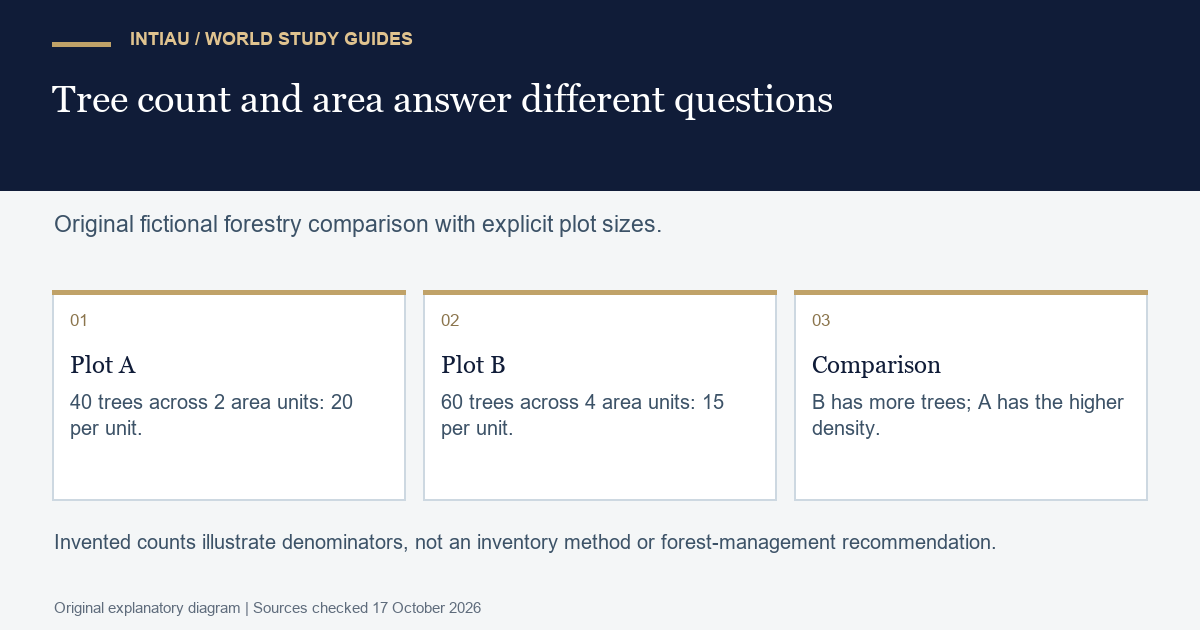
Imagine Plot A contains 40 trees over two area units. Plot B contains 60 over four. Their densities are 20 and 15 trees per area unit. B contains more trees overall, while A has the greater density. Both statements can be true because they answer different questions.
Now ask whether the counts include the same size classes and whether plot boundaries were defined consistently. A comparison cannot be rescued by arithmetic if the objects counted differ. Write a caption stating the count, area and inclusion rule, and leave unknown conditions visible. Do not infer biodiversity, timber yield or conservation value from these totals alone. This original exercise uses fictional plots; it is not an inventory protocol or an NTU assessment.
Questions to settle
Is the 128-credit table confirmed for 2027 entry?
No cohort date is given on the reviewed table, so that confirmation is not established.
Was the selected forest course taught in English?
The reviewed 112-2 record identifies Chinese instruction.
Can a bachelor’s applicant use the February 2027 calendar?
The page identifies that entry route as graduate-only.
Official reading
- Bachelor structure (undated published table)
- Required course progression (undated legacy English listing)
- Forest ecology and silviculture course (112-2; 2023–24 second semester)
- International admission instructions (September 2027 entry)
For other study topics, browse INTIAU Courses; use Contact for questions about INTIAU services. University applications belong with the institution named above.
Related guides
View the study diagram