Peking University’s Sociology undergraduate major is an independent university programme, not an INTIAU offering or partnership. The department’s admissions profile distinguishes Sociology, Social Work and Anthropology, with a shared initial disciplinary foundation before later specialisation.
Start with the 2025 major plan
The official 2025 humanities-volume curriculum, printed pages 424–430, describes four years,139 graduation credits and the local award category 法学学士. Retain that official category when documenting the Sociology qualification; it does not turn this course map into a law curriculum.
Record the plan’s edition alongside the major name. A catalogue of available courses, an admissions category and the graduation rules answer different questions. Start with the graduation plan for requirements, then use individual course information to understand the work involved. This prevents an attractive elective from being mistaken for an entire degree route.
| Stage in the 2025 plan | Selected requirement |
|---|---|
| Year 1 | Introduction to Sociology; Social Anthropology; argumentative writing |
| Year 2 | Social Survey and Research Methods; Social Statistics; Data Analysis Techniques |
| Year 3 | Social Survey Practice, including a summer option in the plan |
| Completion | Graduation thesis,3 credits |
International students have a separately specified distribution of the same 139-credit total. The full plan, rather than this selection, is needed to check those category allocations and permitted substitutions.
Read one actual course beyond its title
The official Chinese Society course entry,03130590, describes using historical documentaries and contemporary video cases to examine social change. Its learning themes include social relationships, structures, organisations, behaviour, conflict and the making of order. The emphasis is on interpreting material sociologically, rather than treating a recording as a self-explanatory account of society.
That separate entry calls the course required, while the 2025 major plan places Chinese Society among professional electives. Use the dated plan for the requirement classification. The course entry is useful here for selected learning themes; it is not being represented as a verified 2026 timetable or a complete current assessment brief.
The university’s English departmental course list also names Analytical Techniques of Data, Fieldwork, Economic Sociology and Historical Sociology. It illustrates the range of methodological and substantive study, but an English-language course title does not establish English instruction or availability in a particular semester.
An original exercise in denominators
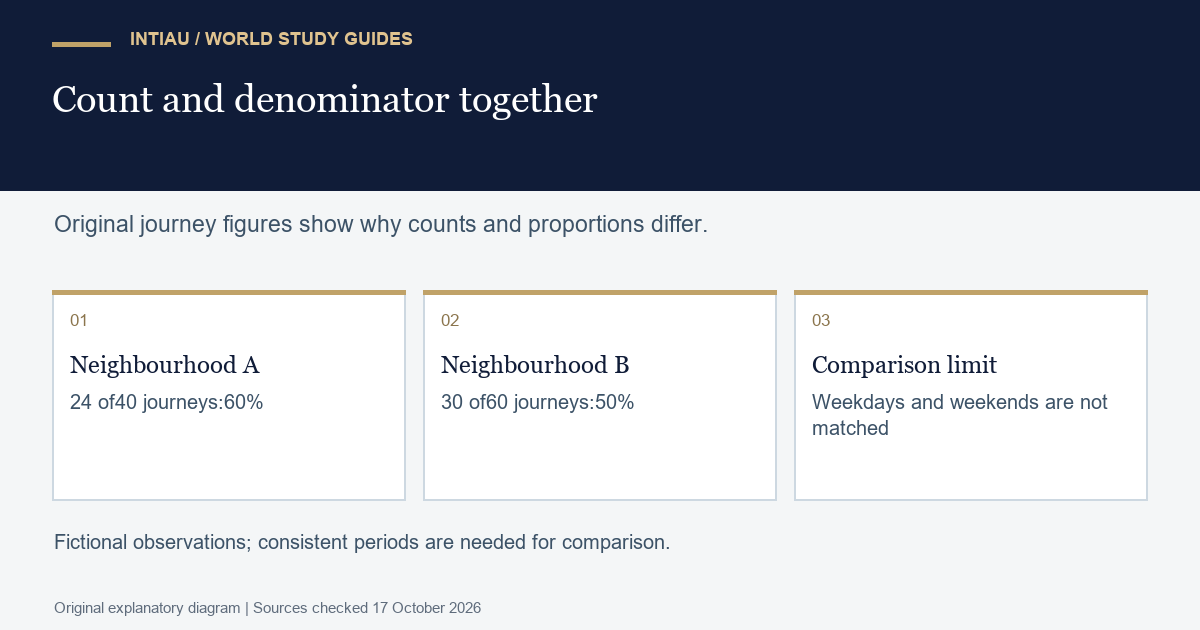
Imagine two fictional neighbourhood summaries. In A,24 of 40 recorded journeys use a bus; in B,30 of 60 do so. The bus shares are 60%and 50%. B has more recorded bus journeys but a smaller share. Write both the count and denominator before making a comparison.
Now suppose the first record covers weekdays and the second only weekends. The arithmetic remains correct, but the comparison mixes observation periods. Rewrite the proposed conclusion so it reports the two records without claiming a neighbourhood difference caused by location. Identify the common observation period you would need for a better comparison.
Keep the exercise on paper with the stipulated nonpersonal numbers. Your output is a calculation, a qualified sentence and a missing-information note, not a proposal to collect residents’ data or a university assignment.
Separate the international application route
The 2026 international entrance-examination guide specifies Chinese-medium undergraduate study and an application period of 1 January–28 February 2026. That period is past on 17 October 2026; this guide supplies no confirmed 2027 window. The published route includes document review, written Chinese, English and Mathematics examinations, and a subsequent examination stage.
The departmental admissions profile explains broad Sociology-category study before later choices. Applicants should match their own admission category and applicant route to the major plan, rather than assume that every applicant enters an identical track.
Three curriculum questions
Is this the complete 139-credit plan?
No. The table selects a few requirements; the official document contains the full categories and student-specific rules.
Do English course names establish an English-taught degree?
No. A translated course list is not a statement about the programme’s teaching language.
Why retain the denominator in the exercise?
Because a larger count can accompany a smaller proportion when the totals differ.
See INTIAU’s Courses or Contact for general information.
Related guides
View the study diagram