Université PSL is a French institution separate from INTIAU. Its Sustainability Sciences bachelor is a three-year programme taught in French and English. Teaching is listed at Rue Amyot and the Jourdan campus in Paris.
Interdisciplinary sustainability study is easier to compare when a problem is defined precisely. “Choose the greener option” leaves the outcome, time horizon and competing constraints unstated. Instead, ask what evidence would support a decision and which discipline could help interpret each part of it. The aim of a curriculum comparison is to understand how those perspectives are connected.
Read an indicative course map as indicative
The 2026/27 course outline names the qualification Licence Sciences, Humanités et Société, parcours Sciences pour un monde durable. It expressly presents examples subject to modification.
| Year | Published emphasis |
|---|---|
| L1 | Multidisciplinary core |
| L2 | Two majors alongside a common core |
| L3 | Specialisation and continuing interdisciplinary study |
Grands enjeux du développement durable is a real L1 course example. The outline also names programming, Earth-system science and economics. These are selected names, not a verified full assessment syllabus.
Use the official map to identify connections you would like to investigate. For instance, a measured physical change and an economic evaluation can address the same proposal while using different assumptions. Do not treat a shared theme as proof that the methods are identical. Ask how you would explain the link between two components to a reader outside either discipline.
Worked exercise: one budget, two reasonable questions
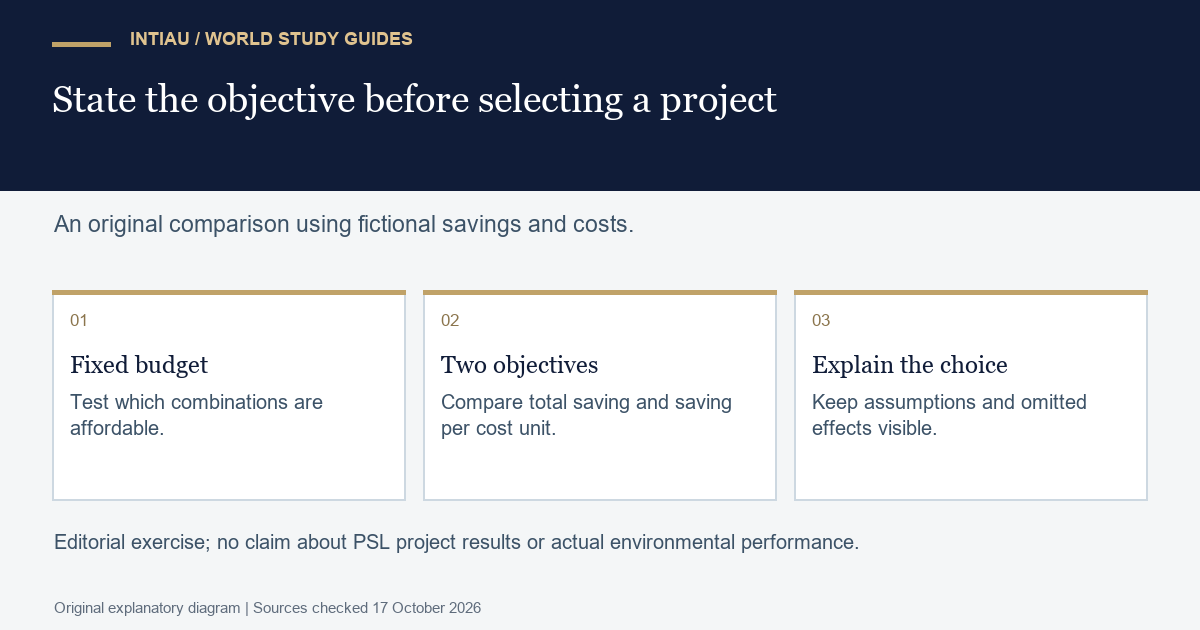
Consider three entirely fictional projects. Project A costs four units and saves eight resource units per year. Project B costs six and saves fifteen. Project C costs three and saves five. You have a budget of seven cost units, projects cannot be divided, and each may be selected at most once. Assume their savings simply add and that no other effects exist in this model.
Start by listing feasible choices. A alone, B alone and C alone are affordable. A plus C costs seven and saves thirteen. A plus B costs ten, while B plus C costs nine, so both exceed the budget. All three cost thirteen. Doing nothing is also feasible and gives zero saving. Listing combinations prevents an attractive project from concealing an unaffordable package.
If the objective is the greatest annual saving within the budget, choose B: fifteen is greater than thirteen, eight, five or zero. If the objective is the greatest saving per cost unit among the individual projects, B also leads: fifteen divided by six is 2.5, compared with two for A and about 1.67 for C. These conclusions depend on the stated one-year metric and additive assumptions.
Now introduce a different constraint: the plan must include two separate projects. B is no longer feasible as the complete answer. The only affordable pair is A plus C, with total saving thirteen. The numerical data did not change; the decision changed because the constraint did. Explain that explicitly rather than saying the first calculation was wrong.
Finally, imagine that B’s saving estimate could fall to ten. Under that scenario, A plus C would save more than B alone. This is a sensitivity check, not a probability forecast. Without evidence about the uncertainty of the estimates, you cannot calculate how likely either outcome is. A range of assumed values should be labelled as a range of assumptions.
Write a short decision note containing the chosen objective, feasible alternatives, calculation and one omitted consideration. Possible omissions include maintenance, distribution of benefits or whether savings persist beyond one year. Adding those issues would require new evidence and perhaps a different model; a longer list of concerns is not itself a solution.
The exercise is an original way to explore your interest in linking quantitative information with a social choice. It supplies no actual environmental project recommendation and is not a PSL assignment, admissions task or description of student outcomes.
Application route and cycle boundaries
PSL’s bachelor application guidance lists Sustainability Sciences among programmes on Parcoursup and links international procedures. Its published 2026 choice and confirmation dates were already past on 17 October 2026. Follow the programme’s applicant-profile instructions and confirm the relevant future entry cycle rather than carrying those dates forward.
The programme overview recommends English B2 and French C1 preparation. Those recommendations should be read alongside the actual admissions instructions; they do not establish acceptance of a qualification or an offer of admission.
Keep a planning record with separate fields for degree wording, teaching languages, curriculum edition and applicant route. The English label “bachelor” does not justify replacing the published qualification with an invented BSc title. Similarly, an indicative course list should not become a guaranteed future timetable.
Three sustainability-study questions
Is the programme described as entirely English-taught?
No. PSL lists French and English.
Is the 2026/27 course outline a fixed complete syllabus?
No. It labels its course examples as indicative and subject to change.
Can a changed constraint alter the worked decision?
Yes. Requiring two projects makes A plus C the only affordable pair.
For INTIAU information, use Courses or Contact.
Related guides
View the study diagram