
Two degree programmes can share a title while teaching different material and assessing it in different ways. This self-guided workshop helps you compare their published curricula using an evidence sheet. The result is a practical shortlist and a set of questions for the universities, rather than an assumed equivalence between programmes.
Allow approximately ninety minutes for the exercise, with more time if the official documents are incomplete. This is a proposed independent learning activity. It is not a scheduled INTIAU class, an enrolment offer, an accredited award or a credit-bearing syllabus.
Gather the right documents
Choose two real programmes at the same intended level. Open each university’s current official programme page, admissions page, course catalogue and module descriptions. Record the academic year as well as the access date. An archived handbook may explain a programme’s history while differing from the rules for new applicants.
In the European Higher Education Area, the European Commission explains that ECTS connects credits with learning outcomes and workload; a full academic year normally corresponds to sixty ECTS credits. Use the stated credit system for each programme. Do not treat an ECTS number, a U.S. credit-hour figure and a local institutional unit as interchangeable.
Use this workshop chart
| Stage | Suggested time | Practical output |
|---|---|---|
| Define the question | 10 minutes | A subject, qualification level and personal study objective. |
| Collect official evidence | 15 minutes | Two sets of dated programme, admissions and module links. |
| Map the curriculum | 25 minutes | A year-by-year chart distinguishing compulsory and optional study. |
| Compare learning and assessment | 25 minutes | Examples of outcomes, prerequisites, projects and assessment methods. |
| Record gaps and next steps | 15 minutes | A shortlist with unresolved questions for each university. |
The timings are an original workshop suggestion, not institutional teaching hours. Work more slowly where you need to understand a prerequisite or unfamiliar terminology.
Build a stage-by-stage curriculum map
- Begin with compulsory study. List required foundations before elective options. Record the module code and official title so that similarly named subjects do not become an assumed match.
- Track progression. Note which modules depend on earlier study. Draw a simple arrow from each prerequisite to the module it unlocks. If the catalogue does not specify a prerequisite, mark it as unknown.
- Separate options from guarantees. Record an elective as an option, together with any published availability conditions. A long option list does not mean every module will run or fit one timetable.
- Locate practical work. Identify laboratories, studio work, placements, dissertations or projects only where the official curriculum includes them. Record whether the component is compulsory and how it is assessed.
- Check the award route. Distinguish a shorter exit award from the full intended qualification and note any published progression conditions.
Compare what students learn, not only course names
Choose one introductory and one advanced module from each programme. Summarise what a student should be able to do after completing each one. Then examine how that learning is assessed. A written examination, a group design project and a laboratory report provide different information about the learning experience.
The ECTS Users’ Guide explains course-catalogue information and the role of learning outcomes, workload and assessment. Its framework is useful for asking focused questions; it does not make an individual student’s modules automatically transferable.
The European Qualifications Framework explanation also distinguishes qualification level from the amount of study. Use level information as context. Two awards at a similar level may have different subject content, entry requirements and professional purposes.
Complete a comparison sheet
| Question | Evidence to record |
|---|---|
| What is the exact award? | Institution, qualification title, duration and current catalogue year. |
| What must I study? | Compulsory modules, credit system and progression requirements. |
| What can I choose? | Options, prerequisites and published availability conditions. |
| How is learning demonstrated? | Assessments, practical work and project requirements. |
| How do I apply? | The actual university admissions route and entry-year instructions. |
| What is still unknown? | Specific questions and the relevant official contact route. |
Turn the worksheet into a useful enquiry
A focused enquiry identifies the programme and entry year, cites the relevant catalogue section, and asks one answerable question. For example: “The catalogue lists this module as optional; is it expected to be available to students entering this pathway?” Keep personal records out of a general public enquiry.
Continue with the INTIAU course-information hub and workshop information. For questions about an INTIAU route, use its contact page. A university elsewhere should answer questions about its own programme.
Frequently asked questions
Does this workshop establish credit transfer or admission eligibility?
No. It organises evidence for comparison. The institution responsible for admission or credit recognition makes the actual decision under its own rules.
Can matching module names prove that two courses are equivalent?
No. Compare the stated outcomes, level, workload, assessment and prerequisites. Record differences and ask the receiving institution about its recognition requirements.
What should I do when a syllabus is missing?
Record the gap and request the relevant official description. Do not fill it with an assumed reading list, assessment weighting or module sequence.
View the explanatory diagram
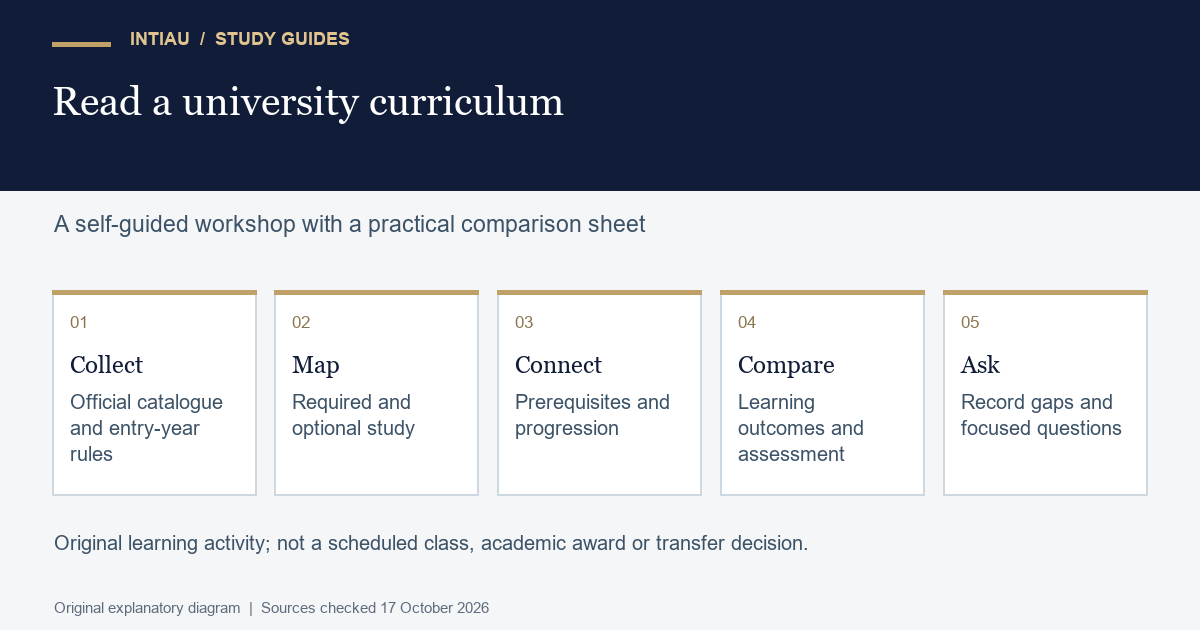
Sources and activity status
Official framework sources checked 17 October 2026. The session plan, worksheet and questions are original educational suggestions.