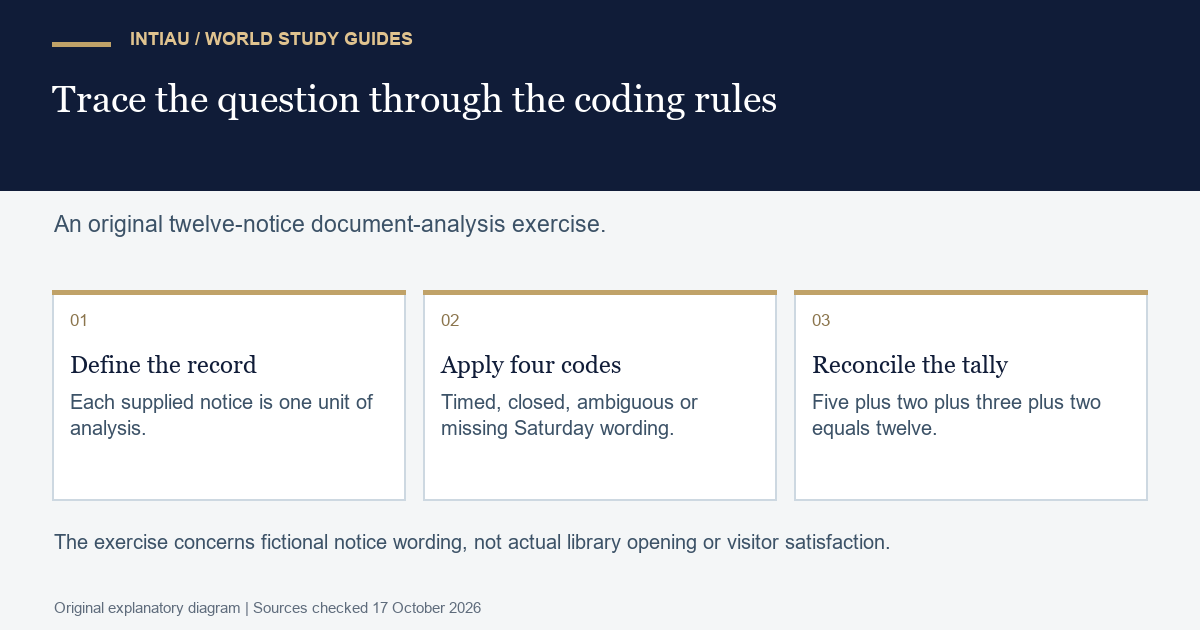
This self-study workshop connects a research question to the records, coding rules and analysis needed to answer it. You will write a methods paragraph that another reader can audit against twelve fictional catalogue notices. The output is a reproducible paper coding scheme, a results tally and a complete methods statement.
Explain what you did and why it fits
The USC Libraries methodology guide describes a methods section as an account of how information was obtained and analysed, with reasons for the chosen procedures. The detail should allow readers to evaluate the relationship between the method and the research problem.
The original fictional question is: “How explicitly do twelve supplied model-library notices state Saturday opening?” It asks about wording in a fixed document set. It does not ask whether opening hours meet community needs, whether visitors understand the notices or whether any library actually opens. No people or live websites are involved.
Inspect the entire miniature corpus
| Card | Notice text | Worked code |
|---|---|---|
| N1 | Saturday: 09:00 to 12:00 | T: timed |
| N2 | Closed on Saturday | C: explicitly closed |
| N3 | Weekend opening varies | A: ambiguous |
| N4 | Monday to Friday: 10:00 to 16:00 | M: Saturday missing |
| N5 | Saturday: 10:00 to 14:00 | T: timed |
| N6 | Ask about weekend access | A: ambiguous |
| N7 | No Saturday service | C: explicitly closed |
| N8 | Saturday: 08:30 to 11:30 | T: timed |
| N9 | Weekday collection only | M: Saturday missing |
| N10 | Saturday: 12:00 to 16:00 | T: timed |
| N11 | Saturday access by arrangement | A: ambiguous |
| N12 | Saturday: 09:00 to 13:00 | T: timed |
For this task, “timed” requires an explicit Saturday start and end. “Explicitly closed” requires a direct Saturday closure statement. “Ambiguous” covers weekend references or Saturday arrangements without fixed hours. “Missing” means Saturday is not directly addressed under these rules. The scheme intentionally does not infer Saturday closure from a weekday-only phrase.
Draft the analysis before polishing the prose
Cover the worked-code column and code each notice once. Record the card identifier beside the category so a disagreement can be resolved by returning to the exact wording. Then count the categories. The answer is five timed notices, two explicit closures, three ambiguous notices and two missing Saturday statements: five plus two plus three plus two equals twelve.
A useful secondary description is that seven notices explicitly supply either fixed Saturday hours or closure. That is a grouping chosen for this exercise, not evidence that all seven provide the same service. Keep the four-category tally alongside it so the grouping does not hide the difference between opening and closure.
Read the complete worked methods paragraph
“We examined the twelve fictional notices supplied in the exercise, treating each notice as one record. We classified Saturday wording as timed, explicitly closed, ambiguous or missing using the stated decision rules. Timed notices had to name Saturday and give both start and end times; weekday-only statements were not treated as explicit Saturday closures. Each classification was retained with its notice identifier, and category totals were checked against the twelve-record corpus. We also grouped timed and explicitly closed notices as explicit Saturday-status statements. The analysis describes these notices only; it does not assess actual access, reader understanding or the prevalence of wording across real libraries.”
This paragraph tells the reader the unit, inclusion set, rule, treatment of a difficult case and tallying procedure. It does not decorate a simple document task with an interview method that was never used. It also distinguishes a fixed supplied corpus from a sample selected to represent a wider population.
Use mismatches as a diagnostic
If your proposed method says “ask users whether the timetable is clear,” it answers a different question about understanding. If it says “measure Saturday attendance,” it addresses behaviour rather than notice wording. Those could be worthwhile projects, but they cannot answer our exact question using the supplied records. Rewrite either the question or the method openly rather than pretending they already align.
Score one point each for naming the twelve-record corpus, the notice-level unit, four operational categories, a traceable tally and the scope boundary. Add a sixth point if the difficult weekday-only case is specified. The worked answer earns six because its rules explain both N4 and N9 without guesswork.
Why is N9 not automatically coded closed?
The exercise’s rule requires an explicit Saturday closure statement. N9 mentions weekdays but does not directly state Saturday status. Changing that rule is possible, but it would require recoding and reporting the change.
Can I infer visitor satisfaction from these notices?
No. The corpus contains wording, not visitors or satisfaction measures. That inference would require different evidence and a different method.
Do I need to search a real catalogue?
No. All twelve records are supplied here. The task is to make the coding and writing auditable without collecting documents, contacting anyone or using an external account.
This is original INTIAU editorial self-study practice; no qualification is awarded. Browse Courses or use Contact for editorial enquiries.
Related guides
View the study diagram