Stanford University is an institution separate from INTIAU; this guide describes Stanford’s Biology B.S., without implying an INTIAU programme or partnership. The official Biology degree entry identifies the Bachelor of Science and provides the formal programme reference.
Before comparing biology degrees, distinguish a subject interest from a preferred way of working. Being curious about living organisms is a useful beginning. You can then ask whether you most enjoy explaining a mechanism, comparing observations across environments, interpreting a pattern in data, or communicating an uncertain result. Keep a short example of each beside the official requirements instead of judging the course from a single specialist title.
A broad degree with different routes through it
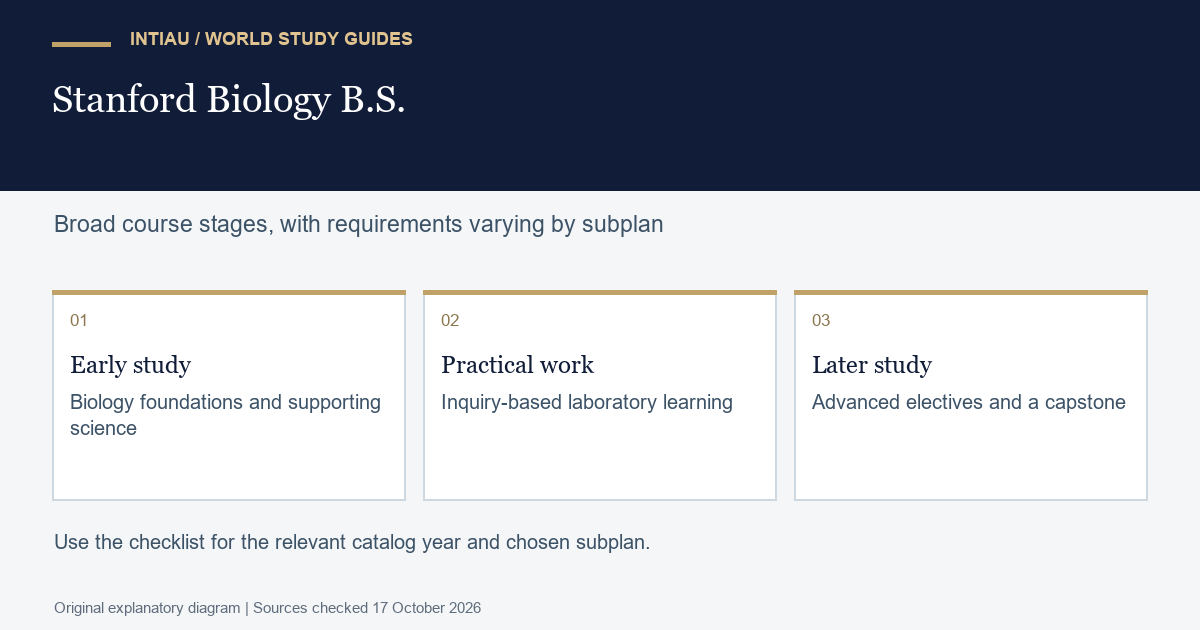
Stanford’s undergraduate major page links 2026–27 checklists. General Biology permits four of six Biology Foundations courses; specialized subplans specify their own foundation choices. Use the applicable checklist.
| Stage | Curriculum components |
|---|---|
| Usually first two years | Biology Foundations, inquiry-based laboratories and supporting STEM courses |
| Remaining two years | Advanced electives, with requirements varying by subplan |
| Synthesis | Writing in the Major and an approved senior capstone route |
This table deliberately groups related work rather than inventing a uniform quarter-by-quarter timetable. When examining a checklist, mark three things: the courses you can choose freely, the courses with a restricted choice, and the prerequisites that determine when a later choice becomes possible. A degree with several options still needs a coherent plan. A favourite advanced topic is more informative once you can identify the preparation that leads to it.
Look closely at one actual course
The official 2026–27 ExploreCourses catalogue lists BIO 82, Genetics, for winter 2027 at four units. Its description addresses inheritance, genetic variation and the use of mutations to investigate biological processes. It lists no prerequisite, recommends BIO 83, and requires attendance at lectures and discussion sections.
A catalogue description is a starting point for assessing intellectual fit, rather than a complete public syllabus. Read the kinds of questions it raises, then ask whether you want to reason from an observed trait toward possible explanations. You do not need to reproduce a university laboratory exercise to explore that interest. A carefully written question, a clear comparison and an honest statement of uncertainty can make your reading more active.
Try comparing two research questions
This original study exercise uses observation and hypothetical planning, not a Stanford assignment. Choose two photographs of plants from a public collection. Describe one visible difference in plain language, without assuming its cause. Next, write two possible explanations. One might involve inherited differences; another might involve conditions in which the plants grew. State what the photographs cannot establish.
Sketch two study plans on paper. In one, compare plants while trying to keep growing conditions similar. In the other, compare the same kind of plant across different conditions. For each plan, identify what you would measure, what you would keep consistent, and one reason your comparison might mislead you. Do not collect specimens or claim that a photograph proves a genetic mechanism.
Finally, write a short explanation for a reader who has never studied genetics. Remove any technical word that you cannot explain. Compare the satisfaction you get from the research design with the satisfaction you get from the explanation. This can help you assess your interests before narrowing your course search.
Writing and a concluding project
The department requires an approved Writing in the Major course, which can overlap other requirements. Capstone routes include honors research, an independent capstone, and an approved relevant out-of-department capstone. The published rules govern approval; an outside project does not automatically qualify.
Where to apply
Stanford’s undergraduate admissions guidance states that applicants apply to the university as a whole rather than to a particular major, department or school. Interest in Biology therefore does not create a separate departmental first-year application.
Instructions checked on 17 October 2026 list the Common Application, academic records, recommendations and ACT or SAT scores among required components. The first-year page lists standard deadlines of 1 November for Restrictive Early Action and 5 January for Regular Decision. Confirm the intended entry cycle and any earlier optional-portfolio deadline directly.
Questions readers often ask
Does every Biology subplan require the same foundation courses?
No. General Biology offers a four-course choice; specialized subplans specify their own requirements.
Does BIO 82 list a required prerequisite?
No. The catalogue lists none, while recommending BIO 83 as preparation.
Do I apply directly to Biology as a first-year student?
No. Stanford admits undergraduate applicants to the university as a whole.
Explore INTIAU Courses or use INTIAU Contact for questions about INTIAU’s own information.
Related guides
View the curriculum diagram