Tampere University is separate from INTIAU. Its Sustainable Urban Development administrative-sciences route leads to a Bachelor of Administrative Sciences: 180 ECTS over three years at Tampere’s City Centre Campus.
Read the administrative route within the wider programme
The 2026–2027 curriculum specifies English as the language of learning. It distinguishes administrative, social-science and technology awards. The following groups published learning areas for the administrative route; it is not a semester schedule.
| Learning area | Published emphasis |
|---|---|
| Disciplinary foundation | Administrative, political and economic phenomena |
| Research | Acquiring, analysing and interpreting data |
| Interdisciplinary application | Urban sustainability and challenge-based projects |
| Research communication | Designing and reporting academic investigations |
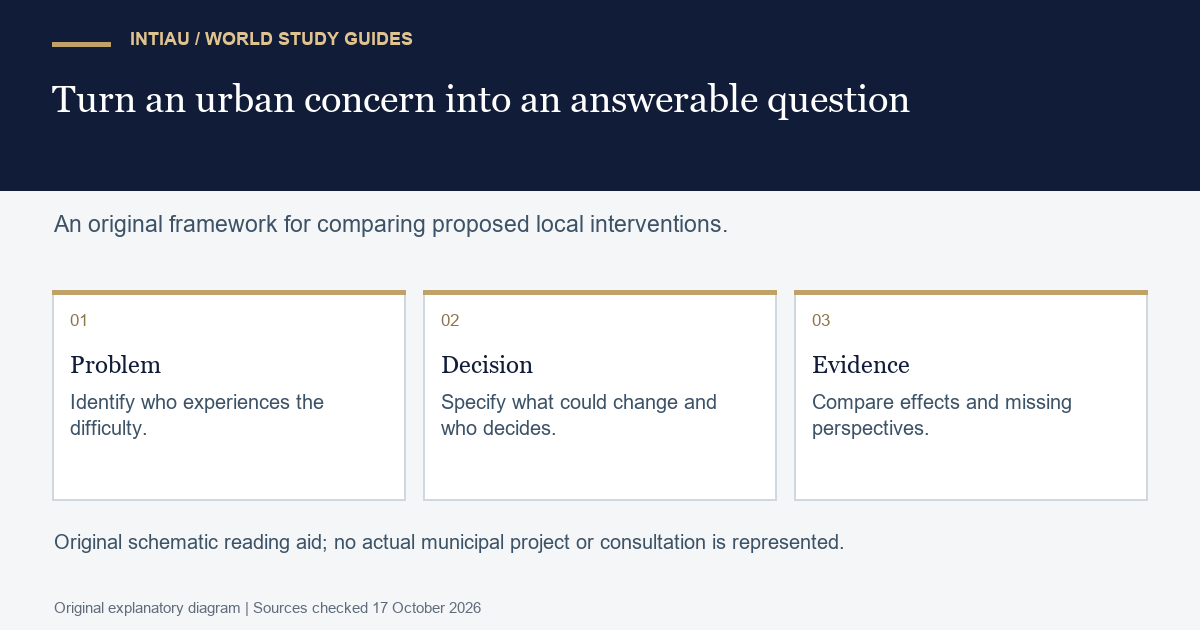
The distinction between an administrative question and an engineering question is useful when comparing the three routes. “Can a path be built here?” differs from “Who has authority to decide where it goes?” and “Whose journeys are missing from the evidence?” A strong project can need all three, while each calls for a different kind of explanation.
In a programme comparison, make a two-column note: the public problem and the decision that could respond to it. Then ask which courses supply concepts for understanding institutions and which supply methods for examining evidence. This is more informative than treating sustainability as a single technique with one universally correct answer.
A named course connects study and local questions
The programme describes Urban Lab as challenge-based collaboration with organisations such as the City of Tampere, involving interdisciplinary teams and urban-development questions.
The university’s Urban Lab teaching blog names Urban Lab 1: Living in the city and Urban Lab 2: Planning policy and Infrastructure. A dated November 2025 account describes work on Viinikanlahti; a June 2026 account discusses Teivo-Mäkkylä. These demonstrate past learning contexts, rather than promising a particular project to a future entrant.
Read such accounts for the decisions students had to make. An attractive proposal is not the same as evidence that it addresses the stated concern. Look for how the problem was defined, which perspectives were heard and what remained uncertain. A project can produce a useful question or reveal a conflict even when it does not deliver a finished municipal intervention.
Keep the entry cycle separate from the curriculum year
The bachelor’s application instructions give the first joint application as 7–21 January 2027, closing at 15:00 UTC+2. Applications use Studyinfo. Eligibility, programme-specific selection and proof of English must be checked in the applicable criteria; submitting an application does not itself establish eligibility.
Begin with the qualification you hold or will complete, then check which documents and selection evidence apply to it. A curriculum page describes study content; it is not a substitute for the current admissions criteria. Keep a copy of the relevant intake instructions so that an older course example is not mistaken for a current application requirement.
Try an original park-access comparison
A fictional district has two neighbourhoods. In North, 80 of 100 households have a park within a ten-minute walk. In South, 30 of 100 do. The combined figure is 55%, but it hides a 50-percentage-point difference. A proposal that improves only North can raise the overall figure while leaving the lower-access neighbourhood unchanged.
Now ask what the indicator omits. A ten-minute route may depend on crossings, mobility and how walking time is measured. Nearby space may also be unusable at the times a household needs it. The next step is not to discard the indicator, but to identify the decision it supports and gather the missing evidence. This original paper exercise illustrates an administrative comparison, not an actual finding about Tampere.
For your own study notes, state the numerator, denominator and affected group before recommending an intervention. That discipline makes disagreement easier to examine: two people may be using the same percentage while answering different questions.
Questions about the route
Is the administrative route taught in English?
Yes. The linked curriculum specifies English.
Are the named Urban Lab locations guaranteed future assignments?
No. They are dated examples of past student work.
Does the 2027 joint application use Studyinfo?
Yes. Applicants follow the university’s instructions and the programme’s Studyinfo criteria.
Compare subject areas through INTIAU Courses, or use Contact for INTIAU information-service enquiries.
Related guides
View the study diagram