Tsinghua University’s Urban Regeneration and Design programme is an independent university offering, not an INTIAU programme or partnership. Its English programme overview connects architectural education with computing, interdisciplinary projects and urban regeneration practice.
Understand the award and the edition
The 2027 Zijing College admission guide, published on 23 September 2026, identifies English instruction and Tsinghua degree conferment. It distinguishes four-year Bachelor of Engineering routes in Architecture, Urban Planning or Landscape Architecture from an additional year leading to the professional Bachelor of Architecture. The college’s published address is in Haidian, Beijing.
Write the intended award at the top of your comparison sheet. A subject label, a college name and a final degree are three different pieces of information. Keeping them separate makes it easier to ask a precise question about the route you actually intend to complete, especially when comparing programmes with different exit points.
Read the curriculum as connected components
The school’s curriculum explanation places progressive design-research studios at the centre, supported by theory and technology concerned with interventions in urban space. It also provides scope for personalised projects. This is a useful description of the teaching structure, rather than a semester-by-semester registration plan.
The 2025 Zijing student handbook, printed pages 15–16, supplies the following selected course examples. Its A/U/L labels distinguish architecture, urban-planning and landscape components. The handbook edition is 2025; it is not a verified 2027 individual study plan.
| Component | Selected published example | Reading point |
|---|---|---|
| Shared A/U/L | Introduction to World Architecture and Urbanism,3 credits | Common disciplinary context |
| Architecture A | Architectural Design I and II,4 credits each | Separate design components |
| Urban planning U | Introduction to Urban Informatics and Smart Cities,2 credits | Information and urban study |
| Landscape L | Landscape Architecture Design I and II,4 credits each | Design and planning components |
The programme overview describes project work supervised across disciplines and learning through urban-regeneration settings. Computing is presented as part of design thinking, rather than as a separate promise that the programme is a computer-science degree.
When reading the full handbook, mark shared components, route-specific components and optional choices in different columns. Do not add every course appearing on a multi-route page into one student’s total. For a named design course, obtain the applicable brief and assessment information before comparing studio hours with a lecture course elsewhere.
An original public-space comparison
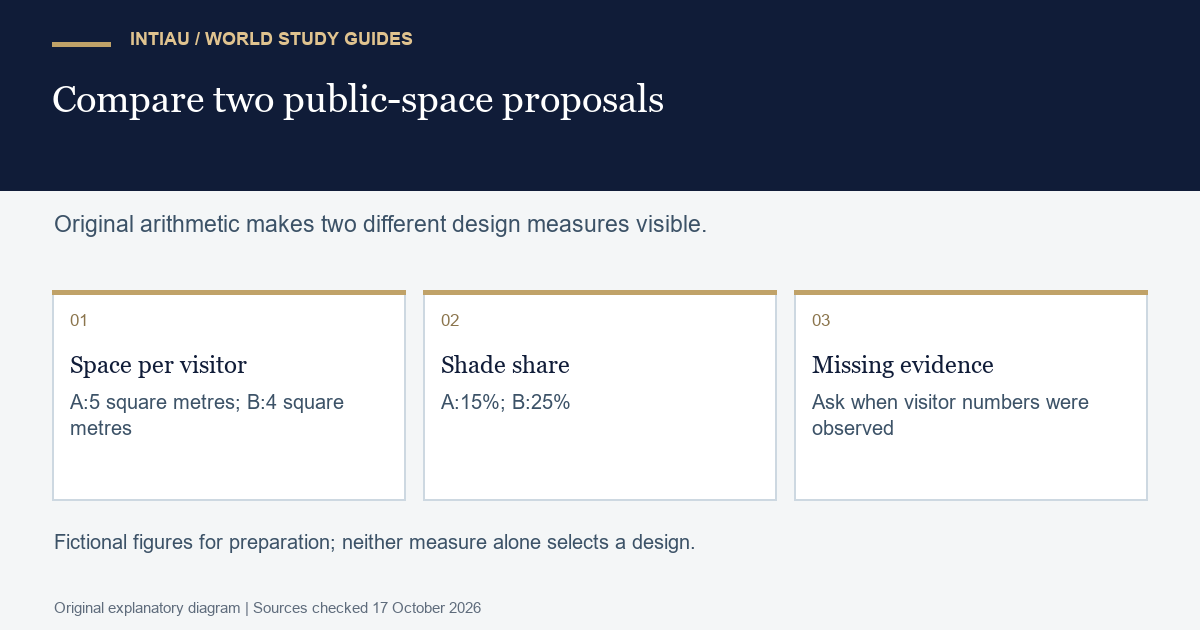
Consider two fictional proposals for a small square. Proposal A provides 600 square metres of usable space for 120 expected visitors; B provides 720 square metres for 180 visitors. Their area-per-visitor figures are 5 and 4 square metres respectively. B supplies more total space but less space per expected visitor. Neither number alone decides which proposal is better.
Now stipulate that A has 90 square metres of shade and B has 180. Their shaded shares are 15%and 25%. Prepare a two-column comparison showing both measures. Explain why selecting B from the shade percentage alone would ignore the crowding measure, while selecting A from area per visitor alone would ignore shade.
Finish by naming one missing observation, such as how visitor numbers vary during the day. Keep that missing observation separate from the supplied arithmetic. This is an original preparation exercise, not a Tsinghua assignment or a real-site design recommendation.
Use the 2027 applicant instructions
The current guide addresses foreign-national applicants and requires the relevant nationality documentation, school records and English-proficiency evidence where applicable. Its first application period is 30 September–20 November 2026 and its second is 21 November 2026–28 February 2027, in Beijing time. These are published 2027-cycle dates checked on 17 October 2026; the older school page’s 2025/26 schedule should not be substituted.
Three route questions
Is studio work separate from the theory and technology?
The curriculum describes a connected structure: progressive studios are supported by theory and technology courses.
Does every four-year exit carry the Bachelor of Architecture?
No. The 2027 guide distinguishes engineering exits after four years from the additional year for the Bachelor of Architecture.
Does the square exercise establish a preferred design?
No. It exposes a trade-off between two stated measures and identifies information still missing.
Explore INTIAU’s Courses or Contact for general enquiries.
Related guides
View the study diagram