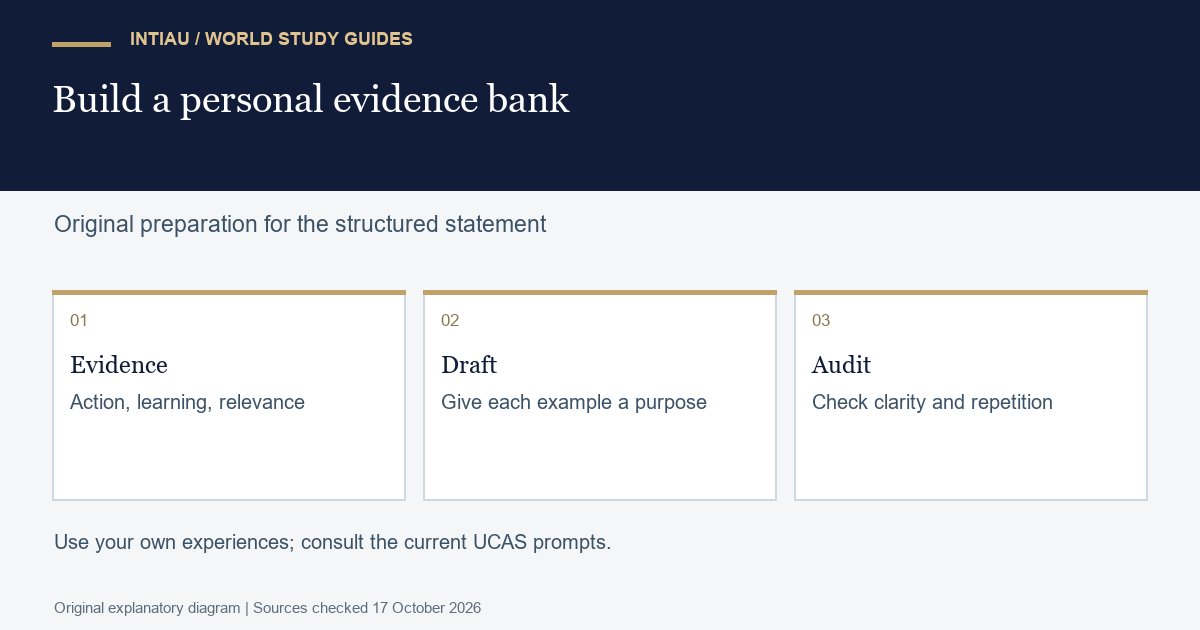
This self-guided UCAS statement workshop is an original preparation activity, not a scheduled INTIAU class, UCAS service or promise of admission.
The deliverable is a private evidence bank and a revision checklist, not a ready-made statement to copy. You will identify experiences you can honestly explain, connect them to your subject and test whether each example adds something different. Keep your own voice and actual history throughout the exercise.
Check the current format first
Checked 17 October 2026: UCAS’s 2026-entry-onwards guidance uses three questions, applicable to the 2027 entry cycle. Their subjects are motivation, preparation through studies and useful preparation beyond formal education. The labels below paraphrase the prompts; use UCAS for the exact wording.
UCAS’s guidance sets a 4,000-character total, including spaces, and at least 350 characters for each answer. These are character counts, not word counts.
Make a dated note of the cycle and official guidance you checked. Do not import an older single-essay template without adapting it to the current fields. A statement-format rule is also different from a course’s application deadline or selection policy; verify those separately for your choices.
Build five honest evidence cards
Choose five experiences from your own life. For each, record an action, something you learned, a question it raised and why that matters to the subject. A class project, independent reading, caring responsibility or ordinary job can provide material if you can explain it concretely. Do not invent impressive activities to fill a category.
Use a short evidence label rather than attaching private documents. For instance, a fictional learner might label a card “revised a history project after finding conflicting accounts”. That example illustrates the method; it is not an experience you should adopt as your own. The useful part is the explanation of changed thinking, not the prestige of a title.
Assign evidence to the three purposes
| Question purpose | Your workshop task | Revision test |
|---|---|---|
| 1: Subject motivation | Describe a particular question or idea that draws you into further study. | Does the explanation reveal curiosity beyond simply naming the subject? |
| 2: Preparation through study | Explain what you practised, understood or reconsidered in formal learning. | Have you described learning rather than just repeated a result? |
| 3: Preparation beyond education | Select another real experience and explain its usefulness to your preparation. | Is the connection specific enough for you to discuss honestly? |
Give each card one main home. If an experience connects with two purposes, decide where its strongest contribution belongs and avoid retelling the same episode. You can retain a cross-reference in your private notes without duplicating the finished explanation. The workshop table is a planning device, not an admissions scoring grid.
Turn one card into a reflective paragraph
Start with what you actually did. Add the evidence or difficulty that changed your understanding. Finish by explaining why that learning makes you want to investigate the subject further or helps you prepare. Read the draft aloud. If you cannot explain a sentence naturally, simplify it before asking someone else for feedback.
Compare two versions of your paragraph: one that lists several activities and one that examines a single experience carefully. Underline every claim that needs support. Remove exaggeration, unexplained terminology and generic praise of the subject. Keep a note of what improved, rather than treating a longer paragraph as automatically stronger.
Run a duplication and character audit
Lay the three drafts side by side. Highlight repeated examples, repeated conclusions and sentences that could describe almost any applicant. Decide whether each sentence contributes action, learning or relevance. Cut a repeated point before cutting the evidence that makes your account understandable.
Check the final text in the current application interface when you are ready to apply, using its own counters. Do not assume a word processor counts every character in exactly the same way. Keep any feedback focused: ask a trusted reader where the explanation becomes unclear, not to replace your experiences or voice. This workshop does not submit an application or collect a personal statement.
Complete the workshop record
Save five private evidence cards, a three-part draft, a duplication log and a dated check against official guidance. End with two unresolved questions about the course or your preparation. Those questions give you a concrete next research task without turning an uncertain point into a fabricated achievement.
Frequently asked questions
Must the three answers be equally long?
No. UCAS permits unequal lengths within the total, provided every answer meets its minimum character requirement.
Can I use the fictional history-project example?
Use it to understand the method, not as a personal claim. Choose an experience that actually belongs to you.
Does completing this exercise guarantee an offer?
No. It helps organise an honest explanation; universities apply their own entry and selection requirements.
Explore INTIAU’s own Courses, or use Contact for questions about INTIAU provision.
Related guides
View the workshop diagram