
The Federal University of Minas Gerais offers Geologia, bacharelado, in Belo Horizonte; this independent guide describes that UFMG programme, not an INTIAU programme or partnership. Official course overview.
Geological interpretation depends on where evidence came from as well as what it appears to show. A notebook that records only a final rock label loses the path by which an interpretation could be checked. Use this guide to investigate the progression from scientific tools to material description, mapping and an independent question.
Preserve the publication boundary
The posted December 2025 pedagogical project states approval on 13 November 2025 but still carries a pending Prograd-signature note. That qualification is retained here. Posted project.
The course overview identifies daytime study and describes entry through Sisu, using Enem results, and a serial-assessment process. The relevant selection notice governs each route.
Checked on 17 October 2026, these records should not be combined with an older project’s totals as though they were one edition. This guide does not infer an application window from the curriculum. Preserve the original Portuguese subject names when asking which version applies to your cohort.
Selected published progression
| Published period | Selected course examples | English reading aid |
|---|---|---|
| First | GEL644 Geologia Geral I; calculus and analytical geometry | General geology with quantitative foundations |
| Fourth | GEL646 Petrografia Macroscópica | Macroscopic description of rocks |
| Fifth and sixth | Sedimentologia; Geologia Estrutural I; Módulo de Mapeamento I | Sedimentary, structural and mapping study |
| Tenth | GEL666 Trabalho Geológico de Graduação | Graduation geological work |
The programme list provides individual course links. The table selects examples rather than reproducing its complete matrix.
A named course is not an automatic transfer match. Compare its description, practical component and assessment evidence with the receiving programme’s requirements. If a period or code differs between records, keep both versions visible and obtain a specific academic answer.
Worked exercise: choose the next fictional sample
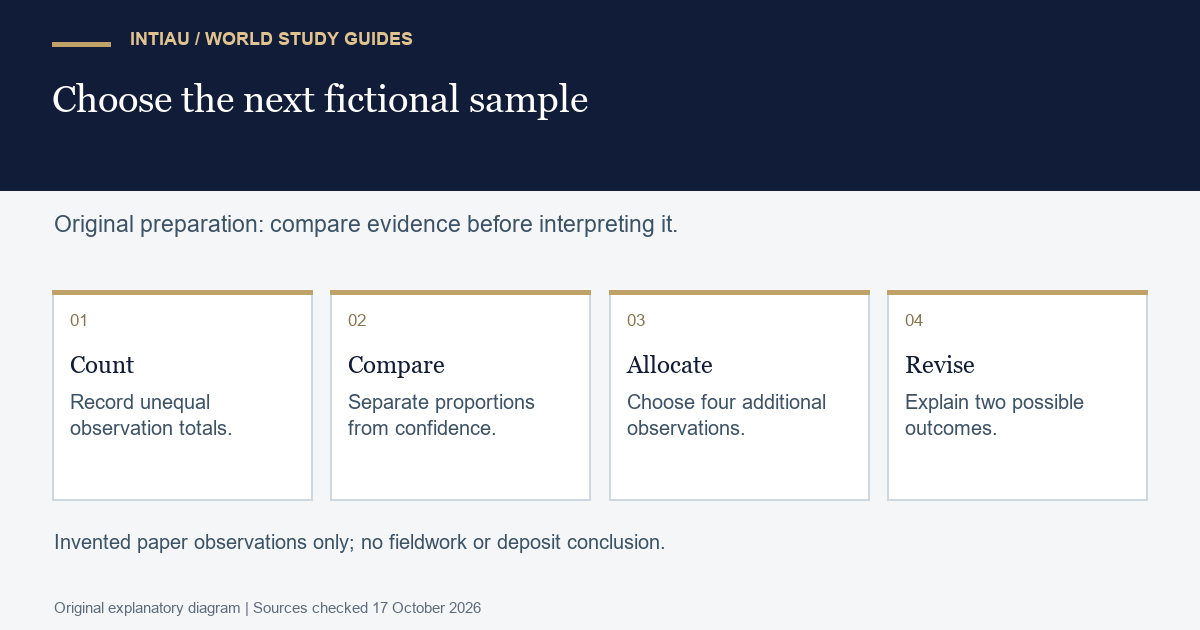
Draw an invented exposure divided into three intervals, A, B and C. Imagine that you have described ten observations in A, ten in B and only two in C. Five descriptions in each of A and B show a fictional feature, while neither observation in C does. Record the counts before suggesting that C is different.
The observed proportions are one half, one half and zero. The last value comes from much less evidence. Explain why the three fractions should not be presented with identical confidence. This is a paper example about sampling, not a claim about a particular rock type or a geological process.
You have time for four additional imaginary observations. Option one distributes them evenly across already well-described intervals A and B. Option two places them in C. Choose a plan and state its purpose. If your question concerns whether C differs, additional observations there may be more informative; if your question concerns variability elsewhere, the preferred plan might change.
Now invent two possible outcomes for four extra observations in C. In one scenario none shows the feature; in another, three do. The combined C results become zero of six or three of six. Calculate both and explain how the second scenario would challenge your original interpretation. Keep the scenarios labelled as possibilities rather than recording either as a field observation.
Add a provenance line for every imaginary entry: interval, observation number, method and uncertainty. Leave the location explicitly fictional. Do not collect real samples, enter unsafe sites or infer a deposit’s value from the exercise. The aim is a transparent decision about evidence, not a field procedure.
Finish with a short sampling justification and one limitation that more observations alone would not solve. A biased observation method, for example, would remain a concern even if the count increased. This distinction helps separate the quantity of evidence from its fitness for a question.
Use the exercise for academic planning
Review whether you found description, numerical comparison or sampling strategy most interesting. Choose one aspect to practise and save a corrected notebook page. A responsible preparation record includes a revision and its reason, rather than presenting every early interpretation as certain.
For an admissions enquiry, keep your selection route and intended entry period separate from questions about curriculum or previous study. For course advice, supply the exact programme edition and original subject name. Avoid asking a general contact to approve professional work, a mineral claim or an assumed equivalence that the evidence cannot establish.
Frequently asked questions
Is the posted project free of approval qualifications?
No. Its approval statement accompanies a pending Prograd-signature note, which should remain visible when discussing applicability.
Is mapping represented in actual course examples?
Yes. The published list includes Módulo de Mapeamento I and later mapping study.
Does the exercise identify a geological deposit?
No. The intervals, feature and observations are invented. They support sampling reasoning and establish no real geological or commercial conclusion.
View the study diagram
Official sources
For other independent study comparisons, see INTIAU Courses; general enquiries can use Contact. The named university decides its own admissions and academic requirements.