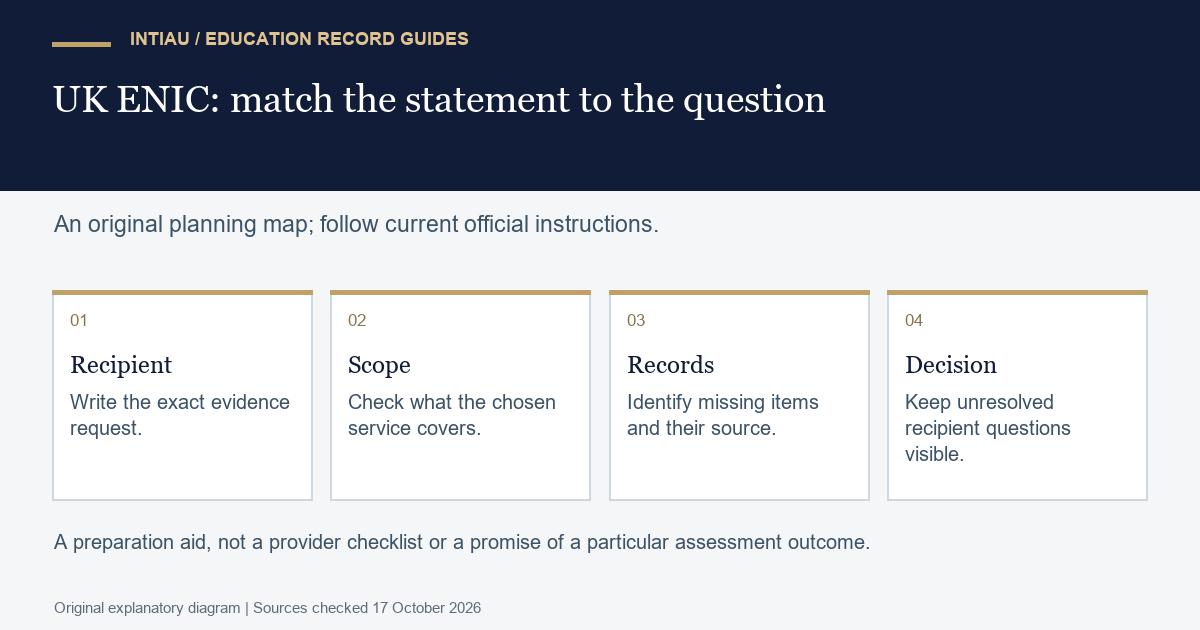
UK ENIC is the United Kingdom’s national information centre for international qualifications and skills, managed by Ecctis for the Department for Education; it is separate from INTIAU. Its official identity page explains the change from the former UK NARIC name. This guide uses information checked on 17 October 2026.
Identify what the recipient wants compared
A Statement of Comparability places international qualifications in the context of the UK education systems. It can accompany the original qualifications for employment, study or professional-registration applications. It does not report grade comparisons, specific subjects or English proficiency. Those boundaries matter when a recipient asks for evidence beyond the general level of an award.
Begin with the recipient’s actual question. “What level is this qualification?” differs from “Does it contain the mathematics prerequisite?” or “Does this applicant meet our language requirement?” Write these as separate questions rather than treating one document as a universal answer. Ask the receiving institution which question its requested statement is intended to address.
Separate academic comparison from Home Office evidence
Ecctis also operates a distinct Qualification and Language Service on behalf of the Home Office. Its current services are English Proficiency and Qualification Comparison, and Qualification Comparison. The service provides a checker to identify the appropriate option. Do not infer a visa evidence requirement from the UK ENIC product name alone.
If your purpose involves a visa or permission, read the receiving authority’s current instructions and the relevant Ecctis service guidance together. This is a service-selection step, not an assessment of immigration eligibility. An older reference to NARIC or a friend’s previous application may describe a different product or process.
Understand the status of the evaluation
UK ENIC’s evaluation explanation considers the awarding body’s status, the qualification’s home-system level, entry requirements, duration, content, assessment and progression. It describes statements as guidance rather than legal documents. The employer or educational institution makes the final employment or study decision.
Read a comparison alongside the recipient’s own rules. A comparison can help explain a qualification without deciding selection, credit, a regulated profession’s requirements or every condition attached to a job. If an employer separately requests background screening, ask what that process covers instead of assuming an academic statement completes it.
Prepare the requested records
The document instructions request final certificates, official transcripts, identity evidence, applicable name-change evidence and translations for non-English documents, subject to the stated Translation Waiver option. Records must come from the awarding institution rather than an affiliate college. Uploads should be clear colour images showing every corner of the document.
| Question | Planning action | What to record |
|---|---|---|
| What decision is being made? | Ask the recipient to describe the required comparison. | Its exact request and date. |
| Which service fits? | Check the current official product scope. | The service name and reason for choosing it. |
| Which evidence is missing? | Match each requirement to an available record. | Who can resolve each gap. |
| What remains undecided? | Keep recipient decisions separate from document preparation. | A short list of questions awaiting answers. |
Original exercise: test three requests against one folder
Imagine that a university, an employer and a public authority each ask you for qualification evidence. On a blank worksheet, give each recipient a separate row. In the first column, write the precise task it describes. In the second, write the information you think a comparison could supply. In the third, identify a question the statement’s published scope leaves unanswered.
Now invent a complication: your transcript names a teaching college while the final certificate names a different awarding institution. Mark the relationship as something to clarify; do not resolve it by editing either record. Then imagine the university also needs subject-level evidence. Draft a focused question asking what additional material it accepts, rather than ordering another service without understanding the gap.
Finally, review the three rows together. Remove assumptions borrowed from one recipient’s process and placed in another’s. Keep the source link beside each factual note and label your own interpretation as a question. This exercise helps separate document organisation from institutional decision-making; it is not a UK ENIC form or a claim that your qualification is eligible.
Frequently asked questions
Will the statement compare my grades or confirm English proficiency?
No. UK ENIC excludes grade comparisons, specific subjects and English proficiency from this statement’s scope.
Does the statement decide whether an institution must admit me?
No. UK ENIC describes its statements as guidance; the receiving institution makes its study decision.
Can I ignore a difference between my current and certificate names?
The document instructions require name-change evidence where the names differ. Follow the published evidence requirements.
For INTIAU’s own record enquiries, use its Degree Verification route or Contact page. UK ENIC and Ecctis applications follow their own official channels.
Related guides
View the evaluation workflow