Utrecht University is separate from INTIAU; its Global Sustainability Science BSc is an English-taught, three-year bachelor in Utrecht. The programme combines natural and social sciences rather than treating sustainability as a single disciplinary topic.
Start your comparison with a change you want to understand. A lower number can indicate an improvement in one measure while concealing growth elsewhere. Ask who or what is being counted, over which period and against which baseline. These questions help you connect scientific description with the choices made by organisations and communities.
Follow the shared work before the track choices
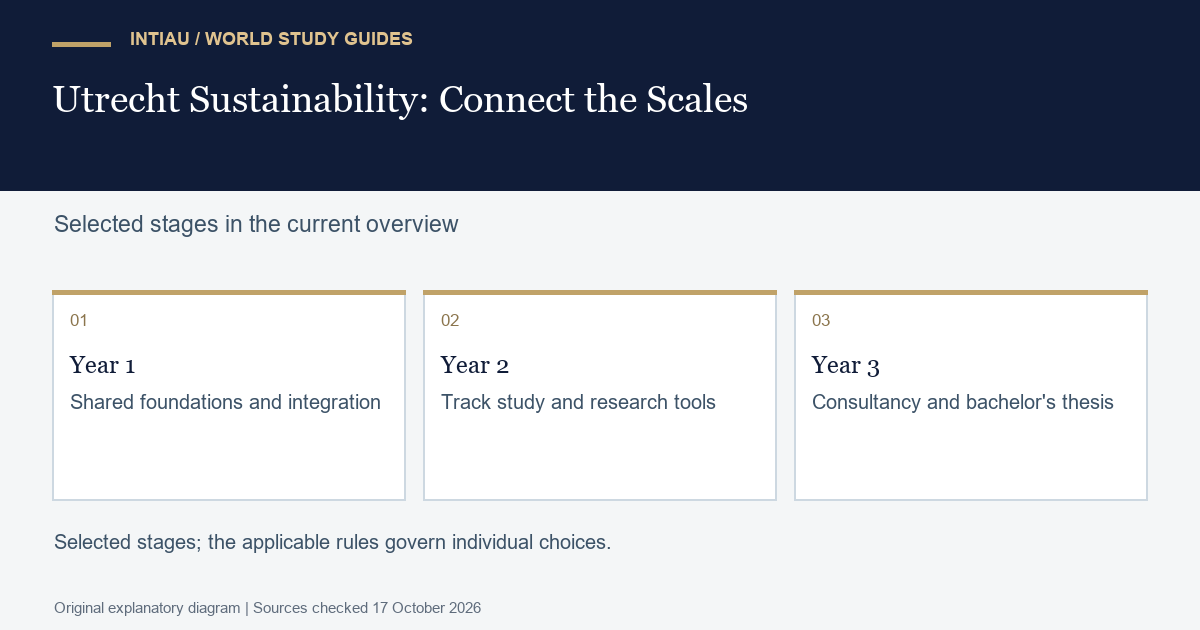
| Year | Published components |
|---|---|
| 1 | Sustainability Challenges, research skills and Regional Integration Project. |
| 2 | Track study, statistics and Global Transformation Project. |
| 3 | Consultancy Project and bachelor’s thesis. |
The study overview describes five tracks and choice within the degree. The table selects stages; it does not guarantee every future combination or replace the formal requirements.
In your own reading sheet, distinguish the subject of a problem from the method used to investigate it. A food-system question might require physical measurements, an account of incentives or a study of behaviour. Record what each method could establish and where you would need another kind of evidence. Do not assume that combining disciplines removes the need to understand their different assumptions.
A dated research-skills example
The 2025/26 study guide describes Research Skills GSS through developing a research proposal, choosing methods, handling data and reporting findings. Scientific integrity is part of that preparation. This real example belongs to the cited edition, not a newly confirmed 2027 syllabus.
Use an outline like this to ask how a project question becomes manageable. A broad aim needs a defined observation and a reason for selecting it. A persuasive report must also explain what the design leaves unresolved. Keep those questions beside course titles when comparing another sustainability programme.
Original worked exercise: compare total and per-person use
This exercise is created for this guide, not assigned by Utrecht. Imagine a fictional shared building using 100 litres of water per person each day, with 20 occupants. Its simulated daily total is 2,000 litres. After a change, use falls to 80 litres per person but occupancy rises to 25. The total remains 2,000 litres.
Write two accurate statements about the result: per-person use fell by 20 percent, while total use did not change. Explain why neither statement cancels the other. They answer different questions. Add the unit, time period and population to every number so that an attractive percentage cannot silently stand in for the whole resource picture.
Now introduce a boundary choice. Perhaps the first calculation excludes water used by a shared laundry, while the second includes it. Recalculate only after defining a consistent boundary. If the missing information is unavailable, show the gap rather than inventing a correction. A comparison becomes weaker when its apparent precision hides a change in what is measured.
Propose two possible next investigations. One might inspect technical changes in fixtures; another might examine how schedules or shared facilities affect use. For each, identify an observation that could challenge your preferred explanation. Keep a possible mechanism separate from the accounting identity used to calculate the total.
Finish with a small diagram of the building boundary, a calculation table and a short recommendation for further investigation. Ask a peer whether your wording confuses efficiency with absolute reduction. This is a paper exercise using invented values, not a claim about an actual building or a recommendation for modifying infrastructure.
Check the route for your qualification
Utrecht’s application page distinguishes diploma and subject requirements. International applicants begin through Studielink and continue in OSIRIS. Matching instructions have their own conditions, including treatment of applicants living abroad.
This guide checked the route on 17 October 2026 without assigning an undated general deadline to a new entrant year. Save your exact qualification, intended start and required documents together. Confirm the current deadline and English evidence for your own category before submitting. Keep that checklist separate from questions about track choice and the later thesis.
Frequently asked questions
Is this an English-taught bachelor?
Yes. The official programme page states English.
Does the map replace an approved study plan?
No. It selects published stages.
Is Studielink the only application step?
No. Follow the subsequent university application instructions.
INTIAU’s own information is available through Courses and Contact. Utrecht determines its admission and study requirements.
Related guides
View the study diagram