The University of Valencia offers the four-year, 240-credit Grado en Sociología through its Faculty of Social Sciences, with on-site teaching in Spanish and Valencian. This independent programme is not an INTIAU qualification or partnership. Official programme and plan.
The faculty is on the Tarongers campus in Valencia. Official location.
Connect the subject with a research question
A useful sociology-degree comparison asks how a social question becomes an investigation. Keep the population, observation and proposed explanation separate. A percentage may describe the people who answered a question while leaving open how well those people represent a wider population. That distinction is a good starting point for evaluating your own interests.
| Stage | Selected published component | Question for comparison |
|---|---|---|
| Year one | Socioestadística; Informática aplicada a la investigación sociológica | How will I describe and organise observations? |
| Year two | Técnicas cuantitativas de investigación social | Which population does a result concern? |
| Year three | Técnicas cualitativas de investigación social | How does the question shape evidence collection? |
| Year four | Prácticas externas; Trabajo Fin de Grado de Sociología | How will I communicate an investigated finding? |
The table selects actual components; it is not the entire degree plan. Retain the original Spanish names when comparing another institution’s terminology. A similar translated title does not by itself establish the same content, methods or practical arrangements.
The 2026/27 Socioestadística guide identifies a nine-credit first-year course. It connects statistical analysis with empirical social data and recommends simultaneous study of applied computing. Selected official guide.
The current course record shows Spanish and Valencian teaching groups. Current course record.
For your comparison notebook, write one question about describing a dataset and another about drawing a wider conclusion. Then identify which information is needed for each. This separates the arithmetic you can perform from the assumptions needed to interpret it, without pretending that a selected module name supplies a complete research design.
Keep access, pre-enrolment and registration distinct
The university’s admission information provides the current pre-enrolment route and applicant notices. Consult the instructions applying to your qualification and intended entry year; this guide does not establish a 2027/28 opening. Official admission information.
Prepare an applicant sheet listing the exact award, qualification held, intended cycle and language questions. Attach the governing source to each action. A teaching schedule establishes when a component runs; it does not establish that you have received a place. Keep past notices visibly dated rather than moving their dates into a new calendar. Add an unresolved-question column so that a missing document instruction remains visible until the university answers it.
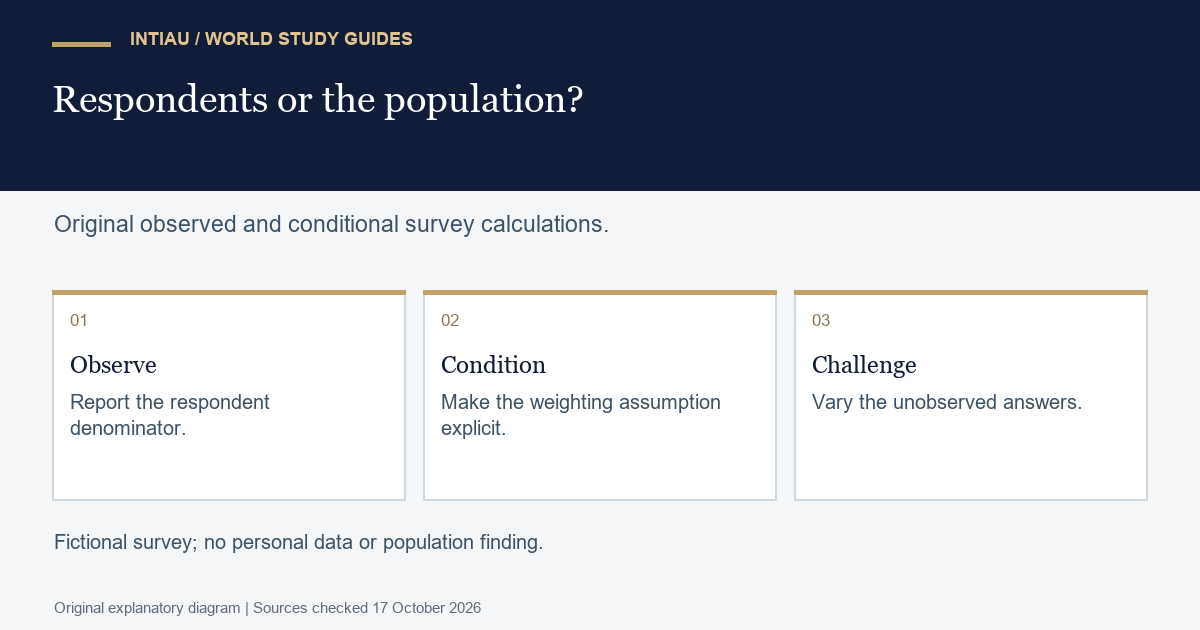
Original worked exercise: respondents and the population
Consider a fictional population containing 100 people in group A and 300 in group B. Fifty members of A and thirty members of B answer an invented yes-or-no question. Forty A respondents and twelve B respondents say yes. No real people or personal records are involved.
Among all respondents,52 of 80 say yes:65%. Separately, the observed proportions are 40/50=80% for A and 12/30=40% for B. The respondent pool gives A a larger share than it has in the stipulated population, so the pooled result and a population-weighted calculation answer different questions.
If, for this exercise only, each group’s respondents are assumed representative of that group, the implied population total saying yes is 100×0.8+300×0.4=200. Dividing by the full population of 400 gives 50%. State the assumption beside the result. Weighting does not demonstrate that the nonrespondents would have answered like the respondents.
Now relax that assumption for B. If only 20% of the 270 nonrespondents in B would say yes, they contribute 54 yes answers; adding the twelve observed yes responses gives 66 of 300 for B. This alternative changes the wider conclusion while leaving every observed response unchanged.
Finish with two clearly labelled findings: the observed respondent result and a conditional estimate under the representativeness assumption. Explain what information is missing. The task illustrates the importance of a population definition and an explicit assumption; it does not supply a survey method or an official university assessment.
Practical questions
Does a larger number of responses remove selection concerns?
Not in this invented task. The question is also who responded and what is assumed about those who did not.
Why retain two percentages?
The observed respondent percentage and the conditional population estimate concern different denominators and assumptions.
Can this page establish my language-group allocation?
No. Check the university’s actual course and group instructions for the intended academic year.
For INTIAU’s own services, see course information and the contact page.
Official source index
- Programme: identity and selected progression.
- Course: selected teaching evidence.
- Admission: applicant route.
- Faculty: location.
Related guides
View the study diagram