
The University of Waterloo offers the Bachelor of Environmental Studies in Planning through its Faculty of Environment; this independent programme is separate from INTIAU.
Checked 17 October 2026. Current department pages checked 17 October 2026; sample curriculum, not a frozen 2027 timetable.
Identify the route before comparing courses
Waterloo lists Planning as co-op only and tells applicants to apply directly to the programme. Programme overview.
Use three separate notebook headings: admission, academic progression and experience. An admission offer answers the first question. A set of course choices answers only part of the second. Keeping these headings separate prevents a comparison from quietly assuming that a work opportunity, a particular elective or a professional outcome follows automatically.
Read the progression and its scale
The School associates years one through four with cumulative totals of 5, 10, 15 and 20 units. School regulations.
| Stage | Published examples | Comparison question |
|---|---|---|
| First autumn | PLAN 100 introduces cities and regions; PLAN 107 examines plan-making. | Can I explain a planning decision clearly? |
| First winter | PLAN 110 develops visual communication; ENVS 178 introduces data management and statistics. | Can a diagram and a dataset support the same argument? |
| Later study | Transportation, housing, finance and planning law appear in the sample upper-year list. | Which decision needs economic or legal evidence? |
| Completion planning | Academic standing and co-op requirements are separate checks. | Which remaining requirement has an owner and a date? |
The first-year page also pairs governance with equity and the public interest through PLAN 103 and PLAN 133. It directs students to the class schedule and calendar for actual offerings and requirements. First-year outline.
Match admission information to your school system
The Ontario example requires six Grade 12 U/M courses, including U-level English at 75%. Other applicants should use curriculum-specific requirements. Entry information.
Record the school system, intended entry year and exact programme beside any requirement you save. Treat a published competitive range as context rather than your personal offer. Before submitting, resolve any uncertainty about document type with the university. This guide does not establish whether an application window is currently open.
Original exercise: two responses to one local barrier
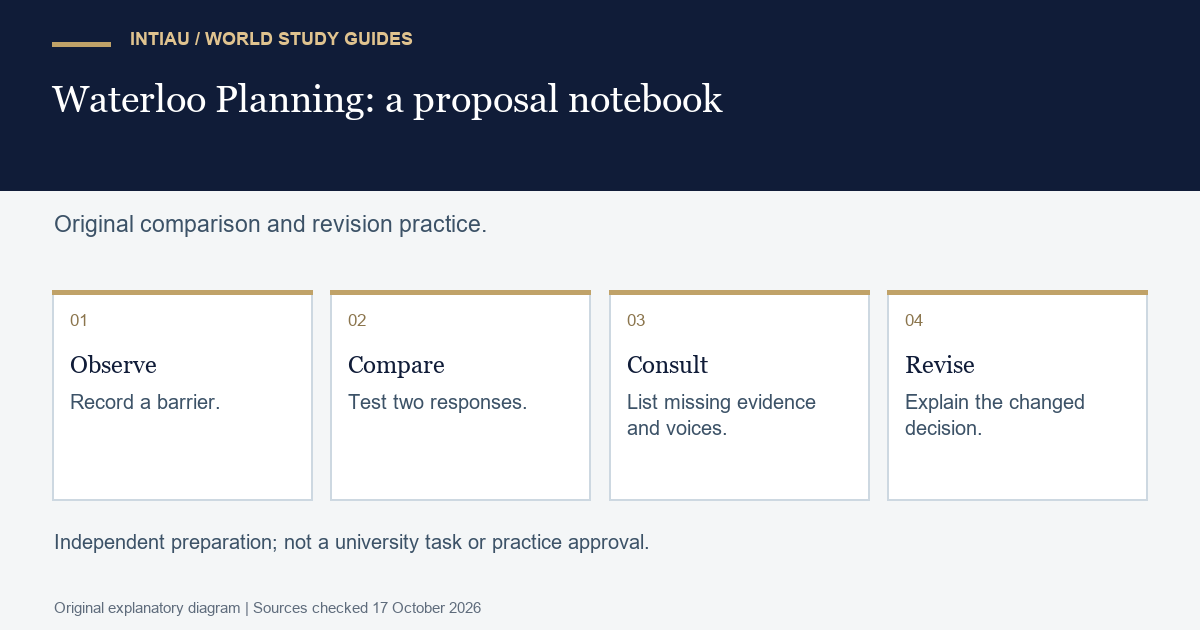
Choose a fictional neighbourhood where a bus stop is difficult to reach from a small housing cluster. Draw a simple map with a road, crossing, walking route and the stop. Use invented distances and label them as assumptions. Write a one-sentence problem that identifies who experiences the barrier without deciding on a solution.
Prepare two responses: relocating the stop and improving the walking route. Compare them using the same four headings: access, safety, implementation constraints and people affected. Do not score an unknown as zero; mark it unknown and write the evidence needed to judge it. A cheap-looking option can still contain an unresolved access problem.
Now add a fictional stakeholder statement: a wheelchair user reports that the proposed route has a steep section. Revise your comparison. Show which assumption changed, which option became less attractive and which additional measurement is needed. You are practising traceable reasoning, not conducting a real site assessment or presenting a university application exercise.
Finish with a short recommendation and a limitations box. The recommendation should explain your criteria, while the box identifies unavailable observations, voices and legal information. Keep the first map beside the revised one. The useful output is a visible account of how evidence changes a decision, rather than a polished drawing that hides uncertainty.
Turn comparison into questions
When reviewing another planning degree, look for the relationship among visual work, quantitative evidence and public decision-making. Count neither attractive course titles nor work placements as interchangeable units. Ask what a student actually produces, how feedback is received and how successive tasks become more demanding. Save these as questions for official advising rather than claims about an unfamiliar programme.
Frequently asked questions
Is a regular non-co-op route listed?
The current programme overview lists Planning as co-op only. Check the applicable entry-year information before applying.
Is the table a confirmed future timetable?
No. It selects examples from current pages; the department directs students to the calendar and class schedule.
Can I use an old calendar without checking my cohort?
The School normally links requirements to entry-calendar rules, with later-calendar choices permitted. Ask an adviser.
View the curriculum comparison map
Official sources and further comparison
Continue your independent comparison through the INTIAU Courses directory, or use INTIAU Contact for a general enquiry. The university controls its programme and admissions decisions.