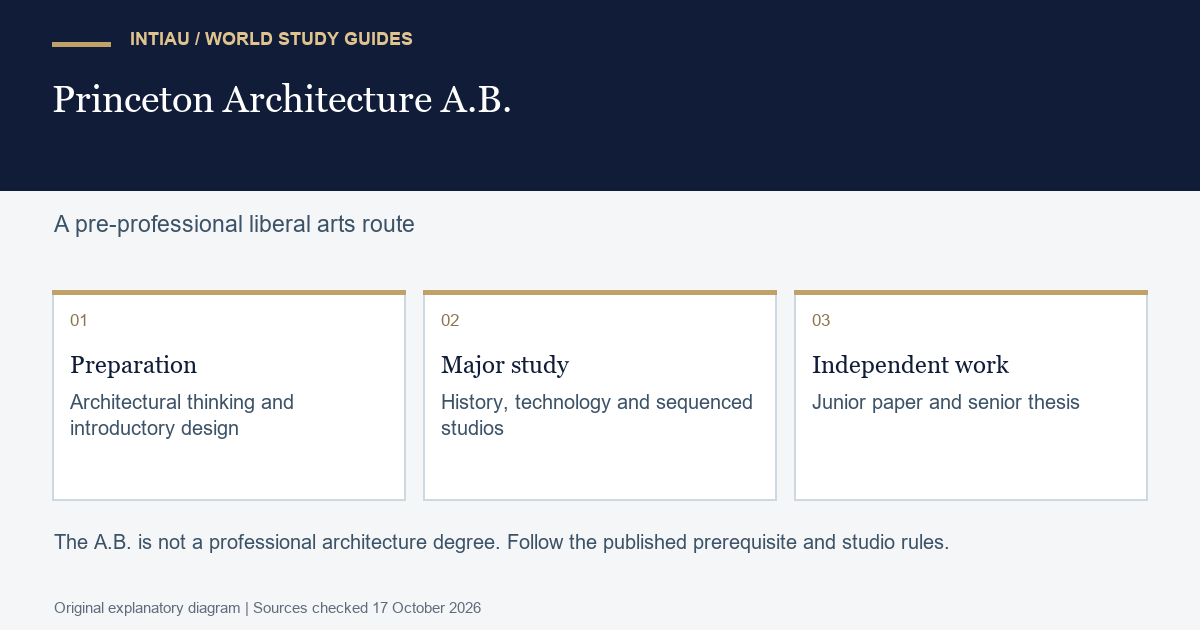
Princeton University is separate from INTIAU; its Architecture A.B. is not an INTIAU programme or partnership. The School explicitly describes the award as a liberal arts degree, not a professional architecture degree. Read the official undergraduate programme page with that distinction in mind.
Architecture can be appealing because a drawing makes an idea visible. A useful course comparison goes further: how will you explain why a proposal belongs in a particular place, what evidence supports its choices, and what changes when another person questions it? Keep those questions beside the curriculum. They help you assess the relationship between making a design, understanding its context and developing an argument about it.
Read the actual sequence
The 2026–27 Undergraduate Announcement lists two prerequisites and twelve further courses across history/theory, building technology and design. Independent work is additional.
| Stage | Curriculum landmarks |
|---|---|
| First or sophomore year | ARC 203 architectural thinking and ARC 204 introductory design |
| Major coursework | Six history/theory courses, two building-technology courses and four design courses |
| Studio sequence | ARC 350 junior fall; ARC 351 junior spring; ARC 404 senior fall |
Use the table as a guide to the programme’s structure, not a substitute for a personal plan. In your comparison notes, distinguish required sequences from choices within a distribution. A course offered later in a sequence may depend on earlier work even if its title sounds accessible. Keep questions about placement and timing for the university’s academic advisers, and avoid constructing a timetable from titles alone.
A course example in representation
ARC 206, Geometry and Architectural Representation, explores geometry through drawing projects using manual and digital techniques, with individual and group critique. The announcement recommends it before junior year but does not make it a prerequisite for the major. Its published catalogue description is a course example rather than a complete weekly syllabus.
This is useful when comparing courses that use the word “design” differently. Look for the role of a drawing: is it a way to record an observation, test a spatial idea, communicate a proposal or argue a position? The same image can serve more than one purpose, but the evidence needed to support it will change. Write a one-sentence purpose beside each example you examine.
Independent work alongside studio
The junior paper precedes the senior thesis, undertaken in ARC 498 and ARC 499. Written and visual work may be combined in proportions agreed with the adviser and thesis committee.
A practical implication for a prospective student is to compare how comfortable you are revising both an image and a written explanation. Choose an earlier piece of your own work and identify one decision you could defend more clearly. Then identify one decision you would now change. That small revision exercise can reveal more than collecting additional polished images without examining their reasoning.
Try comparing two public spaces
This original exercise is not a Princeton assignment or an application-portfolio instruction. Choose two public spaces you already know, such as a library entrance and a covered courtyard. On separate sheets, sketch the main paths a person could take. Mark where the drawing relies on memory rather than observation. Add a short written description of what each space appears to invite people to do.
Now examine a conflict: a direct route might cut across an area intended for sitting. Draw two possible arrangements and state what each one prioritizes. Do not assume that your own preference represents every user’s experience. List the additional information you would want, such as dimensions, different patterns of use or a clearer understanding of the existing layout.
Compare the two drawings with the two written explanations. Which exposed a problem you had overlooked? Finish by writing a question that could guide further reading about the spaces. This gives you a concrete way to compare the appeal of spatial investigation with the appeal of historical or theoretical inquiry, without treating a quick sketch as a resolved building proposal.
First-year application route
Instructions checked on 17 October 2026 direct first-year applicants to Princeton’s central process: Common Application plus Princeton-specific questions. The official dates and deadlines page currently lists 1 November for single-choice early action and 1 January for regular decision, and includes a graded written paper among the materials. Verify the intended entry cycle and all supporting requirements before submission; do not confuse undergraduate application with later major prerequisites.
Questions readers often ask
Is the Architecture A.B. a professional architecture degree?
No. Princeton describes it as a liberal arts undergraduate degree.
Must everyone take ARC 206 before declaring the major?
No. It is recommended before junior year, rather than required as a prerequisite.
Is the first-year application just a design submission?
No. Princeton’s published application includes academic materials and a graded written paper.
INTIAU’s own information is available through INTIAU Courses and INTIAU Contact.
Related guides
View the curriculum diagram