University College London is a separate institution; Architecture BSc at its Bartlett School of Architecture is not an INTIAU programme or partnership.
Choosing an architecture degree means looking beyond a gallery of finished buildings. A useful comparison asks how an idea is investigated, represented, criticised and revised. This guide provides a reading method for prospective students who want to connect creative interests with the practical organisation of study.
Separate the entry year from the teaching catalogue
Checked 17 October 2026: UCL’s saved prospectus lists September 2027 entry, UCAS K100 and a 13 January 2027, 18:00 UK equal-consideration deadline. Its saved-copy warning means applicants should recheck current course and UCAS information.
Keep two dates on your comparison sheet: the intake you intend to join and the academic year described by each module page. A currently available description is useful evidence of teaching content, but it cannot establish every module or assessment for your later intake. Record uncertainty beside the item that needs confirmation, rather than treating the whole programme as either fixed or unknowable.
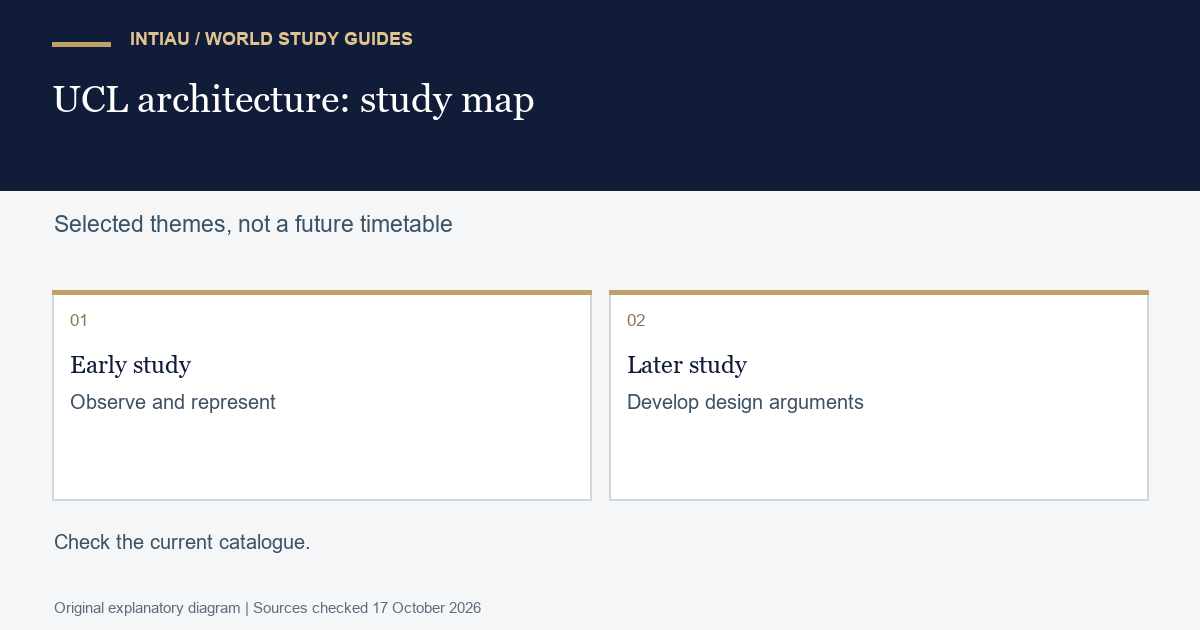
A condensed curriculum map
The table groups selected official themes into a reading sequence. The right-hand column contains original questions for comparing courses; it does not describe extra university requirements.
| Stage | Indicative study | Question to investigate |
|---|---|---|
| Year 1 | Design projects, representation, environmental and structural studies, cities and history. | Can I show how observation changes an early design idea? |
| Year 2 | Design-unit projects, technology, history and theory, ethics. | How would I connect a design argument to a technical decision? |
| Year 3 | Further design-unit projects, technology, history and theory. | Can I explain the evidence supporting a developed proposal? |
A specific current example is Environmental Design, BARC0086: 15 credits in 2026/27, examining climate mitigation, adaptation and ecological regeneration through context-responsive design. Its published assessment is coursework, including a report.
Read that example at three levels. First identify the problem being studied. Next identify the method used to examine it. Finally identify what the student must communicate. This avoids mistaking a compelling topic label for a full understanding of how learning is assessed. Use the same three headings when comparing a second architecture course.
Understand the application sequence
The Bartlett’s application guide describes UCAS followed by a requested digital creative portfolio and, for successful applicants, an interview. It specifies up to ten portfolio pages and a two-week submission period after the request.
Treat your own invitation as the operational instruction. Build a private checklist containing qualification evidence, the requested creative material and each response date. Do not confuse an academic threshold with an offer, or preparation advice with permission to send unsolicited material. Check the relevant qualification and English requirements on the official course page before making a plan around a particular result.
Original comparison activity: one place, two proposals
Choose a familiar public space that you can observe without entering restricted property. Make a small sketch and note three concrete features: where people pause, where movement becomes difficult and how shade changes through the day. Produce two modest design responses on paper. Keep the original observation beside each response so another person can trace the connection.
Now create a comparison sheet for two university programmes. Use four rows: kinds of evidence, forms of representation, technical questions and opportunities for feedback. Place a link to an official source in each factual cell. Leave a blank where the information is unavailable. Then write a short explanation of which learning environment suits the way you work, including one limitation of your evidence.
This is an independent preparation exercise, not a Bartlett portfolio brief or assessment task. Its purpose is to reveal whether you enjoy revising an argument after criticism. Ask a trusted reader to explain your drawing back to you; any mismatch gives you a concrete next revision. A polished final image alone cannot show that process.
Frequently asked questions
Is the BSc the same as the integrated master’s?
No. The Bartlett lists Architecture BSc as three years and Architecture MSci as a separate five-year degree.
Does the module example promise the 2027 syllabus?
No. BARC0086 is a 2026/27 catalogue example; its teaching and assessment information remains subject to change.
Should I send the portfolio before being asked?
Follow the official application sequence and the portfolio request issued through the UCL Applicant Portal.
For broader subject exploration, see INTIAU’s Courses. For questions about INTIAU’s own provision, use Contact.
Related guides
View the curriculum diagram