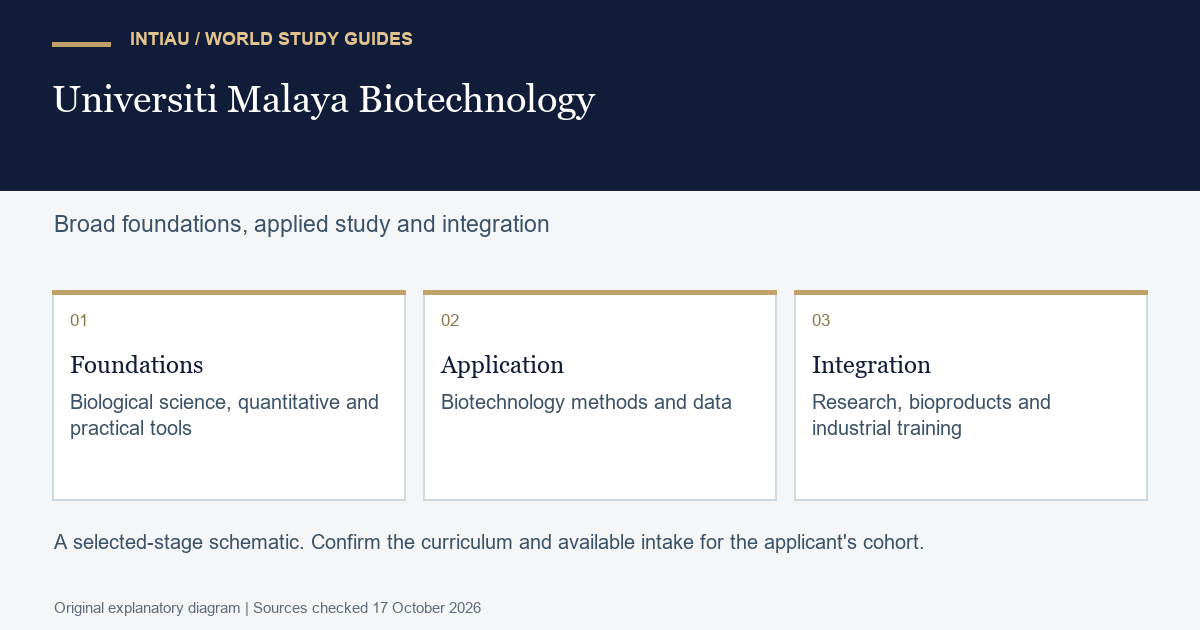
Universiti Malaya (UM) is separate from INTIAU; its Bachelor of Science in Biotechnology is a UM qualification. The official programme page, updated on 16 October 2026, lists four years of full-time study, with eight semesters and a special semester. This guide uses that current map without promising unchanged requirements for a future cohort.
A useful biotechnology comparison asks how biological knowledge becomes a dependable process. You might be drawn to organisms, laboratory techniques, data interpretation or the practical constraints of making a product. Those interests overlap, but they are not identical. Write down which part you want to understand before choosing a degree by a laboratory image or a broad career label.
Read the stages without inventing a timetable
| Stage | Examples |
|---|---|
| Year 1 | Cell biology, chemistry, laboratory techniques, statistics and bioinformatics programming. |
| Year 2 | Microbiology, bioprocess design, plant biotechnology and scientific writing. |
| Year 3 | Biological data analytics, food biotechnology and research. |
| Later study | Bioproduct business, knowledge transfer and industrial training; a special semester is listed. |
Use the table as a reading route. In your own comparison sheet, give each activity a different purpose: learning a concept, practising a method, interpreting evidence, or connecting a result to a wider problem. Do not assume a course does only one of these. The categories help you form questions for an adviser rather than replace the official curriculum.
A module listing is not a complete syllabus
For a concrete dated example, the 2025/2026 Faculty of Science handbook lists SIO2013, Bioprocess Design Principles, with SIO1001 and SIJ1002 as prerequisites. In that edition these are Basic Physics and Fundamentals of Chemistry. This is a published module requirement, not a full teaching syllabus. It should not be used to assert that a later entrant automatically has the same prerequisite rules.
A good next question is what work turns that title into learning: a calculation, a practical record, a model or a written explanation. If the public listing does not answer it, record the gap. A prerequisite can show that earlier knowledge matters while still leaving teaching methods and assessment unresolved. Keep those distinctions visible when comparing a detailed handbook with a short recruitment page.
An original comparison exercise: make the evidence usable
This exercise is created for this guide, not assigned by UM. Use an imaginary dataset rather than conducting an experiment. Suppose a proposed process produces these outputs in three trials: condition A gives 12, 13 and 11 units; condition B gives 16, 8 and 15 units. Calculate a simple average for each condition and show the individual values on a small sketch.
Write down what the average hides. Which condition appears more consistent? What would you need to know about measurement, starting material and experimental conditions before deciding that one is better? Separate an observation from a possible explanation. A result can be interesting while still being insufficient for a confident decision.
Now add a practical constraint: condition B uses twice as much of an input. Make a new comparison column and explain whether your preferred criterion changes. There is no required winner. The useful output is a short decision note that states the criterion, the evidence and the uncertainty, with the arithmetic available for another reader to check.
Finally, identify which part held your attention: understanding the biology, checking the numbers, improving a process or explaining the trade-off. Compare that preference with two official course descriptions from programmes you are considering. Write one precise question for each programme about how students practise that skill. This turns a broad interest in biotechnology into a more discriminating study comparison.
March 2027 dates depend on programme availability
UM’s central How to Apply page, updated on 14 October 2026, lists undergraduate Semester II of Academic Session 2026/2027 as a March intake. The published international window runs from 7 September 2026 to 30 January 2027; the Malaysian Open Channel (SATU) window runs from 5 October 2026 to 22 February 2027. These are different applicant routes, not interchangeable deadlines.
The Biotechnology page lists October and March intakes subject to programme availability. A central March application window alone does not confirm a Biotechnology place or offering.
Before applying, record your applicant category, intended intake and the actual programme option shown in the official application system. If the desired option is absent, ask UM rather than choose a different award merely to complete a form. Keep a copy of the applicable instructions and check whether later information changes the intake or document requirements.
Frequently asked questions
Does the published degree include industrial training?
Yes. The current programme map lists Industrial Training in Biotechnology, including a special-semester entry.
Is the SIO2013 example a full current syllabus?
No. It is a module and prerequisite listing from the explicitly dated 2025/2026 handbook.
Can all applicants use the same March 2027 deadline?
No. UM publishes separate international and Malaysian SATU windows for that intake.
INTIAU’s own information is available through Courses and Contact. UM controls its own programme, availability and application decisions.
Related guides
View the curriculum diagram